
Free Pre-Start Checklist (Combine) Template
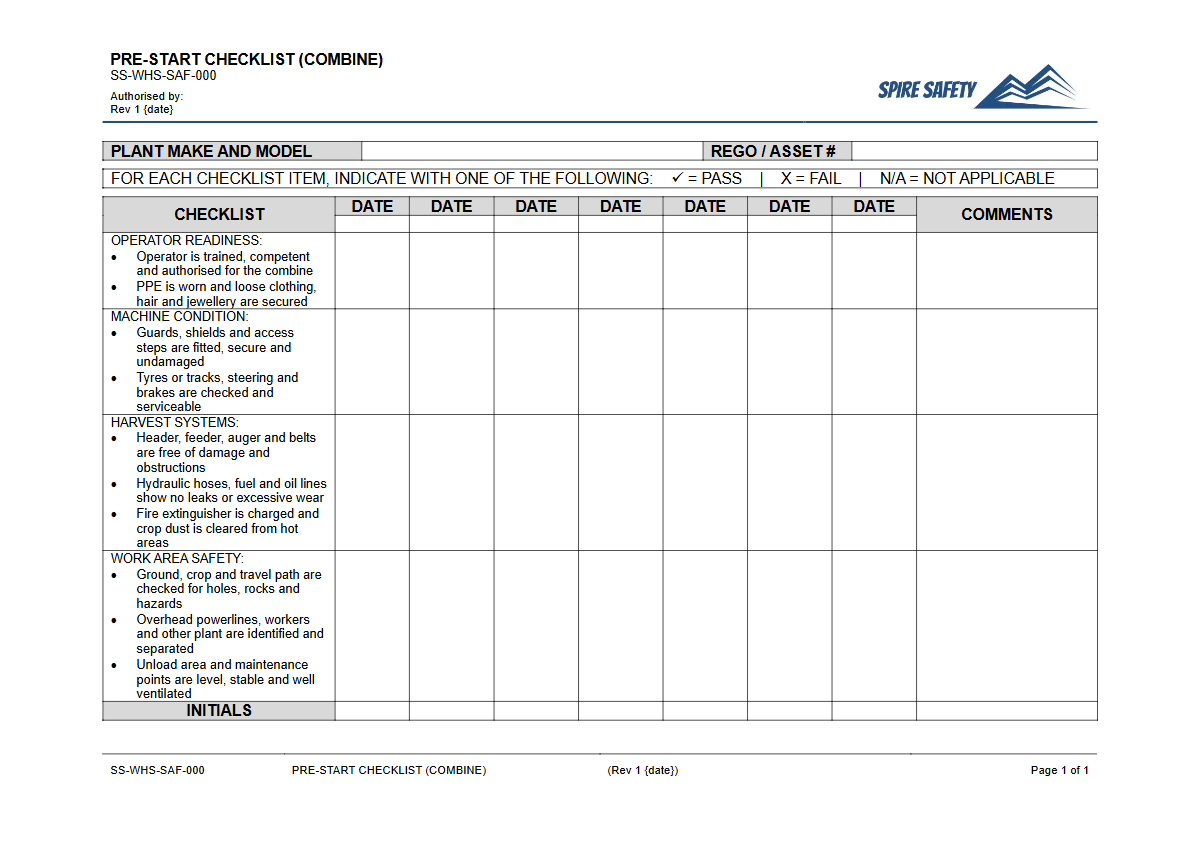
Download our free Pre-Start Checklist for Combine Harvesters. This user-friendly DOCX & PDF template helps standardise equipment inspections.
Free Pre-Start Checklist (Combine) Template
DOCX • 125 KB + PDF
Updated Oct 2026
No signup required
Purpose of the Free Pre-Start Checklist (Combine) Template
Operating a combine harvester involves significant risks, from mechanical and hydraulic failures to fires and entanglement. A systematic pre-start inspection is a critical control measure to identify potential hazards before they cause an incident.
This Free Pre-Start Checklist (Combine) Template provides a structured framework for operators to conduct thorough daily checks, ensuring the machine is safe to operate. Using this template helps a Person Conducting a Business or Undertaking (PCBU) meet their primary duty of care by formalising equipment inspections and record-keeping.
It standardises the inspection process across all operators, creating a consistent approach to safety and maintenance. The checklist serves as a starting point for developing a procedure that complements your Combine Harvester SOP (Safe Operating Procedure).
Video walkthrough
How to use the Free Pre-Start Checklist (Combine) Template
Our template is provided as a fully editable DOCX file, allowing for complete customisation to your specific machinery and operational context. Before deploying it in your workplace, you must adapt it.
This includes adding the make and model of your combine harvester, specific safety components unique to your machine, and any site-specific rules or communication protocols. Consider adding checks for GPS systems, yield monitors, and specific header attachments.
Integrate the completed checklists into your broader WHS management systems to ensure records are maintained, reviewed, and acted upon. We have included common inspection points, but it is your responsibility to ensure the final document is comprehensive and suitable for your organisation's needs.
Customising your checklist:
- Add your company branding and specific machine details (make, model, plant number).
- Review and modify the checklist items to match the components of your combine harvester (e.g., augers, threshing drum, belts, chains, walkers).
- Incorporate checks related to fire mitigation, such as inspecting for combustible crop residue buildup around the engine bay and exhaust systems.
- Include items for checking communication equipment and emergency stop functionality.
- Ensure the procedure for reporting faults and tagging out unsafe equipment is clearly stated on the form.
When to use it
The pre-start checklist should be completed by the operator before the combine harvester is used for the first time each day or at the beginning of each shift. It is a pre-operational check designed to catch faults that may have developed overnight or during previous use.
It is also a valuable tool during harvest season when machinery is operating for long hours under demanding conditions. Reinforcing the importance of these checks can be achieved through regular safety meetings, using resources like a Pre-Start Checks and Plant Maintenance Toolbox Talk to keep safety front-of-mind for all workers.
Who should use it
The primary user of this checklist is the trained and competent operator of the combine harvester. They are in the best position to assess the machine's condition immediately before use.
Supervisors and managers should also be familiar with the checklist to ensure operators are completing it correctly and to review completed forms for recurring issues or maintenance trends. Maintenance personnel can use the information from completed checklists to schedule preventative maintenance and prioritise repairs.
The principles of pre-start inspections apply to a wide range of machinery; just as a CNC Router pre-start checklist is vital for workshop safety, this document is essential for agricultural operations.
By embedding this checklist into daily routines, you create a proactive safety culture where potential problems are identified and managed before they escalate. It transforms the inspection from a tick-box exercise into a meaningful risk management activity.
Verifying that these procedures are consistently followed is a key part of maintaining safety standards, which can be confirmed through processes like WHS compliance auditing. This ensures that safety documentation is not just a paper exercise but a lived reality in the field.
This document is just one of many tools designed to help you build a safer workplace. For more templates and guides covering a wide range of WHS topics, browse our complete free WHS resources library for documents that can support your safety management efforts.
Common mistakes
Common mistakes to avoid
- Failing to physically check items and just ticking boxes ('pencil-whipping').
- Ignoring small hydraulic, fuel, or coolant leaks which can lead to major failures or fires.
- Not thoroughly cleaning flammable chaff and dust from the engine bay, exhaust, and bearings.
- Using a generic checklist without customising it for the specific make and model of the combine.
Legal references
Legal considerations
The following legal requirements may be relevant to this type of work.
- Work Health and Safety Act (Harmonised) — Provides the primary duties for protecting workers and other people from work health and safety risks.
- Work Health and Safety Regulations (Harmonised) — Sets out requirements supporting the management of workplace hazards and risks.
The following codes may be relevant to this type of work.
- Managing WHS Risks Code of Practice — Provides practical guidance on identifying hazards, assessing risks and applying effective controls.
- Work Health and Safety Consultation, Cooperation and Coordination Code of Practice — Provides practical guidance on consulting workers and coordinating with other duty holders.
- Managing the Work Environment and Facilities Code of Practice — Provides practical guidance on safe work environments, workplace facilities and related controls.
Did you know
Fire Risk
Combine harvester fires are a major risk during harvest season. A CSIRO study found that 9% of grain growers experience a harvester fire, with dust and crop residue buildup being a primary cause.
Mechanical Evolution
The first combine harvester, which combined the actions of reaping, threshing, and winnowing, was patented in the United States in 1828 but was not commercially successful until decades later.
FAQ
Frequently asked questions
01What are the most critical checks on a combine harvester pre-start?
02How often should a combine pre-start checklist be reviewed and updated?
03Can a digital pre-start checklist be used for combine harvesters?
04What should an operator do if a fault is found during a combine pre-start check?
Share this resource
Free Pre-Start Checklist (Combine) Template
Browse Categories
How To Use It
- 1Download and open in Word or PDF.
- 2Replace the placeholders with your business details.
- 3Get it reviewed by a WHS specialist before rollout.
Need it customised?
Our WHS consultants can adapt this template to your site, run a gap analysis, or audit what you already have in place.
Book a Free Consultation WHS consulting servicesor call 1300 156 382