
Free Pre-Start Checklist (Come Along) Template
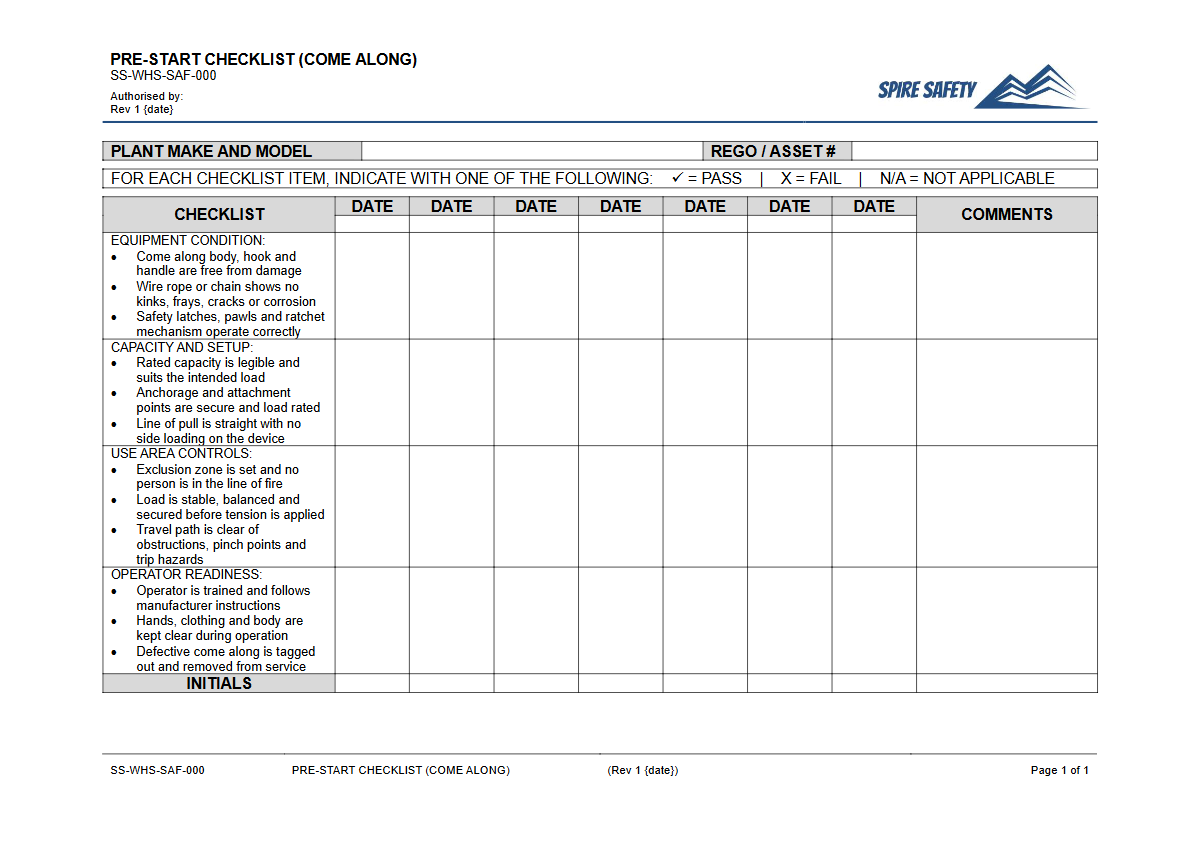
Download our Free Pre-Start Checklist (Come Along) Template (DOCX & PDF). This structured resource helps formalise safety checks for come along winches.
Free Pre-Start Checklist (Come Along) Template
DOCX • 125 KB + PDF
Updated Oct 2026
No signup required
Purpose of the Free Pre-Start Checklist (Come Along) Template
A come along, or hand winch, is a powerful tool for pulling, tensioning, and securing loads. To ensure it operates safely and effectively, conducting a pre-start check before each use is essential.
This free Pre-Start Checklist (Come Along) Template provides a structured framework to guide operators through a thorough inspection, helping to identify potential hazards before they cause an incident. The primary purpose is to formalise the inspection process, helping identify wear, damage, or defects that could lead to equipment failure, uncontrolled release of a load, or injury.
By embedding this checklist into daily operations, organisations can promote operator accountability and maintain a proactive approach to safety. These checks are a fundamental part of equipment safety, often discussed in a pre-start checks and plant maintenance toolbox talk.
Video walkthrough
How to use the Free Pre-Start Checklist (Come Along) Template
To get started, download the template in your preferred format (DOCX or PDF). The key to its effectiveness is customisation.
Important: This document is a template and must be customised to your specific workplace, the models of come alongs in use, and your operational risks. We make no claims about its legal compliance; this is your responsibility. Review and adapt the checklist items to reflect the manufacturer's instructions and any unique site requirements. Once finalised, train all relevant personnel on how to complete the checklist correctly and what actions to take if a defect is found.
Integrating this procedure into a comprehensive WHS management system ensures it is applied consistently across your organisation.
Key Inspection Points
While your customised checklist will be more detailed, a typical come along pre-start inspection should cover several critical areas:
- Frame & Handle: Inspect the main body and handle for any signs of cracking, bending, or excessive wear. Ensure the handle operates smoothly.
- Cable or Strap: Carefully check the entire length of the wire rope or webbing strap for fraying, kinks, broken strands, corrosion, or chemical damage. The process of checking for wear is similar to what you would do when using a pre-start checklist for an aerator to check its tines and moving parts.
- Hooks & Safety Catches: Verify that hooks are not stretched, cracked, or twisted. The safety catches must be present, secure, and function correctly to prevent unintentional unhooking.
- Ratchet Mechanism: Test the pawl and ratchet mechanism to ensure it engages correctly and holds the load without slipping. Listen for any unusual noises during operation.
When to use it
A pre-start check should be completed by the operator before every single use of the come along. It is a brief but critical inspection to verify the equipment's condition immediately prior to it being put under load.
This routine check does not replace the need for more detailed periodic inspections or scheduled servicing as outlined by the manufacturer or your organisation's maintenance program.
Who should use it
This checklist is designed for any person who operates a come along winch. It is also a valuable tool for supervisors and WHS personnel who are responsible for overseeing equipment safety and verifying that inspections are being completed.
Documenting operator skill, for instance through a Verification of Competency for a pipe threader or other plant, is another key control measure to ensure equipment is used correctly. Maintaining these records is not just good practice; it forms part of your due diligence in managing plant safety.
Regular reviews of completed checklists can highlight recurring issues with specific equipment or operator behaviour. These reviews, sometimes conducted as part of a formal WHS compliance audit, help ensure your safety procedures remain effective over time. To discover more tools to support your safety programs, you can browse our full free WHS resources library.
Common mistakes
Common mistakes to avoid
- Using the checklist as a 'tick and flick' exercise without physically inspecting each component.
- Failing to customise the template to reflect the specific manufacturer's requirements for the come along model in use.
- Continuing to use a come along after a fault has been identified, instead of immediately tagging it 'Out of Service'.
- Exceeding the rated capacity (Working Load Limit) of the winch or its anchor points.
Legal references
Legal considerations
The following legal requirements may be relevant to this type of work.
- Work Health and Safety Act (Harmonised) — Provides the primary duties for protecting workers and other people from work health and safety risks.
- Work Health and Safety Regulations (Harmonised) — Sets out requirements supporting the management of workplace hazards and risks.
The following codes may be relevant to this type of work.
- Managing WHS Risks Code of Practice — Provides practical guidance on identifying hazards, assessing risks and applying effective controls.
- Work Health and Safety Consultation, Cooperation and Coordination Code of Practice — Provides practical guidance on consulting workers and coordinating with other duty holders.
- Managing the Work Environment and Facilities Code of Practice — Provides practical guidance on safe work environments, workplace facilities and related controls.
Did you know
Pulling vs. Lifting
Come along winches are designed specifically for pulling and tensioning applications. Using them for vertical lifting is extremely dangerous as their braking mechanisms are not designed to safely suspend a load.
FAQ
Frequently asked questions
01What is a 'come along' winch?
02How often should a come along be inspected?
03Is this pre-start checklist a substitute for a SWMS?
04Can I use this template for any brand of come along?
Share this resource
Free Pre-Start Checklist (Come Along) Template
Browse Categories
How To Use It
- 1Download and open in Word or PDF.
- 2Replace the placeholders with your business details.
- 3Get it reviewed by a WHS specialist before rollout.
Need it customised?
Our WHS consultants can adapt this template to your site, run a gap analysis, or audit what you already have in place.
Book a Free Consultation WHS consulting servicesor call 1300 156 382