
Free Pre-Start Checklist (Cold Saw) Template
Download our free Pre-Start Checklist for cold saws. This DOCX & PDF template helps formalise your daily equipment safety checks.
Free Pre-Start Checklist (Cold Saw) Template
DOCX • 125 KB + PDF
Updated Oct 2026
No signup required
Purpose of the Free Pre-Start Checklist (Cold Saw) Template
A cold saw is a powerful and essential tool in many metalworking and fabrication workshops. However, like any high-speed cutting equipment, it presents significant risks if not maintained or operated correctly.
This Free Pre-Start Checklist (Cold Saw) Template provides a structured framework for operators to conduct consistent, thorough safety inspections before using the equipment. The primary purpose is to identify any potential faults, damage, or operational issues that could lead to an incident, injury, or equipment failure.
Formalising this process helps a Person Conducting a Business or Undertaking (PCBU) meet their primary duty of care to provide and maintain safe plant and structures.
Using a checklist encourages a safety-first mindset and creates a formal record that inspections have been completed. It is a fundamental tool for proactive risk management in the workplace.
To further embed this practice, you can incorporate our Pre-Start Checks and Plant Maintenance Toolbox Talk into your team meetings.
Video walkthrough
How to use the Free Pre-Start Checklist (Cold Saw) Template
Integrating this checklist into your daily operations is straightforward. First, download the template in your preferred format (DOCX for easy customisation or PDF for immediate printing).
The next step is the most critical: adaptation. This document is a starting point based on general Australian WHS principles.
Important: We are not a law firm. This document provides a foundational template, not legal advice.
You must customise this Pre-Start Checklist to reflect the specific models of cold saws used in your workplace, the unique tasks they perform, and the environmental conditions. Consult with operators and review manufacturer guidelines and your own risk assessments during customisation.
Once finalised, train all relevant workers on how to complete the checklist accurately and what to do if they identify a fault. Consistent implementation is key to building robust and effective WHS management systems.
Key Checks for a Cold Saw Pre-Start
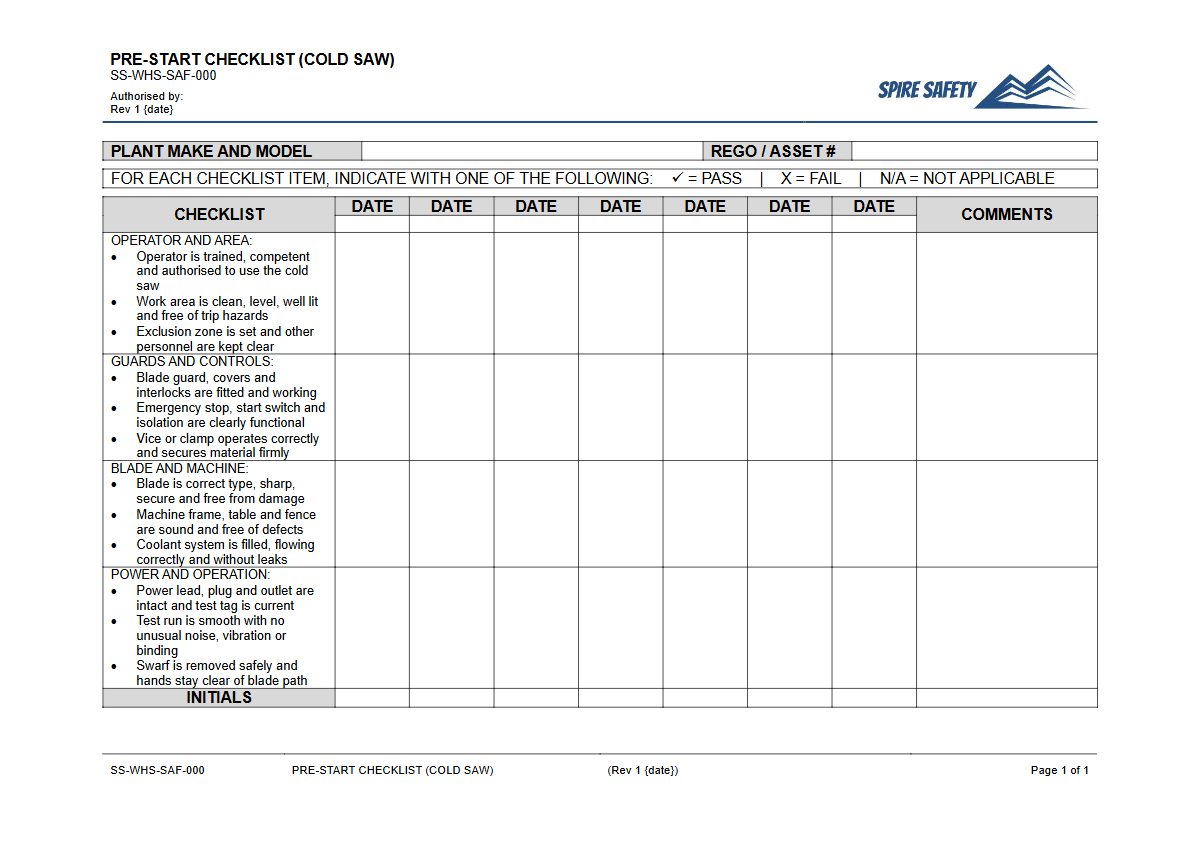
A thorough pre-start inspection for a cold saw should cover several critical areas to ensure it is safe to operate. The checklist prompts the user to inspect key components, including:
- Guards: Confirm that all blade guards and safety shields are in place, secure, and function correctly. Never operate a saw with guards modified, removed, or bypassed.
- Blade Condition: Visually inspect the blade for signs of damage, such as cracks, missing teeth, or excessive wear. A damaged blade can shatter during operation.
- Coolant System: Ensure the coolant reservoir is full and that the pump and delivery system are working correctly. Proper coolant flow is vital for blade life and cut quality.
- Clamping/Vice: Check that the material vice or clamping mechanism is fully operational and can securely hold the workpiece without slipping.
- Controls: Test the ON/OFF switches and, most importantly, the emergency stop button to ensure they function as expected.
- Work Area: The area around the saw should be clear of trip hazards, spills, and unnecessary clutter. Ensure lighting is adequate for the task.
These inspection principles are common across many types of workshop equipment. Similar verification points for guarding and controls are found in our CNC router pre-start checklist.
When to Conduct a Cold Saw Pre-Start
The pre-start checklist should be completed at the beginning of every shift before the cold saw is used for the first time that day. It should also be completed by a new operator taking over the machine mid-shift.
Performing these checks consistently ensures that the equipment's condition hasn't changed overnight or between users, catching potential issues before they escalate into safety incidents.
Who Should Complete the Checklist?
Only workers who have been trained and deemed competent in the safe operation of the specific cold saw should perform the pre-start check. Competency involves not just knowing how to operate the machine, but also understanding its specific hazards and the function of its safety features.
The completed checklists should be reviewed periodically by a supervisor or manager to monitor for recurring issues and ensure the process is being followed correctly.
Confirming an operator's skill is a critical part of workshop safety. This process can be formalised using a document like our Verification of Competency (Pipe Threader) Template, which can be adapted for various types of plant.
Integrating Checklists into Your Safety Framework
Pre-start checklists are more than just a daily task; they are a vital component of a comprehensive safety system. Completed checklists should be filed and retained as part of your WHS records.
These documents serve as evidence of your organisation's commitment to safety and due diligence. They also provide valuable data that can inform your maintenance schedule, assist in incident investigations, and highlight the need for further training or equipment upgrades.
Reviewing these records can reveal trends in equipment faults, allowing for proactive repairs before a failure occurs. The data gathered supports a continuous improvement loop, which can be verified through systematic WHS compliance auditing to ensure your safety programs remain effective.
Common mistakes
Common mistakes to avoid
- Failing to check the saw blade for cracks, warping, or missing teeth before operation.
- Ignoring faulty, bypassed, or missing machine guards and emergency stop buttons.
- Operating the saw without ensuring the workpiece is firmly secured in the vice or clamping system.
- Neglecting to confirm the coolant system is full and delivering adequate fluid to the blade.
Legal references
Legal considerations
The following legal requirements may be relevant to this type of work.
- Work Health and Safety Act (Harmonised) — Provides the primary duties for protecting workers and other people from work health and safety risks.
- Work Health and Safety Regulations (Harmonised) — Sets out requirements supporting the management of workplace hazards and risks.
The following codes may be relevant to this type of work.
- Managing WHS Risks Code of Practice — Provides practical guidance on identifying hazards, assessing risks and applying effective controls.
- Work Health and Safety Consultation, Cooperation and Coordination Code of Practice — Provides practical guidance on consulting workers and coordinating with other duty holders.
- Managing the Work Environment and Facilities Code of Practice — Provides practical guidance on safe work environments, workplace facilities and related controls.
Did you know
Precision Cutting
Cold saws use a high-speed steel (HSS) or tungsten carbide-tipped (TCT) circular blade and a flood coolant system to achieve a burr-free, precise cut with minimal heat transferred to the workpiece.
Preventable Injuries
Lacerations and amputations from unguarded machinery are among the most serious yet preventable workshop injuries reported in Australia each year. Consistent pre-start checks are a key defence.
FAQ
Frequently asked questions
01What is the purpose of a pre-start check for a cold saw?
02How often should a cold saw pre-start checklist be completed?
03Who is responsible for completing the cold saw pre-start?
04Is using this template enough to be WHS-aligned?
Share this resource
Free Pre-Start Checklist (Cold Saw) Template
Browse Categories
How To Use It
- 1Download and open in Word or PDF.
- 2Replace the placeholders with your business details.
- 3Get it reviewed by a WHS specialist before rollout.
Need it customised?
Our WHS consultants can adapt this template to your site, run a gap analysis, or audit what you already have in place.
Book a Free Consultation WHS consulting servicesor call 1300 156 382