
Free Pre-Start Checklist (Circular Saw) Template
Download our free Pre-Start Checklist for Circular Saws. This structured template helps formalise safety checks and manage WHS risks. Get your DOCX & PDF now.
Free Pre-Start Checklist (Circular Saw) Template
DOCX • 125 KB + PDF
Updated Oct 2026
No signup required
Purpose of the Free Pre-Start Checklist (Circular Saw) Template
Operating a circular saw, whether portable or fixed, introduces significant risks of cuts, lacerations, and amputations. A systematic pre-start inspection is a critical control measure to ensure the equipment is safe for use before any work begins.
This Free Pre-Start Checklist (Circular Saw) Template provides a structured format to guide operators through essential safety checks, helping your organisation meet its duty of care under Australian WHS laws. By formalising this process, you create a consistent record that hazards have been identified and controls are in place.
These daily checks are a fundamental component of proactive safety management, helping to prevent incidents before they happen.
Integrating such checklists into daily operations is a cornerstone of building robust and effective WHS management systems. It demonstrates a commitment to safety and provides valuable documentation that can be reviewed during safety meetings, incident investigations, or internal audits. The goal is to move beyond assumptions and verify equipment safety through a documented, repeatable process.
Video walkthrough
How to use the Free Pre-Start Checklist (Circular Saw) Template
This Pre-Start Checklist is provided as a fully editable DOCX file and a print-ready PDF. The DOCX version allows for complete customisation to align with the specific make and model of circular saw used in your workplace, as well as the unique environmental and task-related risks your workers face.
Note: This document is a template and must be customised to your specific workplace. We recommend a competent person, such as a supervisor or safety advisor, reviews and adapts the checklist to ensure it covers all relevant hazards and controls for your equipment and operational context.
Once customised, train all operators on how to use the checklist correctly.
What does this checklist cover?
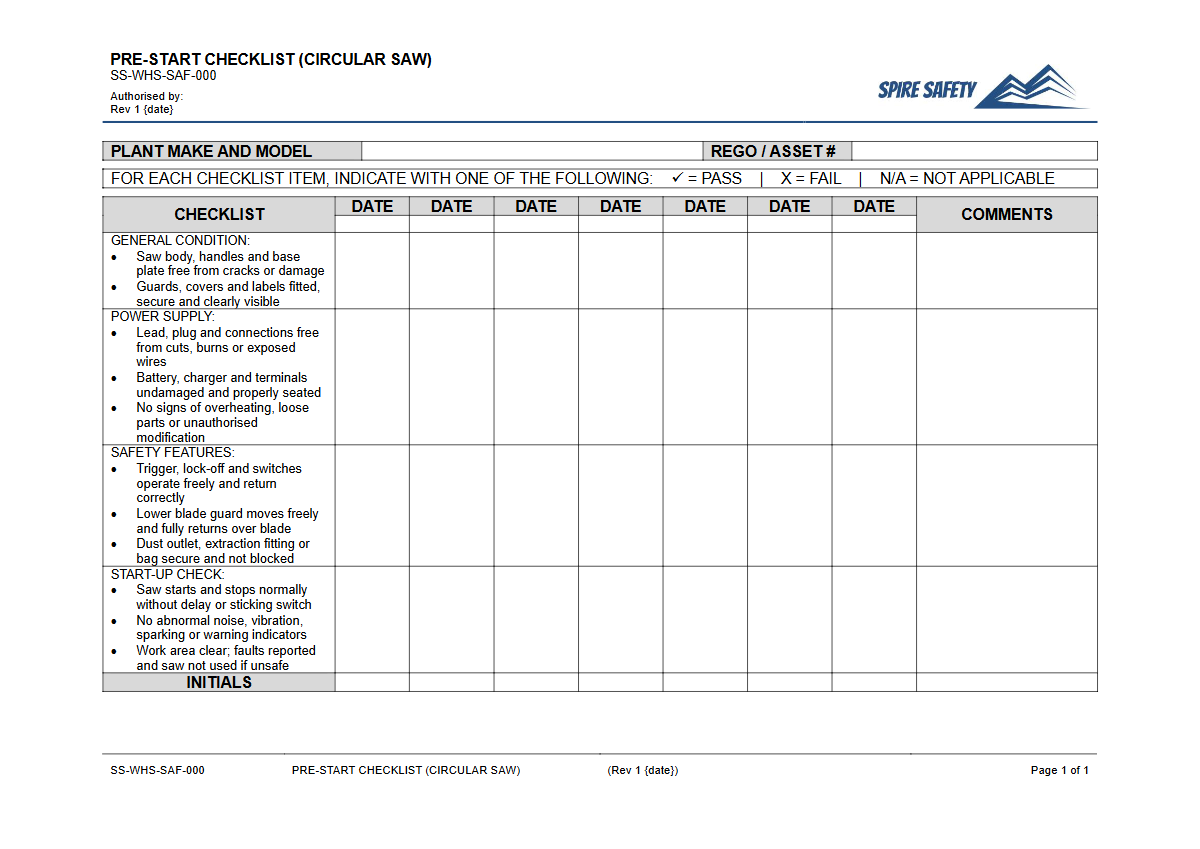
The template provides a structured starting point, prompting checks on key components and safety features common to most circular saws. These include:
- Guards: Verifying the upper blade guard is secure and the lower retractable guard moves freely without sticking.
- Blade: Checking the blade is sharp, free from damage or warping, and is the correct type for the material being cut.
- Power Supply: Inspecting cords and plugs for damage, or checking battery charge and connections for cordless models.
- General Condition: Looking for any signs of damage, loose parts, or missing components on the saw's body and handles.
- Work Area: Ensuring the work area is clear, stable, and free from trip hazards or obstructions.
While this checklist is specific to circular saws, the principle of pre-use inspection applies to all high-risk plant and equipment. For similar tools, you may find our free Pre-Start Checklist for Floor Saws useful.
The same disciplined approach is necessary for ensuring the safety of all machinery.
When to use the Pre-Start Checklist
A circular saw pre-start inspection should be completed before the first use on every shift or before each use if the tool is shared between multiple operators throughout the day. The completed checklist serves as a formal record that the inspection was performed.
These records are vital pieces of evidence during any safety investigation or WHS compliance auditing process, demonstrating that the Person Conducting a Business or Undertaking (PCBU) is actively monitoring the condition of its plant and equipment.
If a fault is identified that poses an immediate or potential safety risk, the saw must be taken out of service immediately. It should be tagged with a "Do Not Operate" or similar tag and reported to a supervisor for repair or replacement by a competent person.
The saw must not be used again until the fault is rectified and it has been cleared for use.
Who should use this Pre-Start Checklist
The checklist should be completed by the person operating the circular saw. All operators must be trained and competent not only in the safe use of the saw but also in how to properly conduct a pre-start inspection.
They need to understand what each item on the checklist means and what constitutes a 'pass' or 'fail'. Supervisors and managers are responsible for ensuring these checks are being completed correctly and for taking appropriate action when faults are reported. This culture of operator-led inspection is essential for workshop safety, extending to other equipment like that covered in our Pre-Start Checklist (Bench Grinder) Template.
For more templates, guides, and tools to support your safety management program, explore our complete free WHS resources library. Each resource is designed to provide a practical starting point for improving safety outcomes in your organisation.
Common mistakes
Common mistakes to avoid
- Failing to customise the template for the specific saw model and work tasks.
- Operators 'ticking and flicking' without physically performing each check.
- Continuing to use a saw after a minor fault has been identified.
- Using the wrong type of blade for the material being cut, increasing the risk of binding and kickback.
Legal references
Legal considerations
The following legal requirements may be relevant to this type of work.
- Work Health and Safety Act (Harmonised) — Provides the primary duties for protecting workers and other people from work health and safety risks.
- Work Health and Safety Regulations (Harmonised) — Sets out requirements supporting the management of workplace hazards and risks.
The following codes may be relevant to this type of work.
- Managing WHS Risks Code of Practice — Provides practical guidance on identifying hazards, assessing risks and applying effective controls.
- Work Health and Safety Consultation, Cooperation and Coordination Code of Practice — Provides practical guidance on consulting workers and coordinating with other duty holders.
- Managing the Work Environment and Facilities Code of Practice — Provides practical guidance on safe work environments, workplace facilities and related controls.
Did you know
Kickback Danger
Circular saw kickback is one of the leading causes of serious injury. It happens when the blade binds in the cut, causing the saw to be thrown back violently towards the operator at high speed.
Power Tool Injuries
According to Safe Work Australia data, power tools are a significant source of workplace injury, with hands and fingers being the most commonly injured body parts. Systematic pre-use checks are a key preventative measure.
FAQ
Frequently asked questions
01What are the most common hazards associated with circular saws?
02Is a pre-start check legally required for a circular saw in Australia?
03How often should a circular saw be more thoroughly inspected?
04What should happen if a fault is found during a pre-start check?
Share this resource
Free Pre-Start Checklist (Circular Saw) Template
Browse Categories
How To Use It
- 1Download and open in Word or PDF.
- 2Replace the placeholders with your business details.
- 3Get it reviewed by a WHS specialist before rollout.
Need it customised?
Our WHS consultants can adapt this template to your site, run a gap analysis, or audit what you already have in place.
Book a Free Consultation WHS consulting servicesor call 1300 156 382