
Free Pre-Start Checklist (Clay Mixer) Template
Download our Free Pre-Start Checklist (Clay Mixer) Template to formalise daily equipment inspections and manage WHS risks in your Australian workplace.
Free Pre-Start Checklist (Clay Mixer) Template
DOCX • 125 KB + PDF
Updated Oct 2026
No signup required
Purpose of the Free Pre-Start Checklist (Clay Mixer) Template
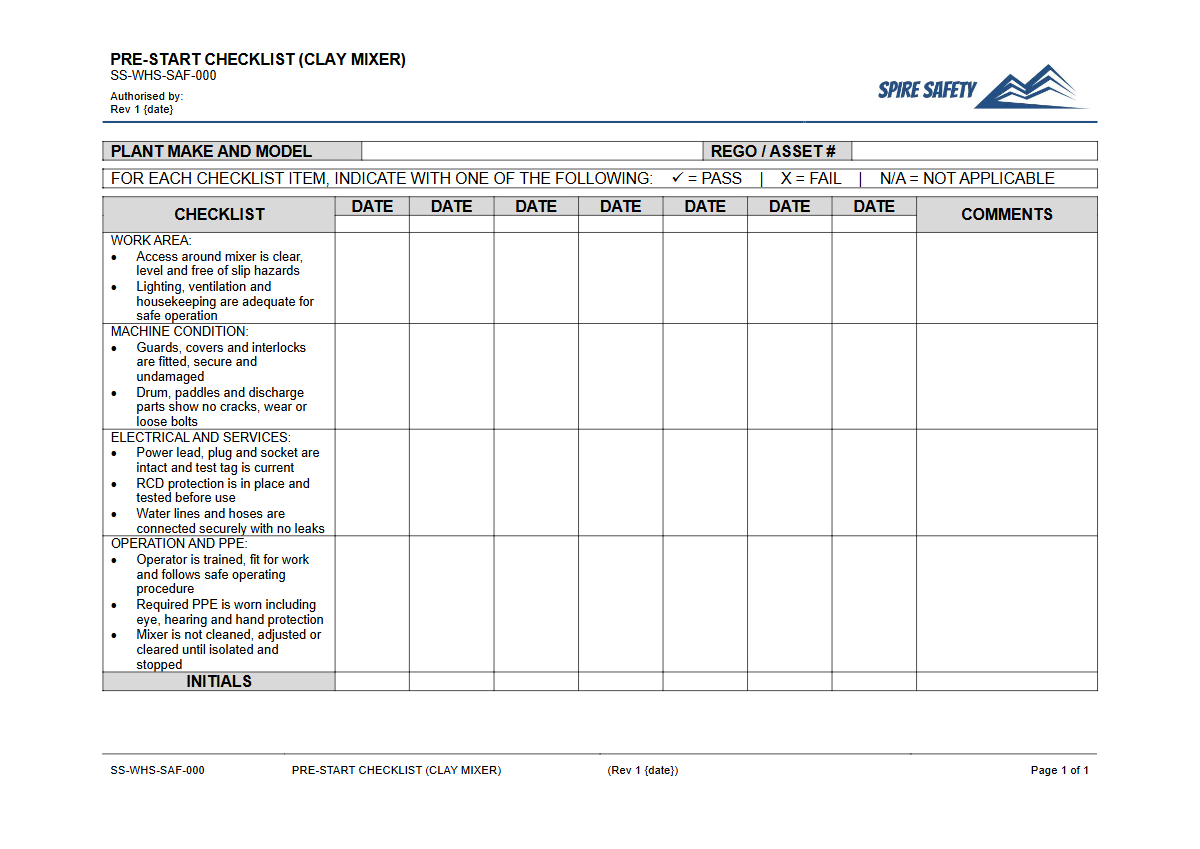
Operating a clay mixer involves significant risks, including entanglement with rotating paddles, crushing hazards, and exposure to airborne dust like respirable crystalline silica. Our Free Pre-Start Checklist (Clay Mixer) Template provides a structured starting point for operators to conduct thorough, documented inspections before each use.
Formalising this process helps identify mechanical faults, electrical issues, or missing guards before they can cause an incident, ensuring the equipment is safe to operate.
Using a consistent checklist promotes a proactive safety culture. It transforms inspections from a memory-based task into a formal procedure, creating a record of due diligence and equipment condition over time.
These daily checks are a fundamental part of any plant maintenance program, helping to prevent costly breakdowns and production delays. To reinforce this behaviour, regular training is essential; our Pre-Start Checks and Plant Maintenance Toolbox Talk Template can help facilitate these discussions with your team.
Video walkthrough
How to use the Free Pre-Start Checklist (Clay Mixer) Template
This resource is available for immediate download in both DOCX and PDF formats. The DOCX file is fully editable, allowing you to tailor it to your specific operational needs. To use the template effectively, follow these steps:
- Download the template and open the DOCX version.
- Review the checklist items against the manufacturer’s instructions for your specific clay mixer model.
- Add, remove, or modify checks to address the unique hazards of your workplace, such as the type of clay being mixed, the location of the equipment, and any surrounding activities.
- Incorporate your company branding and specific procedural references.
- Train all operators on how to complete the checklist accurately and what to do if a fault is found.
Important: This is a template document designed to be a starting point. To ensure it is effective for your organisation, you must customise it to reflect your particular equipment, operational environment, and site-specific risks.
We cannot guarantee its suitability for your specific needs without this critical customisation.
Integrating this checklist into your daily routine is a key component of a systematic approach to safety. Pre-start records provide valuable data that feeds into broader WHS management systems, helping you track asset condition, identify recurring faults, and make informed decisions about maintenance schedules and equipment replacement.
When to use this Pre-Start Checklist
A pre-start inspection should be completed before the clay mixer is used for the first time each day or at the beginning of every shift. If the equipment is used intermittently, a check should be performed before each use.
This frequency ensures that any damage or defects that may have occurred since the last operation, or during a previous shift, are identified before the equipment is energised.
The principles of this checklist can also be adapted for similar rotating equipment. While this document is specific to clay mixers, you may find our Free Pre-Start Checklist (Agitator) Template useful for other mixing machinery in your facility.
Who should use it
The primary user of the checklist is the trained and authorised operator of the clay mixer. They have the most hands-on interaction with the equipment and are best positioned to notice subtle changes in its condition or performance.
It is their responsibility to complete the check thoroughly and accurately before starting work.
Supervisors and managers also have a role. They are responsible for ensuring operators are trained to conduct the checks, reviewing completed checklists periodically, and taking prompt action to address any reported defects.
Verifying that an operator is competent to not only use the machine but also inspect it is crucial. This process is similar to what is outlined in our Verification of Competency (Cement Mixer) Template, which formalises the assessment of an operator's skills.
Finally, maintenance personnel will use the information from completed checklists to schedule repairs and preventative maintenance. A clear and detailed report of a fault helps them diagnose and fix the issue efficiently. Periodically confirming these procedures are being followed correctly is a key part of ensuring workplace safety, often verified through a formal WHS compliance audit.
Common mistakes
Common mistakes to avoid
- Failing to physically check items and just ticking boxes ('pencil-whipping').
- Neglecting to customise the generic template for the specific mixer model and workplace.
- Not immediately reporting identified faults or continuing to use unsafe equipment.
- Inadequate training for operators on how to perform the checks correctly and why they matter.
Legal references
Legal considerations
The following legal requirements may be relevant to this type of work.
- Work Health and Safety Act (Harmonised) — Provides the primary duties for protecting workers and other people from work health and safety risks.
- Work Health and Safety Regulations (Harmonised) — Sets out requirements supporting the management of workplace hazards and risks.
The following codes may be relevant to this type of work.
- Managing WHS Risks Code of Practice — Provides practical guidance on identifying hazards, assessing risks and applying effective controls.
- Work Health and Safety Consultation, Cooperation and Coordination Code of Practice — Provides practical guidance on consulting workers and coordinating with other duty holders.
- Managing the Work Environment and Facilities Code of Practice — Provides practical guidance on safe work environments, workplace facilities and related controls.
Did you know
Silica Dust Hazard
Many types of dry clay contain respirable crystalline silica (RCS). When mixed, this can become airborne, creating a serious long-term health hazard if inhaled without appropriate controls like ventilation and respiratory protection.
Pug Mill vs. Mixer
While often used interchangeably, a 'pug mill' is a specific type of clay mixer that also homogenises, de-airs, and extrudes the clay through a nozzle, preparing it for immediate use in pottery or brick-making.
FAQ
Frequently asked questions
01What should a clay mixer pre-start checklist include?
02Why is it important to customise a pre-start checklist template?
03How often should a clay mixer be inspected?
04Can this template be used for other types of mixers?
Share this resource
Free Pre-Start Checklist (Clay Mixer) Template
Browse Categories
How To Use It
- 1Download and open in Word or PDF.
- 2Replace the placeholders with your business details.
- 3Get it reviewed by a WHS specialist before rollout.
Need it customised?
Our WHS consultants can adapt this template to your site, run a gap analysis, or audit what you already have in place.
Book a Free Consultation WHS consulting servicesor call 1300 156 382