
Free Safe Operating Procedure (AC Refrigerant Recovery) Template
Download our free Safe Operating Procedure (AC Refrigerant Recovery) Template.
Free Safe Operating Procedure (AC Refrigerant Recovery) Template
DOCX • 126 KB + PDF
Updated Oct 2026
No signup required
Purpose of the Free Safe Operating Procedure (AC Refrigerant Recovery) Template
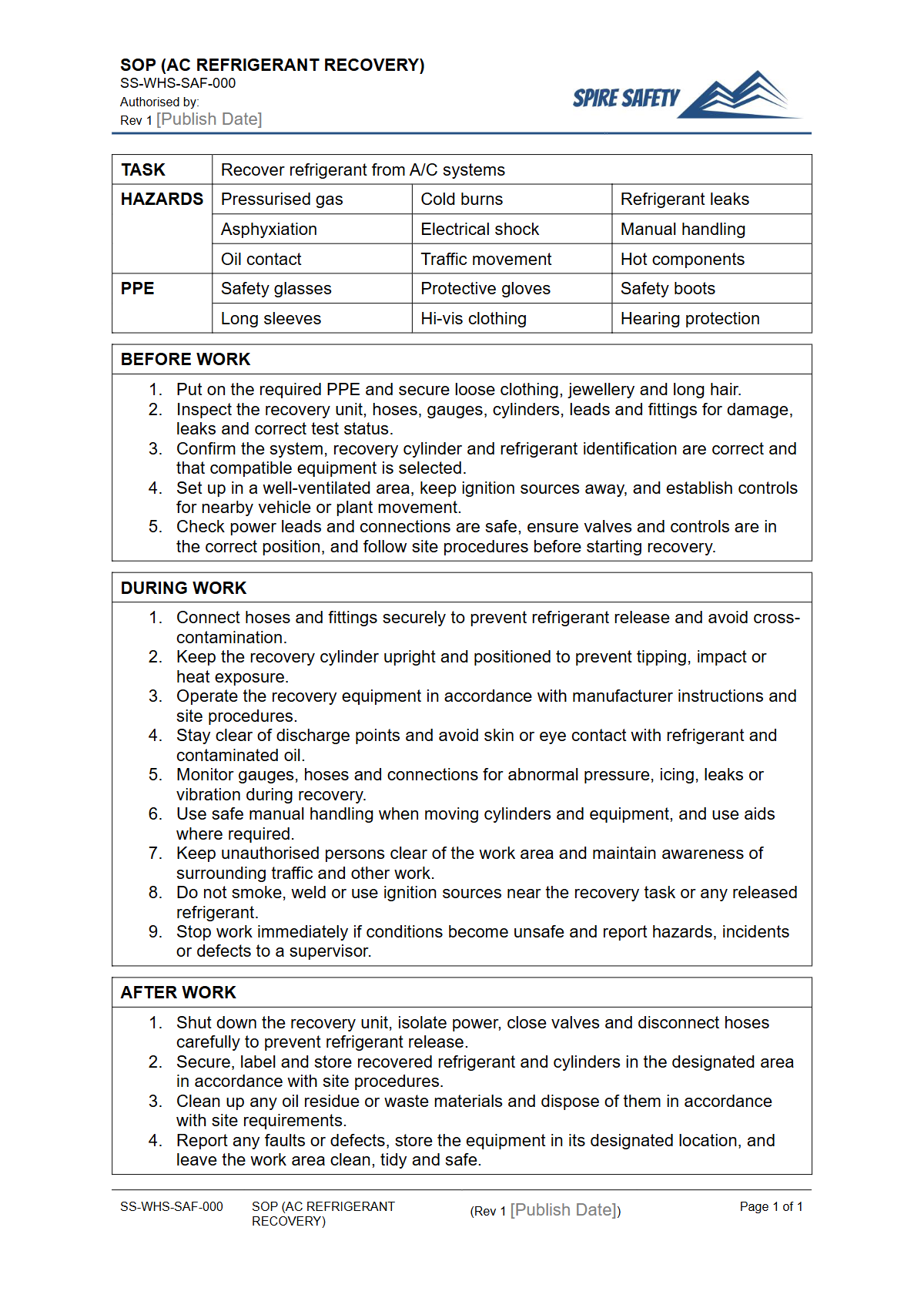
Handling and recovering air conditioning refrigerants involves significant risks, including chemical exposure, high-pressure equipment failure, frostbite, and environmental damage. This Free Safe Operating Procedure (AC Refrigerant Recovery) Template provides a structured framework for documenting the required steps to perform this task safely.
Using a detailed SOP helps your organisation meet its WHS obligations by managing hazards and ensuring workers are protected. It forms a critical part of your broader WHS management systems, demonstrating a commitment to proactive risk control.
The primary purpose of this Safe Operating Procedure is to standardise the process for all technicians, reducing the likelihood of incidents. It details the required PPE, pre-operational checks on recovery units, step-by-step instructions for connecting and operating equipment, and emergency procedures.
By formalising these steps, you create a clear, auditable record of your safety protocols and provide a vital training tool for new and existing personnel. A well-written SOP helps prevent the release of harmful synthetic greenhouse gases into the atmosphere, ensuring compliance with environmental regulations.
Video walkthrough
How to use the Free Safe Operating Procedure (AC Refrigerant Recovery) Template
This document is a template designed to be a starting point. It is not a finished, universally applicable procedure.
You must customise it to reflect the specific equipment, refrigerants, and unique conditions of your workplace.
- Download: Choose between the DOCX and PDF formats. The DOCX file is fully editable.
- Customise: Adapt the content to your site. Insert the specific makes and models of your refrigerant recovery machines, pressure gauges, and other tools. Detail the types of refrigerants your team handles (e.g., R134a, R32, R410A).
- Consult: Discuss the draft procedure with the workers who will be using it. Their practical experience is invaluable for creating a procedure that is both safe and workable. Consultation is a key requirement of WHS legislation.
- Train: Once finalised, use the SOP as a basis for training. Ensure all relevant workers understand the procedure and demonstrate competency before undertaking the task unsupervised.
- Review: Schedule regular reviews of the SOP (e.g., annually) or whenever there is a change in equipment, processes, or regulations.
When to use it
This Safe Operating Procedure should be used every time a worker is required to recover refrigerant from an air conditioning or refrigeration system. This includes tasks such as:
- Decommissioning old AC units before disposal.
- Performing repairs that require the system to be opened, such as replacing a compressor or evaporator coil.
- Scheduled system maintenance that involves removing the existing refrigerant charge for cleaning or weighing.
- Transferring refrigerant from a potentially contaminated system into a dedicated recovery cylinder.
Many AC units are installed in locations that require working at height, so it's critical to consider all associated risks. This may include using our step ladder SOP to define safe access procedures.
Who should use it
This SOP is intended for qualified and licenced heating, ventilation, air conditioning, and refrigeration (HVAC-R) technicians. In Australia, any person who handles refrigerant must hold a relevant refrigerant handling licence from the Australian Refrigeration Council (ARCtick).
This procedure is not a substitute for formal training and licencing. It is a tool to be used by competent personnel to ensure they follow a consistent, safe, and environmentally responsible process.
Site managers and WHS officers can also use the document to verify that safe work practices are being followed through workplace inspections and observations. For mobile mechanics, this procedure can be used alongside other vehicle-specific documents, such as a Body Truck SOP Template, to manage overall operational safety.
Reviewing and Maintaining Your SOP
A Safe Operating Procedure is a living document. It should be reviewed regularly to ensure it remains accurate and effective.
A good practice is to schedule an annual review, but it should also be updated immediately if a new hazard is identified, after an incident, or when new equipment or regulations are introduced. Integrating SOP reviews into your schedule of WHS compliance auditing ensures they are not forgotten.
When you are looking for other document templates, remember to check our complete free WHS resources library for more downloads.
Common mistakes
Common mistakes to avoid
- Using recovery cylinders that are out of date or not designated for the specific refrigerant type.
- Failing to purge air and moisture from hoses before starting the recovery process, leading to system contamination.
- Working in a confined or poorly ventilated area without adequate air monitoring or mechanical ventilation.
- Overfilling recovery cylinders, which can lead to dangerously high pressures when ambient temperatures rise.
Legal references
Legal considerations
The following legal requirements may be relevant to this type of work.
- Work Health and Safety Act (Harmonised) — Provides the primary duties for protecting workers and other people from work health and safety risks.
- Work Health and Safety Regulations (Harmonised) — Sets out requirements supporting the management of workplace hazards and risks.
The following codes may be relevant to this type of work.
- Managing WHS Risks Code of Practice — Provides practical guidance on identifying hazards, assessing risks and applying effective controls.
- Work Health and Safety Consultation, Cooperation and Coordination Code of Practice — Provides practical guidance on consulting workers and coordinating with other duty holders.
- Managing the Work Environment and Facilities Code of Practice — Provides practical guidance on safe work environments, workplace facilities and related controls.
Did you know
Greenhouse Gas Potency
Some common refrigerants are potent synthetic greenhouse gases. For example, one kilogram of R134a has a global warming potential (GWP) 1,430 times greater than one kilogram of carbon dioxide.
FAQ
Frequently asked questions
01What are the main hazards of AC refrigerant recovery?
02Is a specific licence required to handle refrigerants in Australia?
03How often should an SOP for refrigerant recovery be reviewed?
04What Personal Protective Equipment (PPE) is needed for refrigerant recovery?
Share this resource
Free Safe Operating Procedure (AC Refrigerant Recovery) Template
Browse Categories
How To Use It
- 1Download and open in Word or PDF.
- 2Replace the placeholders with your business details.
- 3Get it reviewed by a WHS specialist before rollout.
Need it customised?
Our WHS consultants can adapt this template to your site, run a gap analysis, or audit what you already have in place.
Book a Free Consultation WHS consulting servicesor call 1300 156 382
Related templates
- Free Safe Operating Procedure (AC Vacuum Pump) Template
- Free Safe Operating Procedure (Access Control Panel) Template
- Free Safe Operating Procedure (Access Hatch Inspection) Template
- Free Safe Operating Procedure (Accessible Bus Loading) Template
- Free Safe Operating Procedure (Accessible Van Loading) Template
- Free Safe Operating Procedure (Accommodation Linen Sort) Template