
Free Safe Operating Procedure (Accessible Bus Loading) Template
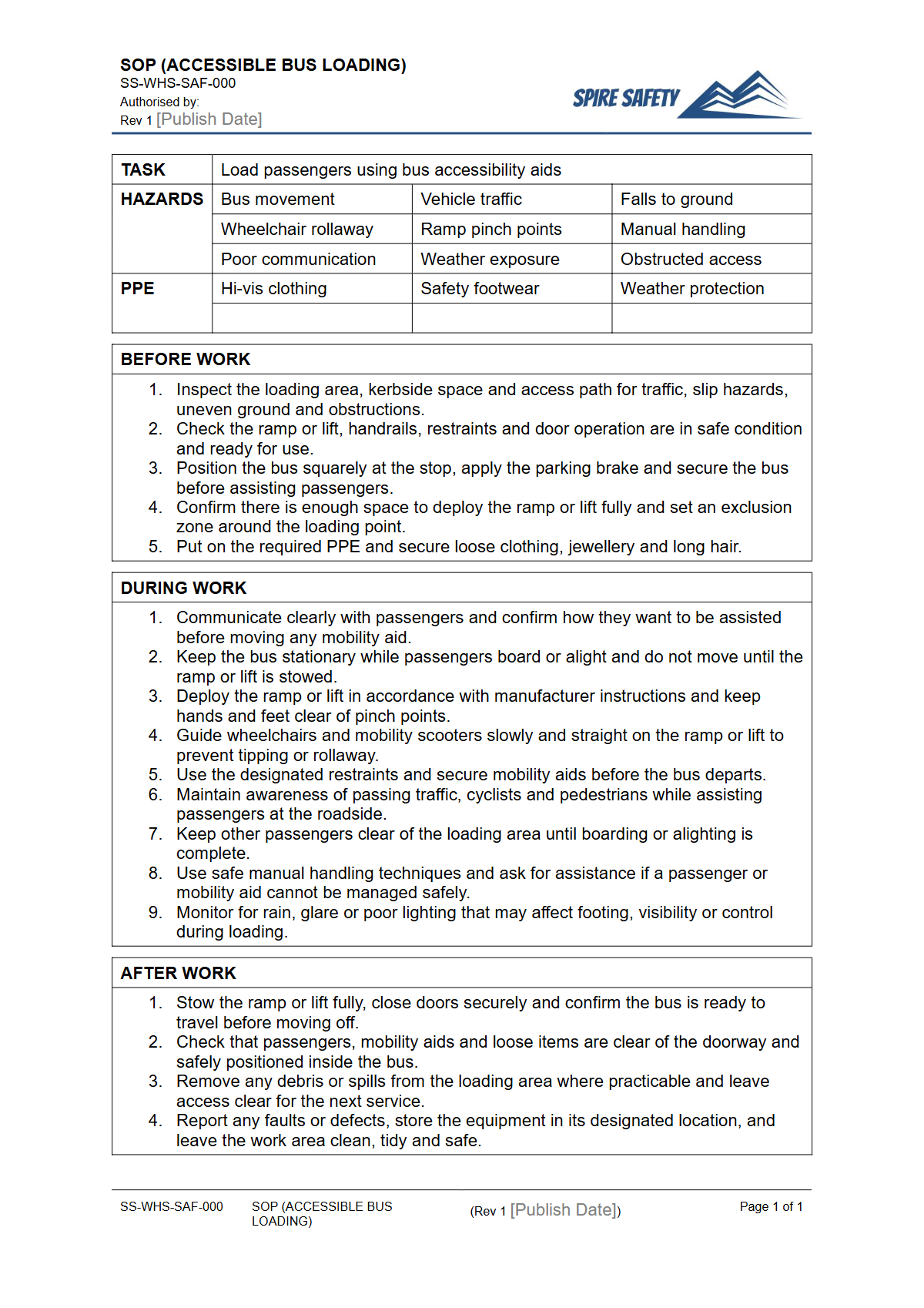
Download our Free Safe Operating Procedure (Accessible Bus Loading) Template.
Free Safe Operating Procedure (Accessible Bus Loading) Template
DOCX • 126 KB + PDF
Updated Oct 2026
No signup required
Purpose of the Free Safe Operating Procedure (Accessible Bus Loading) Template
This Free Safe Operating Procedure (Accessible Bus Loading) Template provides a structured framework for documenting the process of safely loading and unloading passengers with mobility aids onto an accessible bus. Its primary purpose is to minimise risks to both passengers and operators by defining a clear, step-by-step method for using ramps, lifts, and restraint systems.
A documented SOP ensures consistency in training and execution, reducing the likelihood of incidents caused by human error or equipment misuse. Formalising this process is a critical component of robust WHS management systems, demonstrating an organisation's commitment to inclusive and safe transport for all.
Video walkthrough
How to use the Free Safe Operating Procedure (Accessible Bus Loading) Template
This Safe Operating Procedure for accessible bus loading is a starting point designed for customisation. After downloading the DOCX or PDF file, you must adapt it to reflect your specific operational context.
This includes detailing the make and model of your vehicles, the type of accessibility equipment installed (e.g., manual ramp, hydraulic lift), and your organisation's emergency procedures. Review and edit each section to ensure it aligns with your risk assessments and the manufacturer's instructions for the equipment.
Customisation is Essential
Please note: This is a template, not a finished document. To be effective and support your safety obligations, you must customise it to your specific equipment, environment, and operational procedures.
We strongly recommend seeking expert advice if you are unsure how to conduct the necessary risk assessments or tailor this document. Professional WHS consulting can help ensure your procedures are practical and robust.
When to use this Safe Operating Procedure
This SOP should be used as the standard guide for every instance of loading or unloading a passenger who requires a ramp or lift. It is a critical tool for pre-operational checks, driver training, and competency assessments.
It should also be reviewed during incident investigations or when new accessible vehicles or equipment are introduced into the fleet. Integrating this SOP into daily operations helps normalise safe behaviour and ensures a consistent standard of care.
For other vehicle-related tasks, you might need different documents, such as our FREE Body Truck SOP (Safe Operating Procedure) Template, which covers different operational risks.
Who should use it
This procedure is designed for a range of personnel within a transport or community service organisation. Primary users include:
- Bus Drivers and Operators: To guide their actions during the loading and unloading process.
- Training Coordinators: As a foundational document for inducting new staff and conducting refresher training.
- WHS Managers and Safety Officers: To establish a benchmark for safe practices and to use during safety observations.
- Supervisors and Schedulers: To understand the time and safety requirements associated with providing accessible transport.
The document also serves as a key piece of evidence during safety audits. An auditor performing a WHS compliance audit will look for documented procedures like this to verify that an organisation has systematic processes for managing identified risks.
It is also important to have procedures for all equipment used, including ancillary items, which is why a specific procedure like a FREE Step Ladder SOP Template can be just as crucial in a holistic safety system. This SOP helps confirm that workers are not only trained but are following a recognised and approved method. You can find more templates to support your operations in our free WHS resources library.
Common mistakes
Common mistakes to avoid
- Failing to conduct pre-use inspections of the ramp, lift, and restraint mechanisms.
- Poor communication with the passenger before, during, and after the transfer.
- Positioning the bus on uneven or sloping ground, creating an unstable base for the ramp or lift.
- Not ensuring all wheelchair and occupant restraints are correctly and securely fastened before moving the vehicle.
Legal references
Legal considerations
The following legal requirements may be relevant to this type of work.
- Work Health and Safety Act (Harmonised) — Provides the primary duties for protecting workers and other people from work health and safety risks.
- Work Health and Safety Regulations (Harmonised) — Sets out requirements supporting the management of workplace hazards and risks.
The following codes may be relevant to this type of work.
- Managing WHS Risks Code of Practice — Provides practical guidance on identifying hazards, assessing risks and applying effective controls.
- Work Health and Safety Consultation, Cooperation and Coordination Code of Practice — Provides practical guidance on consulting workers and coordinating with other duty holders.
- Managing the Work Environment and Facilities Code of Practice — Provides practical guidance on safe work environments, workplace facilities and related controls.
Did you know
Accessible Transport Standards
The Disability Standards for Accessible Public Transport 2002 mandate specific requirements for Australian public transport, including minimum dimensions for allocated spaces, clear pathways, and operational standards for ramps and lifts to ensure accessibility.
Prevalence of Mobility Aids
According to the Australian Bureau of Statistics, around 1.4 million Australians use a mobility aid, highlighting the critical importance of safe and accessible transport procedures in daily community life.
FAQ
Frequently asked questions
01What key information should be included in an accessible bus loading SOP?
02How often should bus drivers receive training on accessible loading procedures?
03Is a Safe Work Method Statement (SWMS) required for loading a wheelchair onto a bus?
04What are the primary hazards associated with using a bus ramp or lift?
Share this resource
Free Safe Operating Procedure (Accessible Bus Loading) Template
Browse Categories
How To Use It
- 1Download and open in Word or PDF.
- 2Replace the placeholders with your business details.
- 3Get it reviewed by a WHS specialist before rollout.
Need it customised?
Our WHS consultants can adapt this template to your site, run a gap analysis, or audit what you already have in place.
Book a Free Consultation WHS consulting servicesor call 1300 156 382
Related templates
- Free Safe Operating Procedure (Accessible Van Loading) Template
- Free Safe Operating Procedure (Accommodation Linen Sort) Template
- Free Safe Operating Procedure (Acid Cleaning) Template
- Free Safe Operating Procedure (Acid Transfer) Template
- Free Safe Operating Procedure (Adhesive Mixing) Template
- Free Safe Operating Procedure (Adult Change Table) Template