
Free Safe Operating Procedure (Adult Change Table) Template
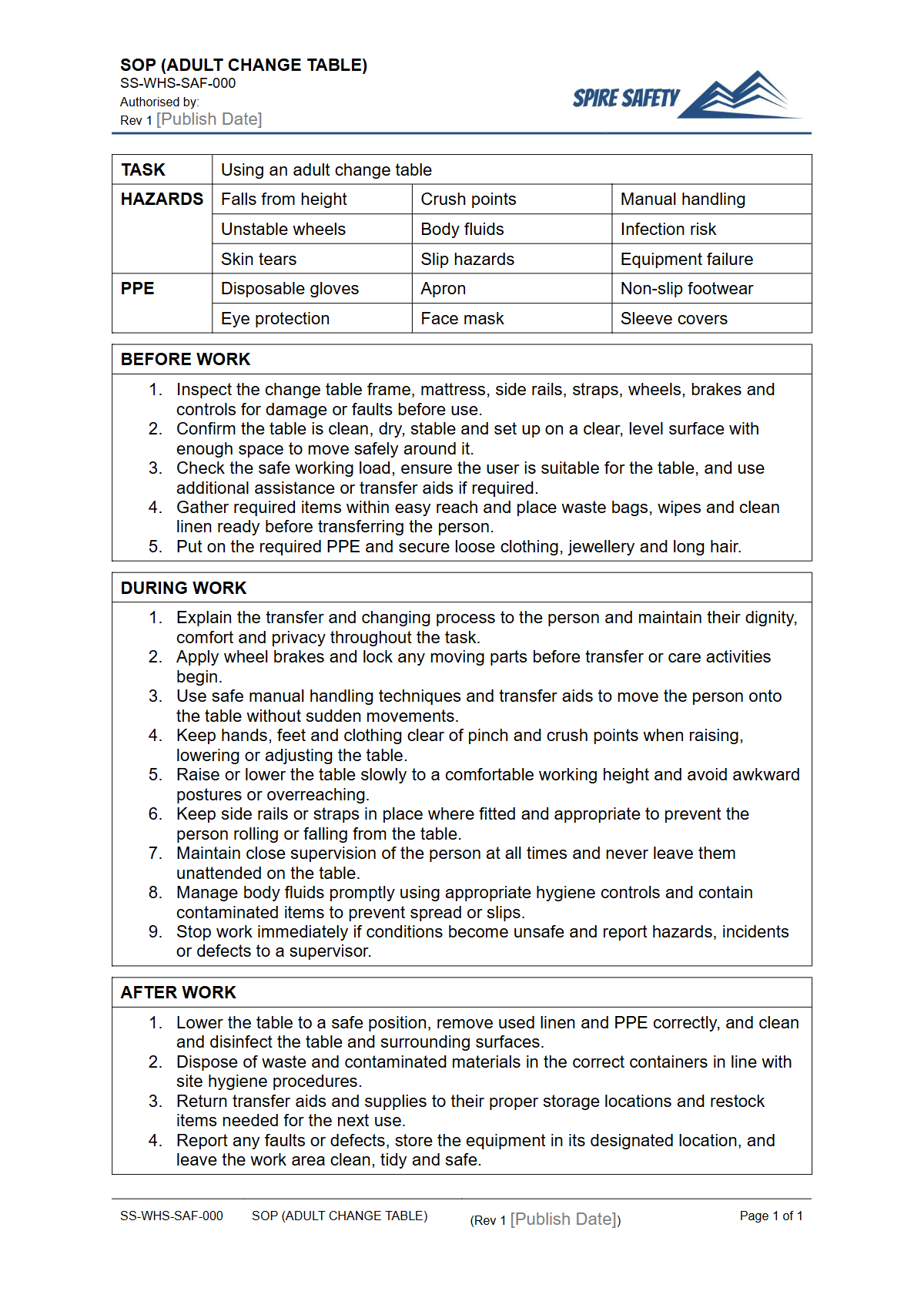
Download our free Safe Operating Procedure (Adult Change Table) template.
Free Safe Operating Procedure (Adult Change Table) Template
DOCX • 126 KB + PDF
Updated Oct 2026
No signup required
Purpose of the Free Safe Operating Procedure (Adult Change Table) Template
Operating an adult change table involves significant manual handling and client interaction risks. This Free Safe Operating Procedure (Adult Change Table) Template provides a structured starting point for organisations to document a clear, step-by-step process for using this equipment safely and respectfully.
A documented SOP is a fundamental tool for managing workplace risks, helping to prevent musculoskeletal injuries to carers and ensuring the dignity and safety of the person being assisted. Using this template helps standardise procedures across your team, provides a consistent basis for training, and demonstrates a commitment to health and safety.
Implementing robust SOPs is a core component of a healthy safety culture. A well-defined procedure minimises ambiguity and reduces the likelihood of incidents caused by unsafe practices or inconsistent methods.
It forms an essential part of a broader risk management strategy, which can be explored further in our free WHS resources library, containing a wide range of tools and templates.
Video walkthrough
How to use the Free Safe Operating Procedure (Adult Change Table) Template
This template is available in an easily editable DOCX format and a ready-to-print PDF. It is designed as a foundation, not a finished document.
You must adapt it to reflect the specific context of your workplace, including the make and model of your change table, the layout of the facility, and the specific needs of your clients.
To correctly use this Safe Operating Procedure template, you should:
- Consult with the workers who will be using the adult change table to ensure the procedure is practical and reflects on-the-ground realities.
- Detail the specific pre-operational checks required for your equipment, such as checking the function of height adjustment controls and safety rails.
- List the personal protective equipment (PPE) required, such as gloves.
- Incorporate any specific client care protocols relevant to the task.
- Clearly outline emergency procedures, including who to contact and the location of emergency stops or equipment.
- Obtain formal sign-off from management before implementing the procedure.
Important Note: This is a template only. To be effective, we recommend that you customise this document in consultation with your team to suit your specific equipment, environment, and operational requirements.
It is not a substitute for a comprehensive risk assessment or professional WHS advice. Properly documenting procedures for all workplace equipment is critical, much like you would for common tools using our free Step Ladder SOP template.
When to use this Safe Operating Procedure
An SOP for an adult change table should be a living document, integrated into your daily operations. It is not a set-and-forget tool.
Its primary uses include training and competency, risk management, and operational consistency.
Use this SOP during:
- New Staff Inductions: Ensure all new employees understand the safe and correct procedure from day one.
- Refresher Training: Conduct regular training sessions to reinforce safe work practices and address any complacency.
- Competency Assessments: Use the SOP as a checklist to formally verify a worker's ability to perform the task safely.
- Incident Investigations: Refer to the SOP when investigating an incident or near miss to determine if the procedure was followed or if it needs revision.
- Workplace Audits: Present the SOP as evidence of your documented safety systems during internal or external audits. Regular procedural reviews are a key part of maintaining safety standards, often verified through a WHS compliance audit.
Who should use this Safe Operating Procedure
This document is designed for use by multiple roles within an organisation, particularly in sectors like aged care, healthcare, disability support, and public facility management.
Roles that will use this SOP include:
- Direct Care Workers, Nurses, and Support Staff: As the primary operators, they will follow the step-by-step instructions to perform their duties safely and effectively.
- Work Health and Safety (WHS) Managers: To integrate the procedure into the organisation's overall WHS management system and use it as part of a risk control strategy.
- Supervisors and Team Leaders: For training their teams, supervising the task, and ensuring compliance with the documented procedure.
- Facility and Operations Managers: To ensure that the equipment provided is supported by appropriate safety documentation and training frameworks. For complex environments, seeking guidance from WHS consulting professionals can ensure your systems are robust and effective.
Common mistakes
Common mistakes to avoid
- Using the template without customising it for specific workplace equipment and client needs.
- Failing to provide practical, hands-on training to staff on the finalised SOP.
- Neglecting to include crucial details like PPE requirements, cleaning protocols, and emergency procedures.
- Not reviewing and updating the SOP after an incident, near miss, or change in work practice.
Legal references
Legal considerations
The following legal requirements may be relevant to this type of work.
- Work Health and Safety Act (Harmonised) — Provides the primary duties for protecting workers and other people from work health and safety risks.
- Work Health and Safety Regulations (Harmonised) — Sets out requirements supporting the management of workplace hazards and risks.
The following codes may be relevant to this type of work.
- Managing WHS Risks Code of Practice — Provides practical guidance on identifying hazards, assessing risks and applying effective controls.
- Work Health and Safety Consultation, Cooperation and Coordination Code of Practice — Provides practical guidance on consulting workers and coordinating with other duty holders.
- Managing the Work Environment and Facilities Code of Practice — Provides practical guidance on safe work environments, workplace facilities and related controls.
Did you know
Manual Handling Impact
In Australia, the healthcare and social assistance industry has one of the highest rates of serious workers' compensation claims, with body stressing and manual handling being the leading cause of injury.
Ergonomic Design
Height-adjustable equipment like change tables can reduce the risk of back injury by over 60% by allowing carers to work at an optimal height, minimising bending and stooping.
FAQ
Frequently asked questions
01What is the main risk associated with using an adult change table?
02Does this SOP template cover specific brands of change tables?
03Who is responsible for customising and implementing this Safe Operating Procedure?
04How often should an adult change table SOP be reviewed?
Share this resource
Free Safe Operating Procedure (Adult Change Table) Template
Browse Categories
How To Use It
- 1Download and open in Word or PDF.
- 2Replace the placeholders with your business details.
- 3Get it reviewed by a WHS specialist before rollout.
Need it customised?
Our WHS consultants can adapt this template to your site, run a gap analysis, or audit what you already have in place.
Book a Free Consultation WHS consulting servicesor call 1300 156 382
Related templates
- Free Safe Operating Procedure (Aerosol Can Puncture) Template
- Free Safe Operating Procedure (After Hours Dispatch) Template
- Free Safe Operating Procedure (After Hours Security) Template
- Free Safe Operating Procedure (AHU Filter Change) Template
- Free Safe Operating Procedure (Air Blow Gun) Template
- Free Safe Operating Procedure (Air Chisel) Template