
Free Safe Operating Procedure (After Hours Security) Template
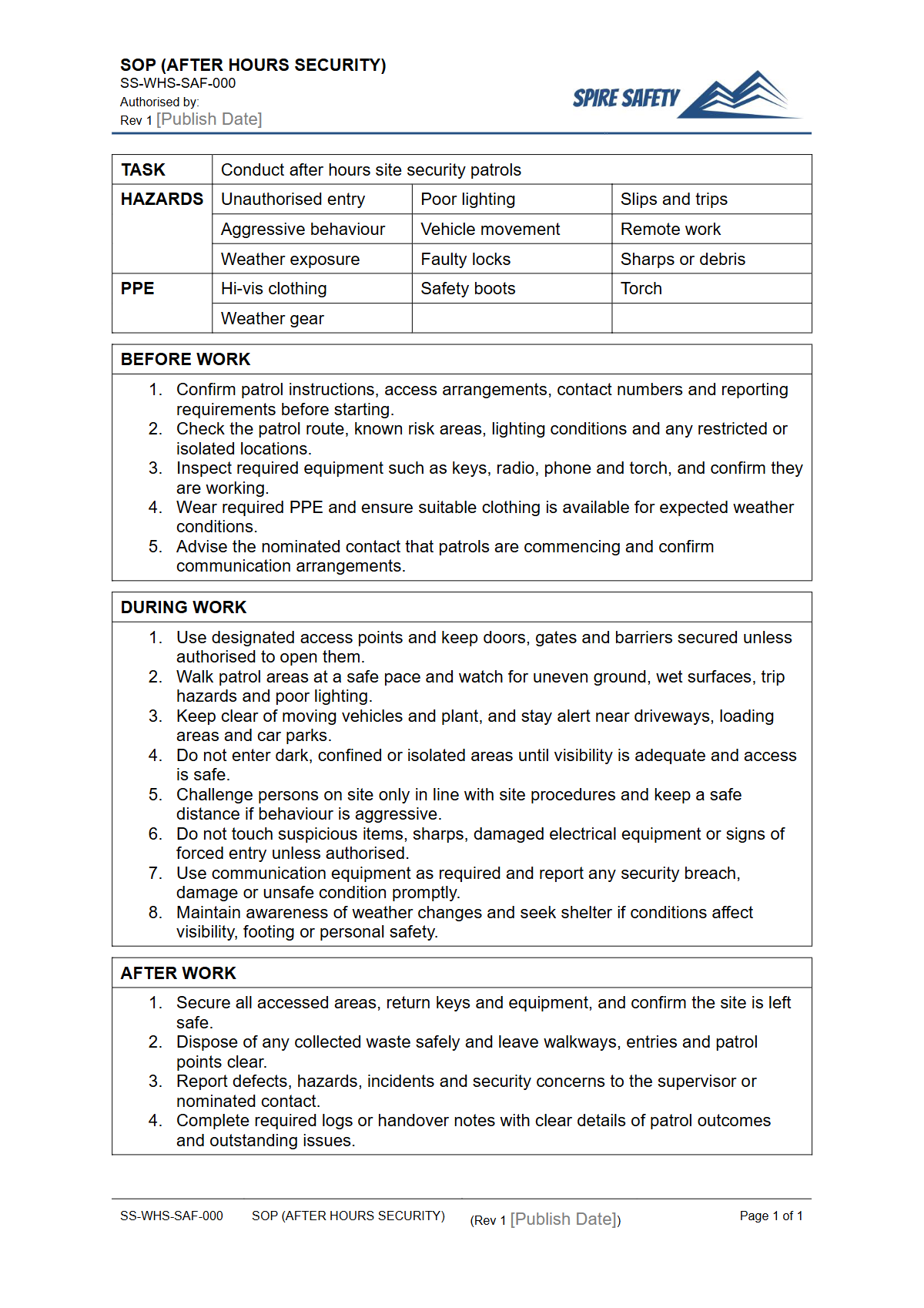
Download our free Safe Operating Procedure (After Hours Security) template. This customisable DOCX & PDF helps you define safe work practices for lone workers.
Free Safe Operating Procedure (After Hours Security) Template
DOCX • 126 KB + PDF
Updated Oct 2026
No signup required
Purpose of the Free Safe Operating Procedure (After Hours Security) Template
Working after hours or alone introduces unique risks that aren't always present during a normal business day. This Free Safe Operating Procedure (After Hours Security) Template provides a structured framework for identifying these risks and outlining clear, safe systems of work for employees.
Its purpose is to help your organisation meet its duty of care by formally documenting procedures for everything from site access and communication protocols to emergency response. By defining these steps, you can significantly reduce the likelihood of incidents and ensure your team knows exactly what to do to stay safe when support staff are not readily available.
A documented SOP is a critical component of a proactive safety culture. It serves as a training tool for employees and a reference point for managers, ensuring consistent and safe work practices are followed across the organisation.
Integrating this procedure into your broader WHS management systems demonstrates a commitment to worker safety and systematic risk management. This procedure helps control hazards associated with lone work, potential security threats, and medical emergencies in isolation.
Video walkthrough
How to use the Free Safe Operating Procedure (After Hours Security) Template
This Safe Operating Procedure for after-hours security is provided as a starting point in both DOCX and PDF formats. It is designed to be adapted to the specific context of your workplace, as no two sites have the exact same layout, risks, or operational needs.
Effective implementation requires careful consideration of your environment and consultation with those who will be following the procedure.
Important: This is a template and must be customised to your specific workplace, equipment, and processes. We recommend a consultation process with your team to ensure all site-specific risks are identified and controlled.
If you require assistance, consider engaging professional WHS consulting services to ensure your documentation is robust and effective.
Key Customisation Steps:
- Risk Assessment: Conduct a thorough risk assessment for all tasks performed after hours. Consider physical security, access control, communication, potential for violence, and emergency scenarios.
- Worker Consultation: Involve employees who work after hours in the development of the SOP. Their firsthand experience is invaluable for identifying practical risks and effective control measures.
- Detail Specific Procedures: Replace generic placeholders with your specific details. This includes contact numbers, designated safe areas, sign-in/out locations, and the exact steps for raising an alarm or reporting an incident.
- Training and Communication: Once finalised, ensure all relevant personnel are trained on the SOP. Keep it in a location that is easily accessible to all staff who may be required to work outside of standard hours.
When to use it
This SOP should be implemented and followed whenever a worker is required to be on-site outside of standard, supervised operating hours. It is particularly relevant for lone workers but also applies to small teams working in isolation.
Common scenarios include facility access for cleaners or maintenance contractors, employees staying late to meet deadlines, IT staff performing system updates, or any situation where the number of people on-site is significantly reduced.
The procedure should be a mandatory part of the work plan for any scheduled after-hours activity. It also serves as a critical reference during emergency situations, providing clear guidance when stress levels are high and immediate action is required. For more procedural templates covering different workplace hazards, you can browse our complete free WHS resources library.
Who should use it
This SOP is intended for use by several key groups within an organisation:
- Persons Conducting a Business or Undertaking (PCBUs): To fulfil their primary duty of care to ensure the health and safety of workers.
- WHS Managers and Safety Officers: To develop, implement, and review safety protocols as part of the overall safety management system.
- Managers and Supervisors: To ensure their team members are aware of, trained on, and adhere to the after-hours procedures before authorising such work.
- Workers and Contractors: To understand their responsibilities and the steps they must take to ensure their own safety and the safety of others while on-site after hours.
Ultimately, the document serves as a control that can be checked and verified. Regular reviews and checks, often as part of a formal WHS compliance auditing program, ensure the procedure remains relevant and is being followed correctly by all parties.
This verification is key to maintaining a safe working environment over the long term.
Common mistakes
Common mistakes to avoid
- Using the template without customising it for the specific workplace layout, entry points, and risks.
- Failing to consult with employees who actually perform the after-hours work.
- Neglecting to establish a reliable and regular communication or check-in system for lone workers.
- Forgetting to train workers on the procedure or make it easily accessible to them.
Legal references
Legal considerations
The following legal requirements may be relevant to this type of work.
- Work Health and Safety Act (Harmonised) — Provides the primary duties for protecting workers and other people from work health and safety risks.
- Work Health and Safety Regulations (Harmonised) — Sets out requirements supporting the management of workplace hazards and risks.
The following codes may be relevant to this type of work.
- Managing WHS Risks Code of Practice — Provides practical guidance on identifying hazards, assessing risks and applying effective controls.
- Work Health and Safety Consultation, Cooperation and Coordination Code of Practice — Provides practical guidance on consulting workers and coordinating with other duty holders.
- Managing the Work Environment and Facilities Code of Practice — Provides practical guidance on safe work environments, workplace facilities and related controls.
Did you know
Consultation is Key
Under Australian WHS law, employers have a legal duty to consult with workers on matters affecting their health and safety. Involving your after-hours team in drafting the SOP is not just good practice—it's a requirement.
Lone Worker Risks
Safe Work Australia identifies lone work as a significant hazard, as workers may be unable to get help in the event of an injury, illness, or incident of violence. A formal communication and check-in procedure is a critical control measure.
FAQ
Frequently asked questions
01What is the main purpose of an after-hours security SOP?
02Is a security SOP a legal requirement in Australia?
03Who is responsible for creating and implementing this procedure?
04How often should an after-hours security procedure be reviewed?
Share this resource
Free Safe Operating Procedure (After Hours Security) Template
Browse Categories
How To Use It
- 1Download and open in Word or PDF.
- 2Replace the placeholders with your business details.
- 3Get it reviewed by a WHS specialist before rollout.
Need it customised?
Our WHS consultants can adapt this template to your site, run a gap analysis, or audit what you already have in place.
Book a Free Consultation WHS consulting servicesor call 1300 156 382
Related templates
- Free Safe Operating Procedure (AHU Filter Change) Template
- Free Safe Operating Procedure (Air Blow Gun) Template
- Free Safe Operating Procedure (Air Chisel) Template
- Free Safe Operating Procedure (Air Curtain Cleaning) Template
- Free Safe Operating Procedure (Air Curtain Operation) Template
- Free Safe Operating Procedure (Air Die Grinder) Template