
Free Safe Operating Procedure (Air Blow Gun) Template
Download our free Safe Operating Procedure (Air Blow Gun) template. This customisable DOCX & PDF provides a solid framework for documenting safe work practices.
Free Safe Operating Procedure (Air Blow Gun) Template
DOCX • 126 KB + PDF
Updated Oct 2026
No signup required
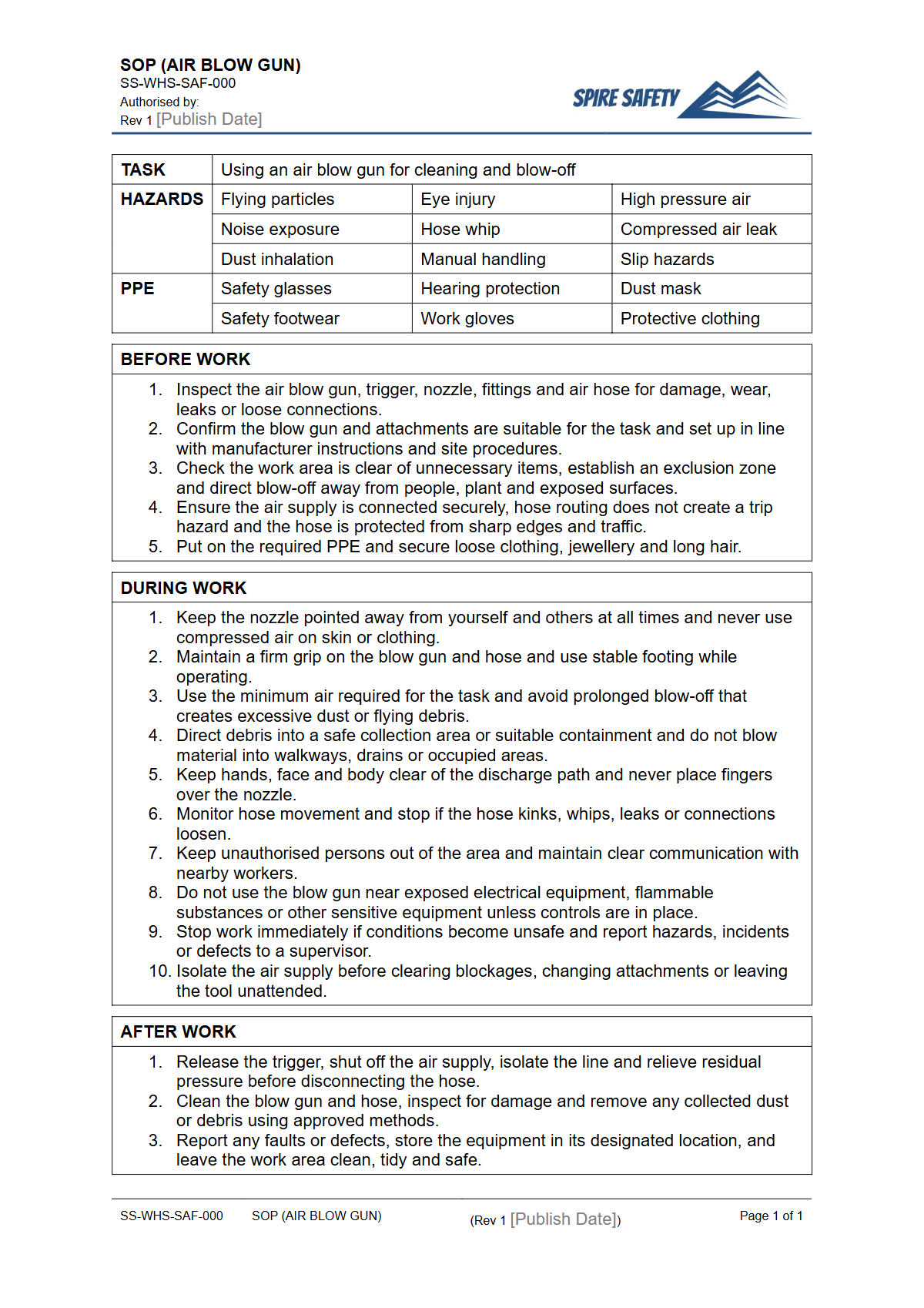
Purpose of the Free Safe Operating Procedure (Air Blow Gun) Template
The primary purpose of this Safe Operating Procedure (Air Blow Gun) template is to provide a clear, step-by-step guide for operators to follow, ensuring tasks are performed safely and consistently. A documented SOP is a critical tool for hazard management, forming a key part of your overall safety system.
It helps your business meet its duty of care under WHS legislation by identifying foreseeable hazards and implementing effective control measures. Using this SOP helps standardise training, provides a reference for supervisors, and demonstrates a commitment to a safe working environment. The procedures for the blow gun are often linked to the equipment that powers it, so you may also benefit from our free Air Compressor SOP template.
Video walkthrough
How to use the Free Safe Operating Procedure (Air Blow Gun) Template
This document is a template and must be customised to reflect the specific equipment, tasks, and environment of your workplace. Download the DOCX file and consult with workers and supervisors who use the equipment daily.
Their input is invaluable for creating a practical and effective procedure.
Important Note
Before use, you must adapt this template to your specific needs. We are not liable for any incidents arising from the use of this document.
It is your responsibility to ensure all procedural details align with your site's unique risks, equipment, and legal obligations. An SOP is most effective when it is part of a comprehensive WHS management system that includes training, supervision, and regular reviews.
When to use it
A Safe Operating Procedure for air blow guns should be a living document, used in several key situations. It must be used as the primary training document for new workers or those unfamiliar with the equipment.
It should be readily accessible in the work area for quick reference by operators before starting a task. Supervisors can use the SOP as a checklist for observing work practices and providing feedback.
It also serves as a critical reference point during incident investigations or when conducting a WHS compliance audit to verify that established safety protocols are being followed.
Who should use it
This SOP is intended for multiple roles within an organisation. Workers and Operators are the primary users; they must understand and follow the procedure to ensure their own safety and the safety of others.
Supervisors and Team Leaders use the SOP to train staff, monitor compliance, and enforce safe work practices. WHS Managers and Personnel use it to develop and standardise safety documentation, conduct risk assessments, and ensure the procedure aligns with broader safety policies. The principles of creating clear, task-specific procedures are universal for common workshop equipment, as seen in our FREE Step Ladder SOP Template.
Key Elements of a Robust Air Blow Gun SOP
A comprehensive SOP for an air blow gun should cover several critical areas to be effective. The template guides you through these sections, including:
- Required Personal Protective Equipment (PPE): Specifies mandatory PPE such as certified safety glasses or goggles, hearing protection, and gloves.
- Pre-Operational Checks: Outlines checks to perform before use, such as inspecting the hose for damage, ensuring secure connections, and verifying the nozzle is a safety-type.
- Step-by-Step Operating Instructions: Details the sequence of actions for safely completing a task, from starting the compressor to directing the air stream away from people and sensitive equipment.
- Post-Operational Procedures: Includes steps for safely shutting down, disconnecting the tool, and storing it correctly.
- Emergency Procedures: Describes the immediate actions to take in case of an injury or equipment malfunction.
Integrating SOPs into Your Safety Culture
A document alone does not create a safe workplace. To be truly effective, your air blow gun SOP must be integrated into your company's safety culture.
This involves comprehensive training for all users, regular toolbox talks to reinforce key safety messages, and a formal review process to update the SOP when equipment, tasks, or regulations change. Encouraging worker feedback and consultation ensures the procedure remains practical and relevant.
If you need assistance developing and embedding these processes, our WHS consulting services can provide expert guidance.
By establishing and maintaining clear, practical Safe Operating Procedures, you build a foundation for a proactive safety culture. Explore our complete free WHS resources library for more templates and guides to support your safety management system.
Common mistakes
Common mistakes to avoid
- Using the air gun to clean dust or debris from skin or clothing, which can cause a life-threatening air embolism.
- Failing to wear mandatory PPE, especially safety glasses, even for 'quick' jobs.
- Using a standard nozzle instead of an engineered safety nozzle, which is designed to prevent 'dead-ending' and regulate pressure.
- Directing the air stream towards other people in the vicinity.
Legal references
Legal considerations
The following legal requirements may be relevant to this type of work.
- Work Health and Safety Act (Harmonised) — Provides the primary duties for protecting workers and other people from work health and safety risks.
- Work Health and Safety Regulations (Harmonised) — Sets out requirements supporting the management of workplace hazards and risks.
The following codes may be relevant to this type of work.
- Managing WHS Risks Code of Practice — Provides practical guidance on identifying hazards, assessing risks and applying effective controls.
- Work Health and Safety Consultation, Cooperation and Coordination Code of Practice — Provides practical guidance on consulting workers and coordinating with other duty holders.
- Managing the Work Environment and Facilities Code of Practice — Provides practical guidance on safe work environments, workplace facilities and related controls.
Did you know
Deadly Pressure
An air pressure of just 12 psi can pop an eyeball from its socket, and as little as 40 psi can rupture eardrums. Most workshop air lines supply pressure well over 90 psi, highlighting the need for regulation and safe use.
The 'Dead-End' Danger
Pressing a standard air gun nozzle directly against a surface (known as 'dead-ending') can build up extreme static pressure, posing a severe risk of the tool or hose failing catastrophically.
FAQ
Frequently asked questions
01Is an air blow gun considered dangerous?
02What is the maximum safe air pressure for cleaning with an air blow gun?
03What PPE is required when using an air blow gun?
04Can I use this template for any type of pneumatic tool?
Share this resource
Free Safe Operating Procedure (Air Blow Gun) Template
Browse Categories
How To Use It
- 1Download and open in Word or PDF.
- 2Replace the placeholders with your business details.
- 3Get it reviewed by a WHS specialist before rollout.
Need it customised?
Our WHS consultants can adapt this template to your site, run a gap analysis, or audit what you already have in place.
Book a Free Consultation WHS consulting servicesor call 1300 156 382
Related templates
- Free Safe Operating Procedure (Air Chisel) Template
- Free Safe Operating Procedure (Air Curtain Cleaning) Template
- Free Safe Operating Procedure (Air Curtain Operation) Template
- Free Safe Operating Procedure (Air Die Grinder) Template
- Free Safe Operating Procedure (Air Diffuser Cleaning) Template
- Free Safe Operating Procedure (Air Fed Respirator) Template