
Free Safe Operating Procedure (Air Chisel) Template
Download our free Safe Operating Procedure (Air Chisel) template. This user-friendly DOCX & PDF provides a solid foundation for managing risks.
Free Safe Operating Procedure (Air Chisel) Template
DOCX • 126 KB + PDF
Updated Oct 2026
No signup required
Purpose of the Free Safe Operating Procedure (Air Chisel) Template
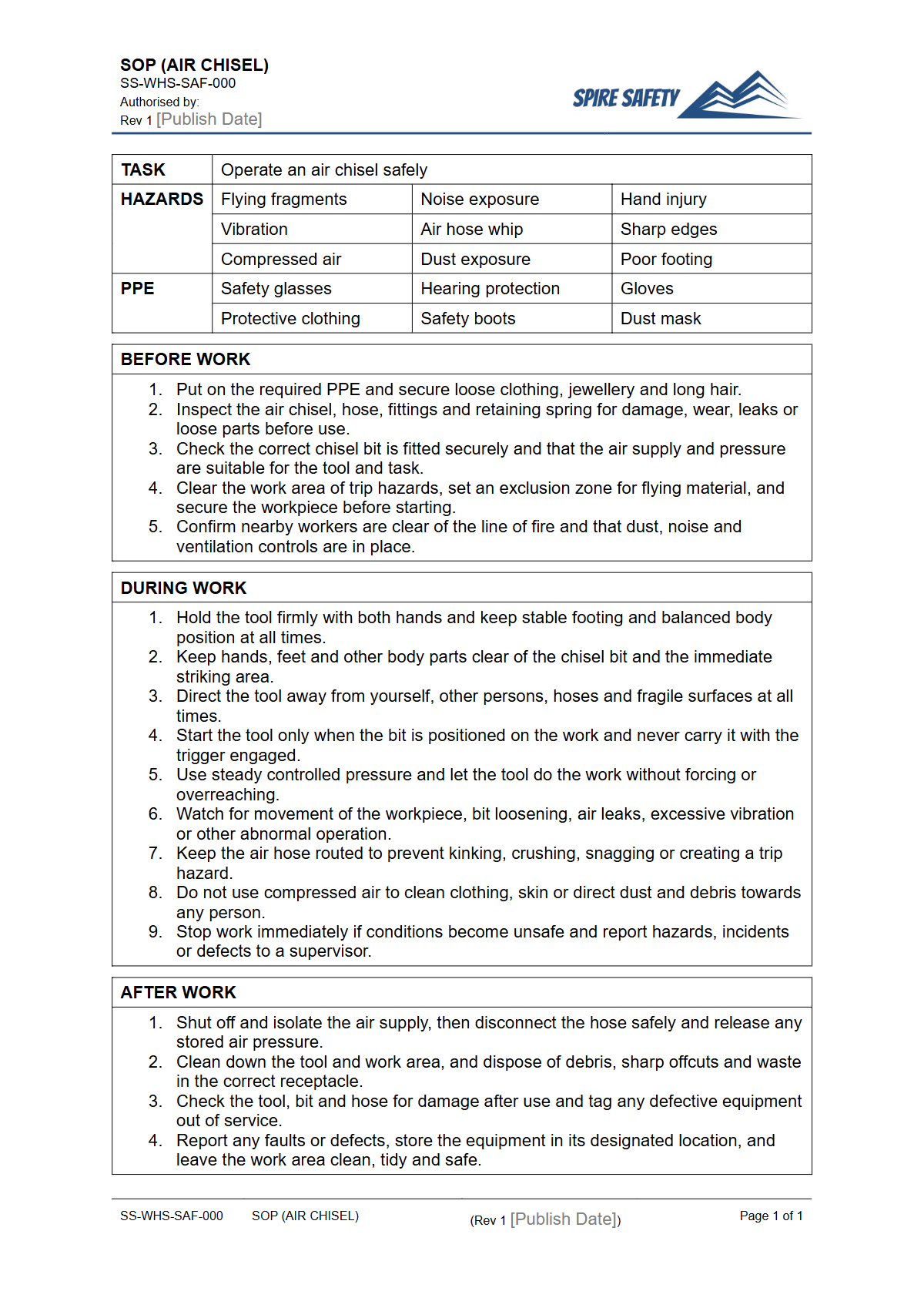
This Safe Operating Procedure (SOP) for air chisels, also known as pneumatic hammers, provides a structured framework for documenting the safest way to perform tasks using this equipment. Its primary purpose is to identify potential hazards and outline clear control measures to minimise the risk of injury to operators and others in the vicinity.
Air chisels present significant risks, including hand-arm vibration, high noise levels, airborne dust, and flying debris. Implementing a formal SOP helps organisations meet their work health and safety obligations by ensuring a consistent and safe approach to the tool's operation.
A well-defined SOP is a critical component of a hazard management strategy. It serves as a practical tool for training, a reference for operators, and evidence of risk management processes.
By standardising procedures, you reduce the likelihood of incidents caused by inconsistent practices or lack of knowledge. This document forms an integral part of broader comprehensive WHS management systems, demonstrating a commitment to proactive safety management.
Video walkthrough
How to use the Free Safe Operating Procedure (Air Chisel) Template
Our free Safe Operating Procedure (Air Chisel) template is designed for ease of use and customisation. Simply download the file in your preferred format (DOCX for easy editing or PDF) and adapt it to your specific operational context.
The document is pre-formatted with key sections that guide you through the process of outlining your site's procedures.
Sections include pre-operational checks, step-by-step operating instructions, and post-operational procedures. You will need to populate these sections with details relevant to your specific air chisel models, the tasks they are used for, and the unique conditions of your work environment.
The most effective SOPs are developed in consultation with the workers who actually use the equipment, as they have firsthand experience with the associated risks.
Important: This document is a template and must be customised to suit your organisation's specific needs. We have provided a structured starting point aligned with Australian WHS practice, but you are responsible for ensuring the final SOP accurately reflects your workplace hazards, equipment, and control measures.
Consultation with your team is essential for creating a practical and effective document.
Key Considerations for Customisation
When adapting this template, pay close attention to the specific hazards associated with air chisel use. Hand-Arm Vibration Syndrome (HAVS) is a serious and irreversible condition caused by prolonged exposure to vibration.
Your SOP should specify time limits for use, recommend the use of anti-vibration gloves, and mandate regular breaks. Noise-induced hearing loss is another significant risk, so stipulating the required class of hearing protection is critical.
The power source for the tool also requires careful management. Ensure your procedures include checks for the pneumatic hose and its connections to prevent whipping or sudden failure.
This SOP should be used in conjunction with a free Air Compressor SOP to cover the entire system safely. Furthermore, consider the material being worked on.
Tasks involving concrete, stone, or materials containing crystalline silica require specific dust control measures, such as on-tool water suppression or extraction, and appropriate respiratory protection.
Integrating with Other Safety Procedures
An SOP for a single piece of equipment rarely exists in isolation. It should be integrated with your overall site safety plan.
For example, if the air chisel is used for fabrication tasks, it should align with the procedures for other equipment, such as your Plasma Cutter SOP (Safe Operating Procedure). For tasks requiring work at height, ensure you also have a Safe Operating Procedure for step ladder use to address fall hazards. This holistic approach ensures that safety is managed across the entire task, not just one part of it.
When to use an Air Chisel SOP
A Safe Operating Procedure for an air chisel should be used in several key situations. It is an essential document for training new or inexperienced operators, providing them with clear, step-by-step guidance.
It should also be readily available in the work area as a quick reference for all workers. The SOP is a foundational document for conducting task-specific risk assessments and should be reviewed and updated whenever a new model of air chisel is introduced, a task changes, or after an incident or near miss occurs.
Regular reviews as part of your WHS compliance auditing program ensure it remains current and effective.
Who should use it
This SOP is intended for a range of personnel within an organisation. Supervisors and managers use it to train staff and to monitor and enforce safe work practices.
Operators (workers) use it as their guide to performing their job safely. WHS personnel and safety committees use it to formalise risk controls and as a benchmark for workplace inspections and audits.
By involving all these groups in the development and review of the SOP, you foster a stronger safety culture where everyone understands their role in preventing injury. You can find more templates like this in our free WHS resources library to support your team.
Common mistakes
Common mistakes to avoid
- Using the incorrect type or size of chisel bit for the task, leading to tool failure or ineffective work.
- Failing to conduct pre-start checks on the air hose and couplings, creating a risk of high-pressure hose whip.
- Neglecting to wear appropriate PPE, especially anti-vibration gloves and hearing protection.
- Not securing the work area to protect bystanders from flying debris ejected during operation.
Legal references
Legal considerations
The following legal requirements may be relevant to this type of work.
- Work Health and Safety Act (Harmonised) — Provides the primary duties for protecting workers and other people from work health and safety risks.
- Work Health and Safety Regulations (Harmonised) — Sets out requirements supporting the management of workplace hazards and risks.
The following codes may be relevant to this type of work.
- Managing WHS Risks Code of Practice — Provides practical guidance on identifying hazards, assessing risks and applying effective controls.
- Work Health and Safety Consultation, Cooperation and Coordination Code of Practice — Provides practical guidance on consulting workers and coordinating with other duty holders.
- Managing the Work Environment and Facilities Code of Practice — Provides practical guidance on safe work environments, workplace facilities and related controls.
Did you know
Vibration Exposure
The vibration from tools like air chisels can permanently damage nerves and blood vessels in the hands and arms. This condition, Hand-Arm Vibration Syndrome (HAVS), is preventable but not curable.
Noise Levels
A typical air chisel can operate at over 110 decibels (dB), which is well above the Australian workplace exposure standard of 85 dB. Unprotected exposure can cause permanent hearing loss in a very short amount of time.
FAQ
Frequently asked questions
01What personal protective equipment (PPE) is required when using an air chisel?
02Is specific training required to operate an air chisel?
03How can the risk of Hand-Arm Vibration Syndrome (HAVS) be managed?
04How often should a Safe Operating Procedure be reviewed?
Share this resource
Free Safe Operating Procedure (Air Chisel) Template
Browse Categories
How To Use It
- 1Download and open in Word or PDF.
- 2Replace the placeholders with your business details.
- 3Get it reviewed by a WHS specialist before rollout.
Need it customised?
Our WHS consultants can adapt this template to your site, run a gap analysis, or audit what you already have in place.
Book a Free Consultation WHS consulting servicesor call 1300 156 382
Related templates
- Free Safe Operating Procedure (Air Curtain Cleaning) Template
- Free Safe Operating Procedure (Air Curtain Operation) Template
- Free Safe Operating Procedure (Air Die Grinder) Template
- Free Safe Operating Procedure (Air Diffuser Cleaning) Template
- Free Safe Operating Procedure (Air Fed Respirator) Template
- Free Safe Operating Procedure (Air Grease Gun) Template