
Free Safe Operating Procedure (Aerosol Can Puncture) Template
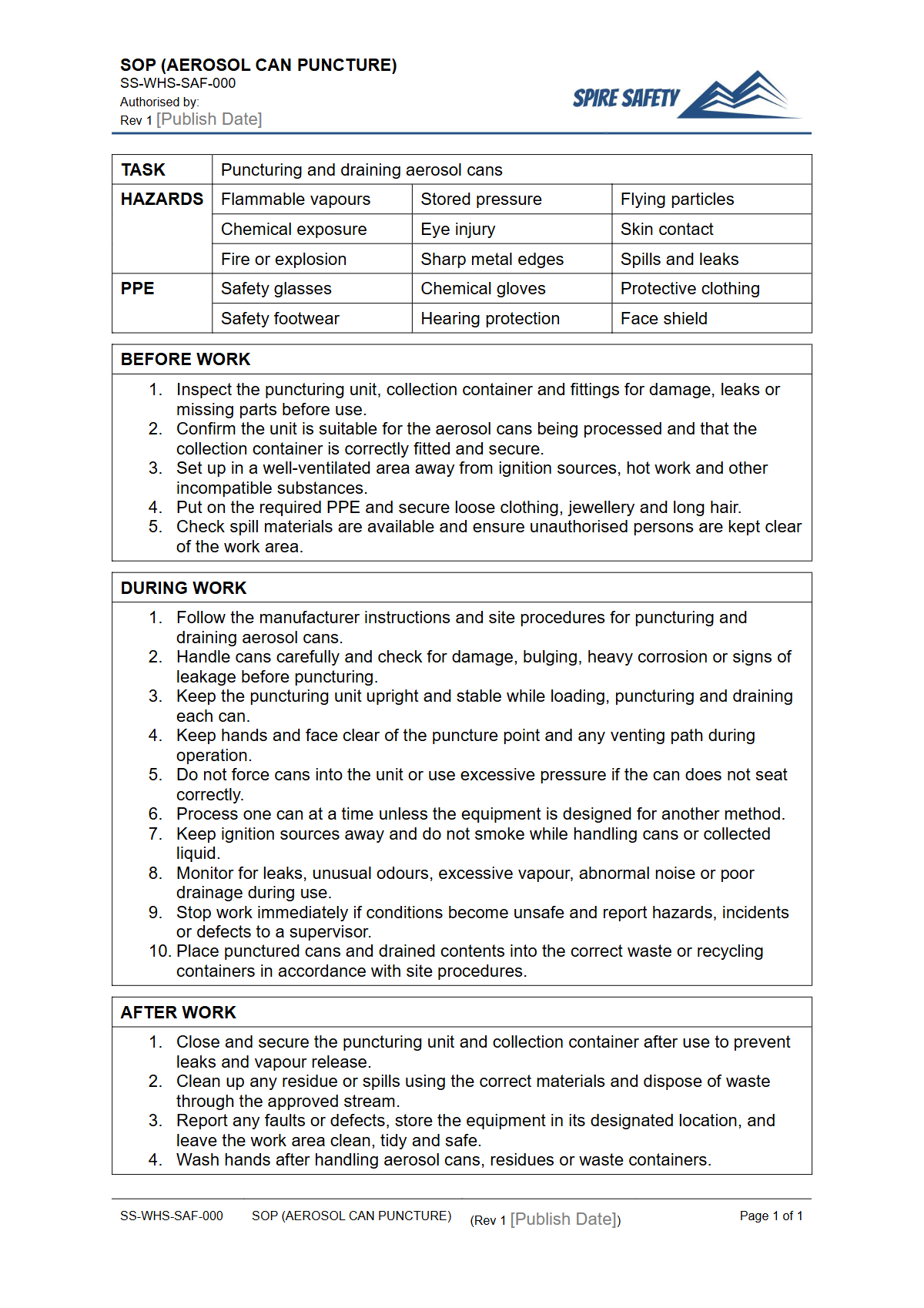
Download our free Safe Operating Procedure (Aerosol Can Puncture) template. This Word & PDF resource helps you outline safe work steps for this hazardous task.
Free Safe Operating Procedure (Aerosol Can Puncture) Template
DOCX • 126 KB + PDF
Updated Oct 2026
No signup required
Purpose of the Free Safe Operating Procedure (Aerosol Can Puncture) Template
Puncturing aerosol cans is a hazardous task that requires strict controls to prevent fire, explosion, chemical exposure, and injury. This Free Safe Operating Procedure (Aerosol Can Puncture) Template provides a structured framework for documenting the specific steps and precautions necessary for this activity.
Using a formal SOP helps your organisation standardise its process, ensuring every worker understands the risks and required control measures. It serves as a vital tool for worker training, competency assessment, and supervision.
A documented procedure is a cornerstone of a proactive safety culture and is essential for managing high-risk activities effectively. It forms a key part of your risk assessment process, demonstrating that you have identified hazards and implemented controls to manage them so far as is reasonably practicable.
This SOP is a fundamental component within broader comprehensive WHS management systems, helping to formalise and communicate your organisation's safety expectations.
Video walkthrough
How to use the Free Safe Operating Procedure (Aerosol Can Puncture) Template
This template is provided in both DOCX and PDF formats for your convenience. To use it, download the file and systematically work through each section, adding details specific to your workplace.
This includes identifying the exact make and model of the can puncturing device, the types of aerosol products being processed, and the personal protective equipment (PPE) required.
It is crucial to involve workers who perform the task in the development and review of the SOP. Their practical experience is invaluable for creating a procedure that is both safe and workable.
Once completed, the SOP should be formally approved, communicated to all relevant personnel, and made readily accessible at the point of work. Regular reviews are necessary to ensure it remains current with any changes in equipment, chemicals, or regulations.
Please note: This document is a template and must be customised to your specific workplace. We are not responsible for the outcomes of its use.
You must adapt it to reflect the unique hazards, equipment, products, and control measures present in your operational environment. Always consult the Safety Data Sheet (SDS) for any chemical product being handled.
Key Hazards of Puncturing Aerosol Cans
Understanding the specific hazards is the first step in controlling them. Puncturing aerosol cans can introduce several serious risks, including:
- Fire and Explosion: Many aerosol products use flammable propellants like butane or propane. Releasing this gas near an ignition source (sparks from tools, static electricity, open flames) can cause a fire or explosion.
- Chemical Exposure: The contents of the can (e.g., paints, solvents, pesticides) can be hazardous. Puncturing can release these substances as a spray or mist, leading to inhalation, skin contact, or eye absorption.
- Projectile Injury: If a can is not properly secured or is over-pressurised, it or parts of the puncturing device can become projectiles, posing a significant impact risk to the eyes and body.
- Environmental Contamination: Improper disposal of residual contents can contaminate soil and water systems.
Controlling these hazards requires a multi-faceted approach, including correct equipment use, adequate ventilation, and appropriate PPE. Documenting these controls in an SOP, similar to how one might create a free Air Compressor SOP for other workshop equipment, ensures consistency and safety.
When to Use This Safe Operating Procedure
This Safe Operating Procedure should be developed, implemented, and followed before any worker undertakes the task of mechanically puncturing aerosol cans. It is particularly important for workplaces that generate a significant volume of aerosol can waste, such as automotive workshops, manufacturing facilities, and maintenance departments.
It should be used as the primary reference document for training new workers and for conducting regular refresher training for experienced staff. The SOP also serves as a critical reference during incident investigations and safety audits.
Having this formal process is a key part of demonstrating safety diligence, which can be formally checked through a WHS compliance audit. It provides clear, unambiguous instructions that eliminate guesswork and informal 'rules of thumb' that can lead to incidents. Furthermore, if your workshop uses a variety of tools, you might find it beneficial to standardise procedures for other equipment, such as by using a Plasma Cutter SOP template for high-energy cutting tasks.
Who Should Use This SOP
This SOP is intended for use by several key groups within an organisation:
- Workers: The primary users are the individuals who physically perform the can puncturing task. They must follow the procedure step-by-step to ensure their own safety and the safety of others.
- Supervisors and Team Leaders: Managers are responsible for ensuring workers are trained on the SOP, have access to it, and follow it correctly. They use it as a tool for supervision and for correcting unsafe behaviour.
- WHS/HSE Managers: Safety professionals use the SOP as a formal record of risk control for a specific hazardous task. It forms part of the overall safety management system and is a key document for demonstrating regulatory alignment.
Developing robust safety documents can sometimes require specialist knowledge. If you are unsure about the specific risks or control measures for your operations, seeking advice from a WHS consulting professional can provide valuable external perspective and ensure your procedures are thorough.
You can also explore our full range of document templates and safety guides in our free WHS resources library to support your safety program.
Common mistakes
Common mistakes to avoid
- Puncturing cans in a poorly ventilated area or near ignition sources like grinders or welding equipment.
- Failing to consult the Safety Data Sheet (SDS) to understand the specific chemical and flammability hazards.
- Using makeshift tools (e.g., a hammer and nail) instead of a purpose-built, earthed can puncturing device.
- Incorrectly segregating waste, such as mixing residual liquids or disposing of non-empty cans in general waste.
Legal references
Legal considerations
The following legal requirements may be relevant to this type of work.
- Work Health and Safety Act (Harmonised) — Provides the primary duties for protecting workers and other people from work health and safety risks.
- Work Health and Safety Regulations (Harmonised) — Sets out requirements supporting the management of workplace hazards and risks.
The following codes may be relevant to this type of work.
- Managing WHS Risks Code of Practice — Provides practical guidance on identifying hazards, assessing risks and applying effective controls.
- Work Health and Safety Consultation, Cooperation and Coordination Code of Practice — Provides practical guidance on consulting workers and coordinating with other duty holders.
- Managing the Work Environment and Facilities Code of Practice — Provides practical guidance on safe work environments, workplace facilities and related controls.
Did you know
Propellant Power
Many aerosol propellants, like propane and butane, are highly flammable Liquid Petroleum Gases (LPGs). A single can may contain enough gas to create a significant fire risk if released in a confined, unventilated space near an ignition source.
Recycling Rules
Punctured and empty steel or aluminium aerosol cans are often recyclable. However, local council regulations vary, so always check their specific requirements for disposal before adding them to your recycling stream.
FAQ
Frequently asked questions
01Is it legal to puncture aerosol cans in Australia?
02What is the main danger of puncturing an aerosol can?
03What PPE is required for puncturing aerosol cans?
04Can I use this SOP template for any type of aerosol can?
Share this resource
Free Safe Operating Procedure (Aerosol Can Puncture) Template
Browse Categories
How To Use It
- 1Download and open in Word or PDF.
- 2Replace the placeholders with your business details.
- 3Get it reviewed by a WHS specialist before rollout.
Need it customised?
Our WHS consultants can adapt this template to your site, run a gap analysis, or audit what you already have in place.
Book a Free Consultation WHS consulting servicesor call 1300 156 382
Related templates
- Free Safe Operating Procedure (After Hours Dispatch) Template
- Free Safe Operating Procedure (After Hours Security) Template
- Free Safe Operating Procedure (AHU Filter Change) Template
- Free Safe Operating Procedure (Air Blow Gun) Template
- Free Safe Operating Procedure (Air Chisel) Template
- Free Safe Operating Procedure (Air Curtain Cleaning) Template