
Free Safe Operating Procedure (After Hours Dispatch) Template
Our free Safe Operating Procedure for after-hours dispatch helps manage key risks like lone work and fatigue. Customise the DOCX or PDF for your team.
Free Safe Operating Procedure (After Hours Dispatch) Template
DOCX • 126 KB + PDF
Updated Oct 2026
No signup required
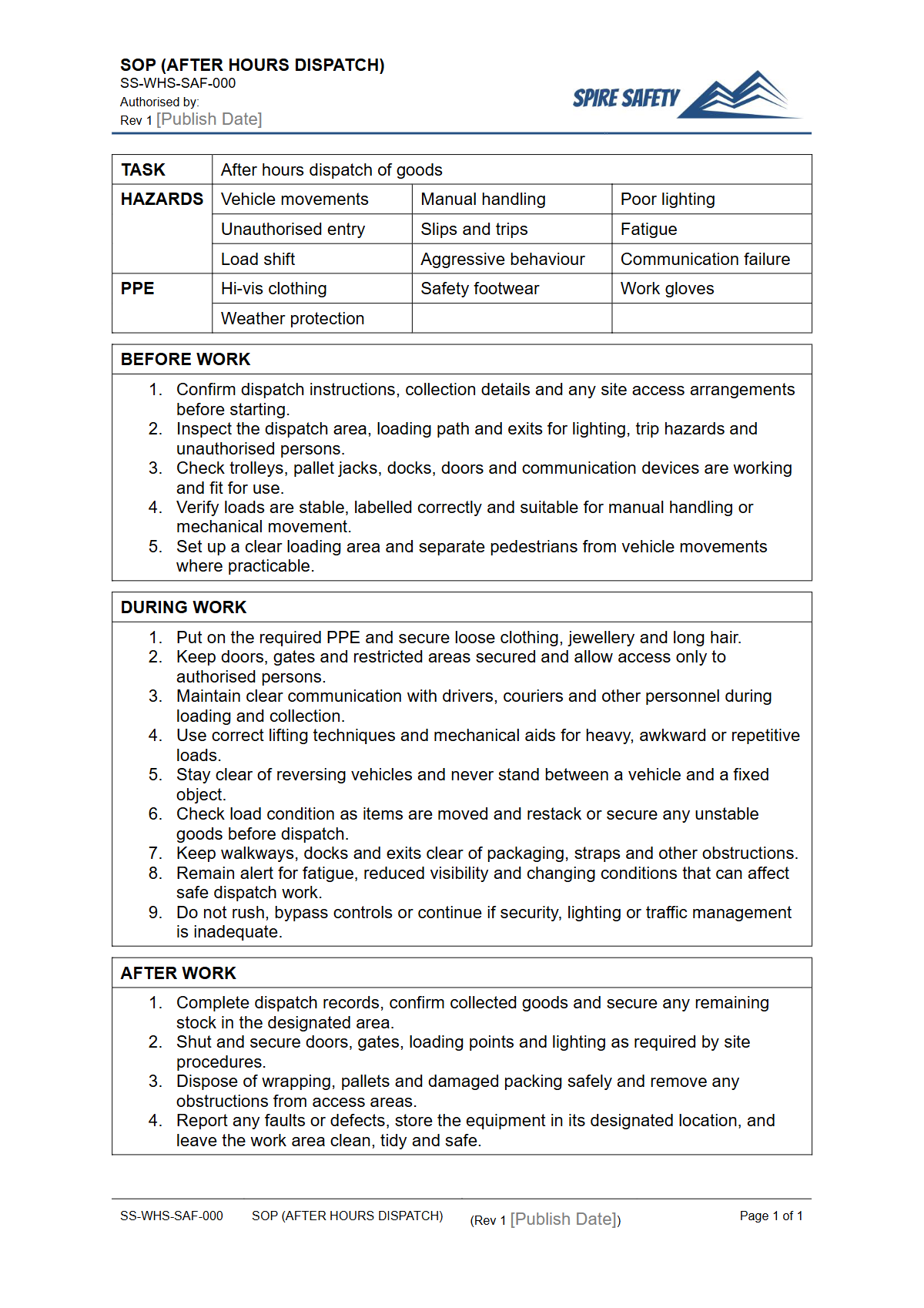
Purpose of the Free Safe Operating Procedure (After Hours Dispatch) Template
Dispatching goods outside of standard business hours introduces unique workplace health and safety risks. This includes lone work, fatigue, inadequate lighting, and increased security concerns.
A formalised, documented procedure is essential for managing these hazards effectively. This free Safe Operating Procedure (After Hours Dispatch) template provides a structured starting point for your business to establish and communicate safe work methods for all after-hours logistics tasks.
Using a clear SOP helps you meet your duty of care as a PCBU (Person Conducting a Business or Undertaking) by ensuring workers are provided with the necessary information and instruction to work safely. It serves as a critical component within broader WHS management systems, demonstrating a commitment to proactive risk management for non-routine operations.
Video walkthrough
How to use the Free Safe Operating Procedure (After Hours Dispatch) Template
This template is designed to be a comprehensive but generic foundation. To make it effective, you must adapt it to the specific circumstances of your workplace.
Download the resource in your preferred format (DOCX or PDF) and work through each section, adding or removing information to align with your site, equipment, products, and personnel. The goal is to create a document that is practical and easily understood by your workers.
We strongly recommend consulting with your workers during the customisation process. Their direct experience is invaluable for identifying all potential hazards and developing workable controls.
Once customised, the SOP should be used for training, inductions, and as an on-the-job reference for anyone involved in after-hours dispatch. For other task-specific procedures, you might require a dedicated SOP for a body truck or other relevant vehicles.
A Note on Customisation
This document is a template, not a finished product. We have provided a structured framework based on Australian WHS principles, but you must ensure the final document accurately reflects the specific hazards and control measures relevant to your business operations.
Liability for workplace health and safety rests with the PCBU, and effective safety management requires procedures tailored to your unique environment.
When to Use This SOP
This Safe Operating Procedure should be implemented for any task related to the dispatch of goods that occurs outside of your organisation's normal operating hours. This includes evening, night, and weekend shifts where staffing levels may be reduced and supervision is less direct.
Key activities covered would typically include preparing goods for dispatch, loading vehicles, completing paperwork, and securing the premises after the task is complete.
It is particularly crucial when high-risk machinery is involved, such as when using forklifts or managing the safe operation of a telehandler in low-light conditions. The SOP provides a clear, repeatable process to follow, which helps reduce the chance of errors and incidents when workers may be experiencing fatigue.
Who Should Use It
This procedure is intended for all personnel involved in the after-hours dispatch process. This includes warehouse operators, forklift drivers, logistics coordinators, truck drivers, and any supervisors overseeing these activities.
It serves as a vital training tool during employee inductions and for refresher training to ensure consistent, safe practices are maintained across all shifts.
WHS managers and supervisors should use the finalised SOP as a benchmark for monitoring performance and conducting workplace inspections. It forms part of a worker's general safety competency, alongside other basic procedures like those outlined in a step ladder SOP for simple warehouse tasks.
Key Elements of an After-Hours Dispatch SOP
A robust SOP for this task should clearly outline several key areas to ensure all risks are considered. Our template includes sections for:
- Required PPE: Specifies mandatory personal protective equipment, such as high-visibility clothing, safety footwear, and gloves.
- Risk Assessment: Identifies potential hazards like slips and trips, fatigue, manual handling, vehicle movement, and security threats.
- Pre-Operational Checks: Details checks for equipment, lighting, and site security before work commences.
- Step-by-Step Procedure: A logical sequence of tasks from receiving the dispatch order to finalising the load and locking up.
- Communication Protocols: Defines procedures for lone worker check-ins and contact methods.
- Emergency Procedures: Outlines clear steps to take in case of an incident, injury, or security breach.
These documented elements provide clear criteria that can be checked during internal or external WHS compliance audits to verify that safety processes are being correctly implemented and followed.
Beyond the Template
A document alone does not create a safe workplace. This SOP must be supported by adequate worker training, effective supervision, and a positive safety culture.
Regularly review the procedure—especially after any incident or near-miss—to ensure it remains current and effective. For more tools to build out your safety system, explore our complete free WHS resources library.
Common mistakes
Common mistakes to avoid
- Using the template without customising it for the specific site, vehicles, and products.
- Forgetting to include clear emergency and communication procedures for lone workers.
- Failing to train all relevant staff, including casuals and shift workers, on the finalised SOP.
- Not reviewing the SOP after a near-miss or when a process changes.
Legal references
Legal considerations
The following legal requirements may be relevant to this type of work.
- Work Health and Safety Act (Harmonised) — Provides the primary duties for protecting workers and other people from work health and safety risks.
- Work Health and Safety Regulations (Harmonised) — Sets out requirements supporting the management of workplace hazards and risks.
The following codes may be relevant to this type of work.
- Managing WHS Risks Code of Practice — Provides practical guidance on identifying hazards, assessing risks and applying effective controls.
- Work Health and Safety Consultation, Cooperation and Coordination Code of Practice — Provides practical guidance on consulting workers and coordinating with other duty holders.
- Managing the Work Environment and Facilities Code of Practice — Provides practical guidance on safe work environments, workplace facilities and related controls.
Did you know
Night Work Risks
Safe Work Australia data indicates that working at night or in the evening is associated with a higher rate of injury compared to day work, highlighting the need for robust, task-specific safety procedures for after-hours operations.
FAQ
Frequently asked questions
01What is the difference between a Safe Operating Procedure (SOP) and a Safe Work Method Statement (SWMS)?
02Why is an SOP specifically needed for after-hours work?
03How often should we review our After Hours Dispatch SOP?
04Does this template cover fatigue management?
Share this resource
Free Safe Operating Procedure (After Hours Dispatch) Template
Browse Categories
How To Use It
- 1Download and open in Word or PDF.
- 2Replace the placeholders with your business details.
- 3Get it reviewed by a WHS specialist before rollout.
Need it customised?
Our WHS consultants can adapt this template to your site, run a gap analysis, or audit what you already have in place.
Book a Free Consultation WHS consulting servicesor call 1300 156 382
Related templates
- Free Safe Operating Procedure (After Hours Security) Template
- Free Safe Operating Procedure (AHU Filter Change) Template
- Free Safe Operating Procedure (Air Blow Gun) Template
- Free Safe Operating Procedure (Air Chisel) Template
- Free Safe Operating Procedure (Air Curtain Cleaning) Template
- Free Safe Operating Procedure (Air Curtain Operation) Template