
Free Safe Operating Procedure (Acid Cleaning) Template
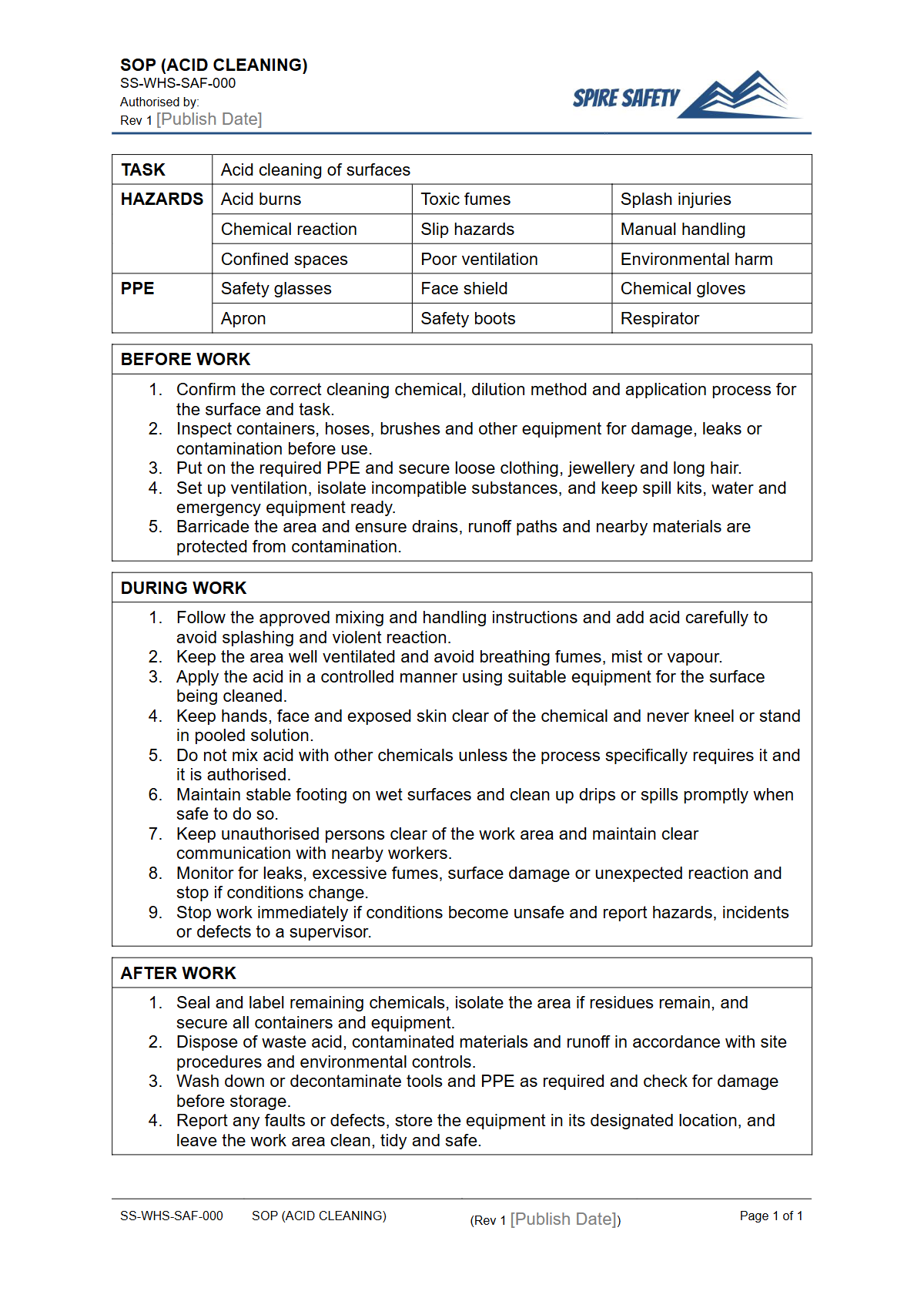
Download our free Safe Operating Procedure (SOP) template for acid cleaning. This customisable DOCX and PDF helps you document risks and controls.
Free Safe Operating Procedure (Acid Cleaning) Template
DOCX • 126 KB + PDF
Updated Oct 2026
No signup required
Purpose of the Free Safe Operating Procedure (Acid Cleaning) Template
This free Safe Operating Procedure (Acid Cleaning) Template provides a structured starting point for organisations to document the required steps for safely performing cleaning tasks with acidic solutions. Working with acids, which are hazardous chemicals, poses significant risks, including severe burns, respiratory damage from fumes, and environmental contamination if not handled correctly.
This template is designed to help you formalise control measures and provide clear instructions to workers, forming a critical component of a safe system of work.
Using a standardised SOP helps ensure that all workers follow the same approved process, reducing the likelihood of incidents caused by procedural errors or lack of knowledge. A well-drafted procedure covers key areas such as hazard identification, required Personal Protective Equipment (PPE), pre-operational checks, step-by-step instructions for the task, and emergency response actions.
Integrating such procedures is a fundamental part of developing robust WHS management systems that protect your people and ensure operational consistency.
Video walkthrough
How to use the Free Safe Operating Procedure (Acid Cleaning) Template
To get started, download the template in your preferred format (DOCX or PDF). The document is structured based on the model WHS framework and common Australian industry practices, but it is not a finished document.
You must adapt it to the specific context of your workplace to ensure it is effective and relevant.
IMPORTANT: This document is a template and must be customised for your specific workplace. We recommend a competent person, in consultation with workers who perform the task, reviews and tailors the content to reflect your unique equipment, the specific acids used (including their concentration), existing controls, and site-specific emergency procedures.
Review every section and replace the placeholder text with your site-specific information. This includes detailing the exact types of PPE, the location of safety showers and eyewash stations, and the correct procedures for neutralising and disposing of waste acid.
The final document should be reviewed and approved as part of a regular WHS compliance auditing program to ensure it remains current.
When to use an Acid Cleaning Safe Operating Procedure
An SOP for acid cleaning should be used any time an employee or contractor is required to perform a task using acidic solutions. This is not limited to large-scale industrial processes; it applies to any task where there is a risk of exposure.
Common applications include descaling industrial equipment, cleaning concrete or masonry, preparing metal surfaces for painting or welding, and certain types of facility maintenance.
The procedure should be treated as a live document, readily accessible to workers at or near the location where the task is performed. It should be used during worker training and induction, for refresher training, and as a reference tool before starting work. If the cleaning task involves working at heights, even minor ones, additional procedures and risk assessments are necessary, like those detailed in our FREE Step Ladder SOP Template.
Who should use this SOP
This Safe Operating Procedure is intended for several groups within an organisation. Primarily, it is for the operators—the workers who physically carry out the acid cleaning tasks.
They must be trained in the SOP and have its steps demonstrated to them to ensure competency. Supervisors and managers should also use the SOP to oversee the work, conduct safety observations, and verify that the documented procedures are being followed correctly.
WHS professionals and managers can use this template to standardise safety protocols across different teams or sites. Establishing consistent, documented procedures for high-risk tasks is a key responsibility for a Person Conducting a Business or Undertaking (PCBU).
Just as you would document procedures for operating machinery using a resource like our FREE Plasma Cutter SOP (Safe Operating Procedure) Template, chemical handling tasks demand the same level of documented diligence. For expert assistance in developing and implementing these crucial documents, consider engaging professional WHS consulting services.
Key Safety Considerations
Before any acid cleaning task, a thorough risk assessment must be conducted. The hierarchy of controls should always be applied, prioritising elimination or substitution where possible.
For example, could a less hazardous cleaning method or chemical be used? Engineering controls, such as local exhaust ventilation to remove fumes, are critical.
Administrative controls include this SOP, clear signage, and robust training. Finally, specific, chemical-resistant PPE is the last line of defence.
Always consult the Safety Data Sheet (SDS) for the specific acid being used to determine appropriate controls and PPE.
Documenting safety procedures is essential for consistency across all high-risk workshop activities, whether it involves chemical handling or advanced fabrication. For instance, tasks that might seem safer than acid cleaning still carry significant risks that must be managed, as shown in our FREE Waterjet Cutter SOP Template. By documenting processes for all hazardous tasks, you create a comprehensive safety framework.
You can explore more procedural templates in our free WHS resources library to build out your organisation's safety documentation.
Common mistakes
Common mistakes to avoid
- Failing to consult the specific Safety Data Sheet (SDS) for the acid being used.
- Using incorrect or damaged Personal Protective Equipment (PPE), especially gloves and eye protection.
- Performing acid cleaning in a poorly ventilated area, leading to inhalation of corrosive fumes.
- Improperly neutralising and disposing of waste acid, causing environmental damage and creating new hazards.
Legal references
Legal considerations
The following legal requirements may be relevant to this type of work.
- Work Health and Safety Act (Harmonised) — Provides the primary duties for protecting workers and other people from work health and safety risks.
- Work Health and Safety Regulations (Harmonised) — Sets out requirements supporting the management of workplace hazards and risks.
The following codes may be relevant to this type of work.
- Managing WHS Risks Code of Practice — Provides practical guidance on identifying hazards, assessing risks and applying effective controls.
- Work Health and Safety Consultation, Cooperation and Coordination Code of Practice — Provides practical guidance on consulting workers and coordinating with other duty holders.
- Managing the Work Environment and Facilities Code of Practice — Provides practical guidance on safe work environments, workplace facilities and related controls.
Did you know
SDS is Key
The Safety Data Sheet (SDS) for a hazardous chemical is not just a suggestion; under Australian WHS laws, it is a mandatory document that must be accessible to any worker who may be exposed to the substance.
Not All Gloves Are Equal
Using the wrong type of glove when handling acids can be more dangerous than using no gloves at all, as the acid can be trapped against the skin. The SDS specifies the correct material for chemical-resistant gloves, such as nitrile, neoprene, or butyl rubber.
FAQ
Frequently asked questions
01What is a Safe Operating Procedure for acid cleaning?
02Is this acid cleaning SOP template ready to use immediately?
03What other controls are needed besides an SOP for acid cleaning?
04How often should a Safe Operating Procedure for acid cleaning be reviewed?
Share this resource
Free Safe Operating Procedure (Acid Cleaning) Template
Browse Categories
How To Use It
- 1Download and open in Word or PDF.
- 2Replace the placeholders with your business details.
- 3Get it reviewed by a WHS specialist before rollout.
Need it customised?
Our WHS consultants can adapt this template to your site, run a gap analysis, or audit what you already have in place.
Book a Free Consultation WHS consulting servicesor call 1300 156 382
Related templates
- Free Safe Operating Procedure (Acid Transfer) Template
- Free Safe Operating Procedure (Adhesive Mixing) Template
- Free Safe Operating Procedure (Adult Change Table) Template
- Free Safe Operating Procedure (Aerosol Can Puncture) Template
- Free Safe Operating Procedure (After Hours Dispatch) Template
- Free Safe Operating Procedure (After Hours Security) Template