
Free Safe Operating Procedure (Acid Transfer) Template
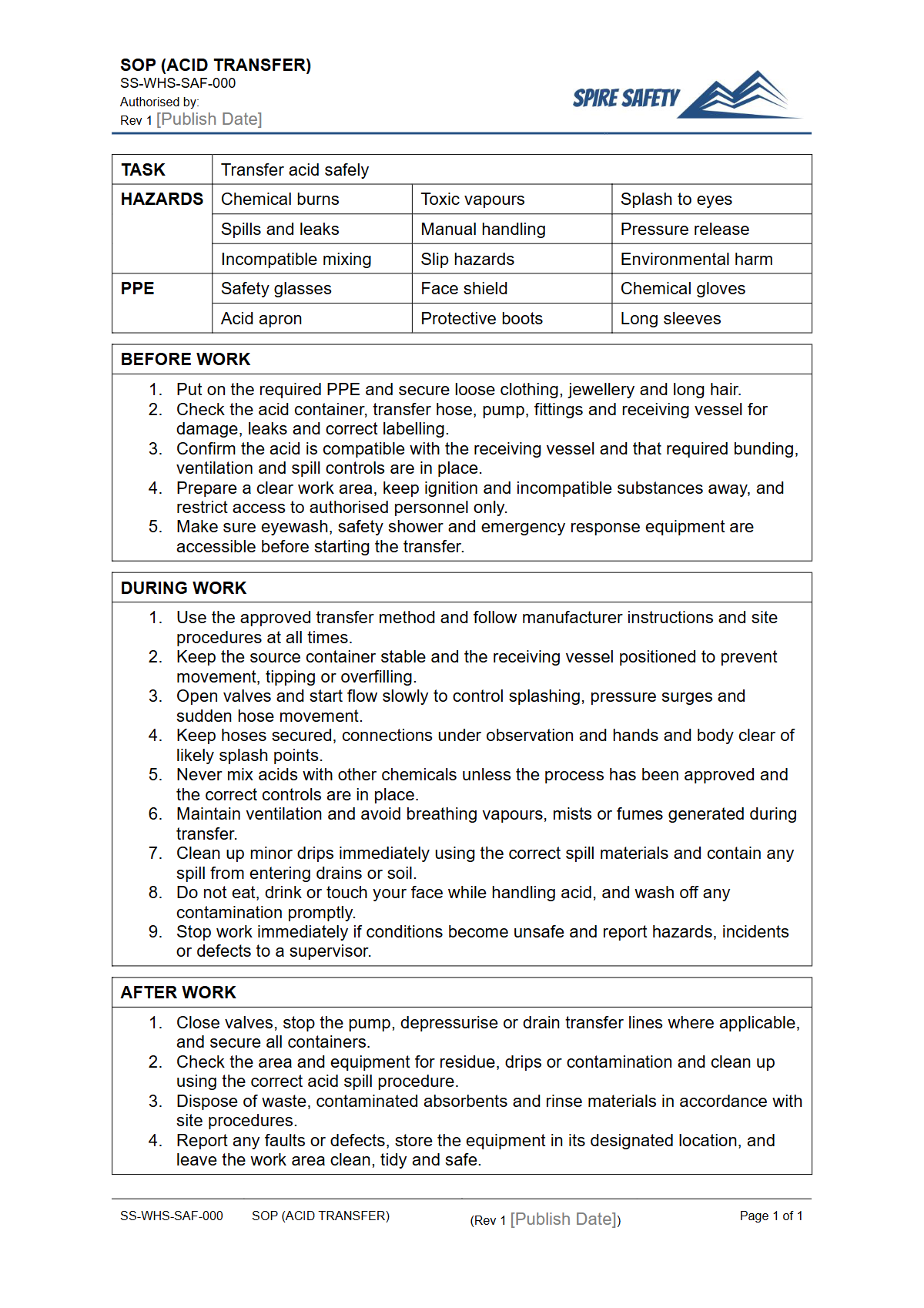
Download our free Safe Operating Procedure (Acid Transfer) template. This customisable DOCX and PDF provides a structured guide for safely handling acids.
Free Safe Operating Procedure (Acid Transfer) Template
DOCX • 126 KB + PDF
Updated Oct 2026
No signup required
Purpose of the Free Safe Operating Procedure (Acid Transfer) Template
Handling and transferring acids are high-risk activities that can lead to severe chemical burns, respiratory damage, and environmental contamination if not managed correctly. This free Safe Operating Procedure (Acid Transfer) Template provides a structured framework for documenting the safe methods required to perform this hazardous task.
Its primary purpose is to minimise risk by outlining essential safety controls, required Personal Protective Equipment (PPE), step-by-step instructions, and emergency response actions.
By implementing a detailed Safe Operating Procedure (SOP), your organisation can ensure that all personnel are aware of the hazards and follow a consistent, safe process every time. This document is a critical component of a compliant WHS management system, demonstrating a commitment to protecting workers from the risks associated with corrosive substances.
Video walkthrough
How to use the Free Safe Operating Procedure (Acid Transfer) Template
This downloadable document is provided in both DOCX and PDF formats for your convenience. It is designed as a comprehensive starting point, pre-filled with sections based on Australian WHS guidelines and industry best practices.
To use it effectively, you must adapt its contents to reflect the specific circumstances of your workplace.
Please note: We have designed this document as a template. You must customise it with your specific equipment (pumps, hoses, containers), workplace layout, types of acids used, and emergency procedures.
A generic procedure is not a substitute for a site-specific risk assessment. Consultation with workers who perform the task is a crucial part of this customisation process.
After downloading, review each section and fill in the blank fields with your site-specific information. This includes identifying the exact acids, detailing the transfer location, and specifying the brand and model of equipment used.
If you need expert help tailoring this document or developing your chemical safety controls, our WHS consulting team can provide practical assistance.
When to use an Acid Transfer SOP
A Safe Operating Procedure for acid transfer should be developed, implemented, and reviewed before any task involving the movement of acids from one container to another is undertaken. It is not just for major bulk transfers; it is equally important for smaller, routine activities.
Specific situations where this SOP is essential include:
- Decanting acids from bulk containers (e.g., IBCs or drums) into smaller, more manageable containers.
- Using manual or powered pumps to transfer corrosive liquids.
- Connecting and disconnecting transfer hoses and pipework.
- Manually pouring acids between containers.
Similar to how a Brake Press SOP is used before operating machinery, this procedure should be readily available at the point of use and consulted by workers before they begin the task.
Who should use it
This Safe Operating Procedure template is intended for use by several key roles within an organisation. Primarily, it is a tool for Persons Conducting a Business or Undertaking (PCBUs), WHS managers, and supervisors to establish and document a safe system of work.
They are responsible for ensuring the procedure is accurate, specific, and effectively communicated.
The finalised SOP is for the direct use of workers and operators tasked with transferring acids. It should be a core part of their training and competency assessment for handling hazardous chemicals.
The procedure can also be used during worker inductions, pre-start meetings, and toolbox talks to reinforce safe work practices. Furthermore, it serves as a critical evidence document during a WHS compliance audit, helping to demonstrate how your organisation manages high-risk tasks.
Key Elements of a Safe Acid Transfer Procedure
A robust SOP for acid transfer covers the entire task lifecycle, from preparation to clean-up. Documenting procedural steps is crucial for all high-risk tasks, from using basic equipment as detailed in our Step Ladder SOP to complex chemical handling. Key sections to include are:
- Hazard Identification: Listing all potential hazards, including chemical burns, inhalation of fumes, splashes, spills, and manual handling injuries.
- Control Measures: Specifying the controls to mitigate risks, such as using dedicated transfer areas with adequate ventilation, spill containment bunding, and proper grounding techniques to prevent static discharge.
- Personal Protective Equipment (PPE): Clearly defining the mandatory PPE, including chemical-resistant gloves, aprons, boots, face shields, and respiratory protection where required.
- Emergency Procedures: Outlining immediate actions in case of a spill, splash, or fire, including the location and use of emergency eyewash stations, safety showers, and spill kits.
Explore our full free WHS resources library for more templates to help you build out your safety management system.
Common mistakes
Common mistakes to avoid
- Using incorrect or degraded containers, hoses, or pumps that are not compatible with the specific acid.
- Working in a poorly ventilated area, leading to the accumulation of hazardous fumes or vapours.
- Failing to ensure an emergency eyewash station and safety shower are immediately accessible, unobstructed, and tested regularly.
- Not having the correct Safety Data Sheet (SDS) readily available for the specific acid being transferred.
Legal references
Legal considerations
The following legal requirements may be relevant to this type of work.
- Work Health and Safety Act (Harmonised) — Provides the primary duties for protecting workers and other people from work health and safety risks.
- Work Health and Safety Regulations (Harmonised) — Sets out requirements supporting the management of workplace hazards and risks.
The following codes may be relevant to this type of work.
- Managing WHS Risks Code of Practice — Provides practical guidance on identifying hazards, assessing risks and applying effective controls.
- Work Health and Safety Consultation, Cooperation and Coordination Code of Practice — Provides practical guidance on consulting workers and coordinating with other duty holders.
- Managing the Work Environment and Facilities Code of Practice — Provides practical guidance on safe work environments, workplace facilities and related controls.
Did you know
Acid into Water
The 'Golden Rule' of dilution is to always add acid to water, never the other way around. Adding water to acid can generate intense heat, causing the mixture to boil violently and splash corrosive acid out of the container.
Chemical Storage Codes
In Australia, the storage of corrosive substances like acids is governed by standards like AS 3780. This includes requirements for segregation from incompatible substances, such as bases and flammable liquids, to prevent dangerous chemical reactions.
FAQ
Frequently asked questions
01What PPE is required for transferring acids?
02How should small acid spills be handled?
03What training is needed before someone can transfer acids?
04Why can't I just use a generic chemical handling SOP for acids?
Share this resource
Free Safe Operating Procedure (Acid Transfer) Template
Browse Categories
How To Use It
- 1Download and open in Word or PDF.
- 2Replace the placeholders with your business details.
- 3Get it reviewed by a WHS specialist before rollout.
Need it customised?
Our WHS consultants can adapt this template to your site, run a gap analysis, or audit what you already have in place.
Book a Free Consultation WHS consulting servicesor call 1300 156 382
Related templates
- Free Safe Operating Procedure (Adhesive Mixing) Template
- Free Safe Operating Procedure (Adult Change Table) Template
- Free Safe Operating Procedure (Aerosol Can Puncture) Template
- Free Safe Operating Procedure (After Hours Dispatch) Template
- Free Safe Operating Procedure (After Hours Security) Template
- Free Safe Operating Procedure (AHU Filter Change) Template