
Free Safe Operating Procedure (Adhesive Mixing) Template
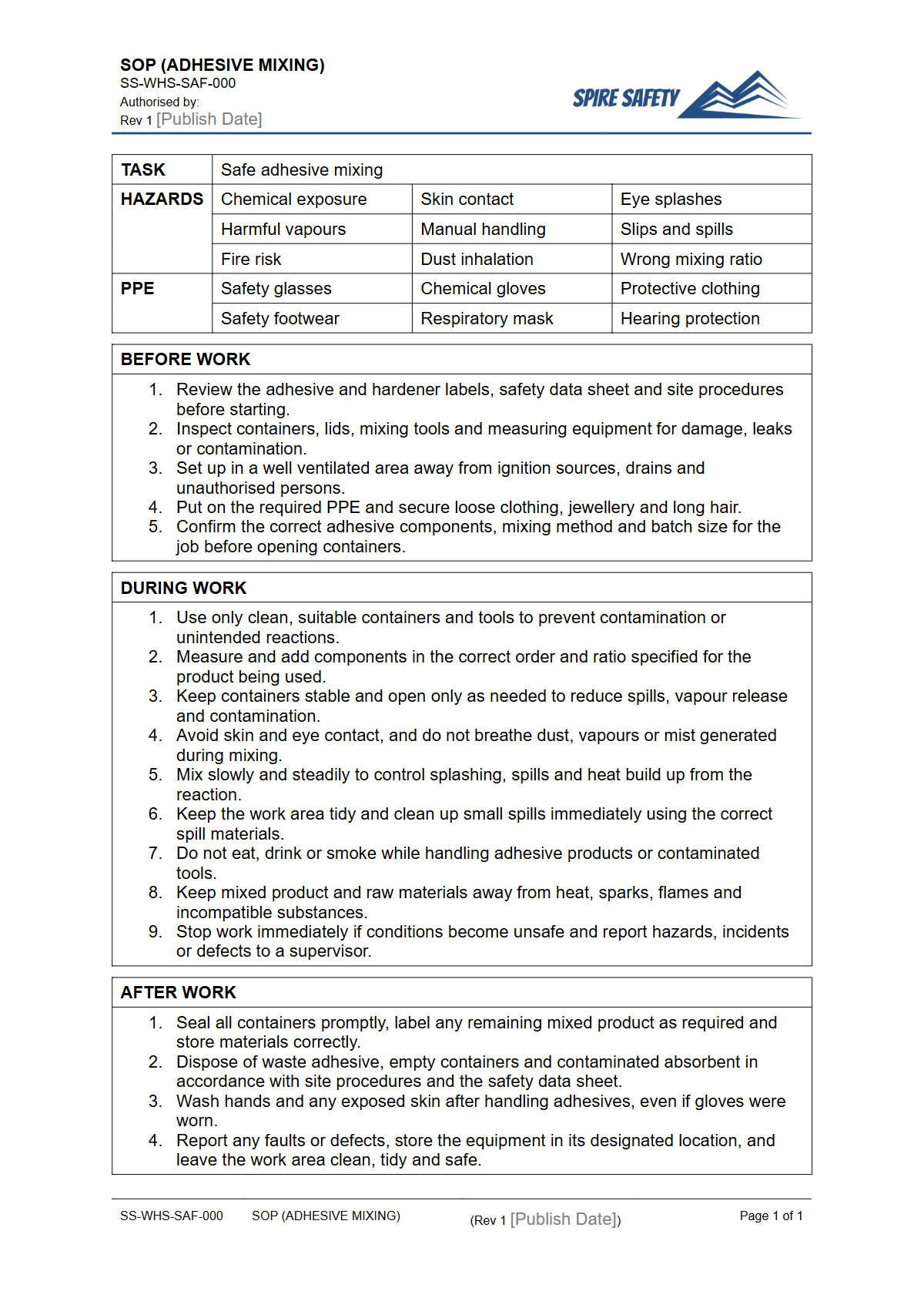
Download our free Safe Operating Procedure (SOP) template for adhesive mixing.
Free Safe Operating Procedure (Adhesive Mixing) Template
DOCX • 126 KB + PDF
Updated Oct 2026
No signup required
Purpose of the Free Safe Operating Procedure (Adhesive Mixing) Template
Mixing industrial adhesives involves significant risks, including exposure to hazardous chemicals, fire, and ergonomic strains. This Free Safe Operating Procedure (Adhesive Mixing) Template provides a structured framework for documenting the essential safety controls required for this task.
Using a standardised SOP helps ensure workers follow a consistent, safe method every time they mix adhesives, reducing the likelihood of incidents and promoting a safer work environment. The procedure prompts you to consider hazards such as chemical burns, respiratory irritation from vapours, and musculoskeletal disorders from manual handling.
A well-developed SOP is a critical component of any risk management process. It serves as a key training tool for new and existing employees, a reference point for supervisors, and evidence of your organisation's commitment to managing health and safety risks.
This document helps control risks associated with the task, similar to how procedures for other high-risk equipment, like a FREE Plasma Cutter SOP Template, manage specific operational hazards.
Video walkthrough
How to use the Free Safe Operating Procedure (Adhesive Mixing) Template
This downloadable template is provided in both DOCX and PDF formats for your convenience. The DOCX file is fully editable, allowing you to tailor the content to your specific operational needs. To effectively implement this Free Safe Operating Procedure (Adhesive Mixing) Template, follow these steps:
- Consult: Engage with the workers who perform the mixing tasks. Their direct experience is invaluable for identifying practical hazards and effective controls.
- Review SDS: Gather the Safety Data Sheets (SDS) for all adhesives and chemicals used. The SDS contains critical information on hazards, handling, storage, and required personal protective equipment (PPE).
- Customise: Edit the template to include details specific to your workplace. This includes the exact names of the adhesives, the equipment used (e.g., mixers, ventilation systems), and the specific steps involved in your process.
- Train: Formally train all relevant workers on the finalised SOP. Ensure they understand the steps, the risks, and the emergency procedures.
- Supervise and Review: Supervisors must ensure the SOP is consistently followed. The procedure should be reviewed regularly and updated whenever a process, chemical, or piece of equipment changes.
It is crucial to note that this document is a template only. It must be customised by a competent person to reflect the specific adhesives, equipment, environment, and legislative requirements applicable to your workplace.
Integrating this SOP into your broader WHS management systems ensures a cohesive approach to workplace safety.
Key Elements for Your Customisation
When adapting the template, ensure you thoroughly detail the following sections:
- Hazard Identification: List all potential hazards identified from your risk assessment and the product's SDS, including chemical, physical, and ergonomic risks.
- Required PPE: Be specific. Instead of just 'gloves', specify 'nitrile chemical-resistant gloves' or whatever the SDS mandates. Include requirements for safety glasses, face shields, respiratory protection, and protective clothing.
- Ventilation: Describe the required ventilation controls, such as the use of a local exhaust ventilation (LEV) system or requirements for general workshop airflow.
- Step-by-Step Procedure: Detail the pre-start checks, mixing sequence, and post-task cleanup in a clear, logical order.
- Emergency Procedures: Outline the immediate actions for spills, fire, and first aid response for chemical exposure (inhalation, skin/eye contact).
Proper disposal may involve moving containers, requiring adherence to safe handling procedures. If using plant like a body truck to move materials or waste, ensure operators are trained and competent, and that relevant procedures, such as a FREE Body Truck SOP Template, are in place and followed.
When to use it
A Safe Operating Procedure for adhesive mixing should be used as a primary control for the task. It is a 'live' document that should be referenced whenever the task is performed, especially by new or infrequent operators.
It is essential during worker inductions, for refresher training, and as a basis for toolbox talks on chemical safety. The SOP must also be reviewed and potentially updated following any incident or near-miss, or when new adhesives, mixing equipment, or processes are introduced.
Regular reviews of your SOPs should be part of your safety schedule, which can be verified through a formal WHS compliance auditing process.
Who should use it
This SOP is intended for several key groups within an organisation. Primarily, it is for the operators who are directly responsible for mixing the adhesives. They must be trained on its contents and follow it step-by-step. Supervisors and line managers must also be familiar with the SOP to effectively oversee the work, supports your compliance efforts, and provide guidance. WHS personnel and managers will use the SOP as part of the overall safety management system, for risk assessments, training development, and incident investigations. For guidance on implementing effective training and supervision frameworks, our WHS consulting services can provide tailored support. You can also explore our full range of documentation in our free WHS resources library.
Common mistakes
Common mistakes to avoid
- Using a generic SOP without customising it for the specific adhesive and workplace.
- Failing to read and incorporate critical information from the product's Safety Data Sheet (SDS).
- Providing inadequate ventilation, leading to dangerous concentrations of airborne contaminants.
- Neglecting to train workers on the finalised, site-specific procedure and confirm their understanding.
Legal references
Legal considerations
The following legal requirements may be relevant to this type of work.
- Work Health and Safety Act (Harmonised) — Provides the primary duties for protecting workers and other people from work health and safety risks.
- Work Health and Safety Regulations (Harmonised) — Sets out requirements supporting the management of workplace hazards and risks.
The following codes may be relevant to this type of work.
- Managing WHS Risks Code of Practice — Provides practical guidance on identifying hazards, assessing risks and applying effective controls.
- Work Health and Safety Consultation, Cooperation and Coordination Code of Practice — Provides practical guidance on consulting workers and coordinating with other duty holders.
- Managing the Work Environment and Facilities Code of Practice — Provides practical guidance on safe work environments, workplace facilities and related controls.
Did you know
VOCs Are A Major Hazard
Many adhesives release Volatile Organic Compounds (VOCs) during mixing and curing. These can have serious short and long-term health effects if not controlled with effective ventilation.
The SDS is Your Primary Guide
The Safety Data Sheet (SDS) for your specific adhesive is the most important source of information for creating a valid SOP. It legally must detail all hazards, first aid measures, and required safety controls.
FAQ
Frequently asked questions
01What is a Safe Operating Procedure (SOP)?
02Why is an SOP for adhesive mixing so important?
03Does this template meet Australian WHS requirements?
04What key information must be included in my customised adhesive mixing SOP?
Share this resource
Free Safe Operating Procedure (Adhesive Mixing) Template
Browse Categories
How To Use It
- 1Download and open in Word or PDF.
- 2Replace the placeholders with your business details.
- 3Get it reviewed by a WHS specialist before rollout.
Need it customised?
Our WHS consultants can adapt this template to your site, run a gap analysis, or audit what you already have in place.
Book a Free Consultation WHS consulting servicesor call 1300 156 382
Related templates
- Free Safe Operating Procedure (Adult Change Table) Template
- Free Safe Operating Procedure (Aerosol Can Puncture) Template
- Free Safe Operating Procedure (After Hours Dispatch) Template
- Free Safe Operating Procedure (After Hours Security) Template
- Free Safe Operating Procedure (AHU Filter Change) Template
- Free Safe Operating Procedure (Air Blow Gun) Template