
Free Safe Operating Procedure (Accessible Van Loading) Template
Download our free Safe Operating Procedure for accessible van loading. This customisable DOCX and PDF template helps manage risks and train staff.
Free Safe Operating Procedure (Accessible Van Loading) Template
DOCX • 126 KB + PDF
Updated Oct 2026
No signup required
Purpose of the Free Safe Operating Procedure (Accessible Van Loading) Template
Safely loading and unloading passengers with mobility challenges into an accessible van is a high-risk task that requires a clear, repeatable process. This Free Safe Operating Procedure (Accessible Van Loading) Template provides a structured framework for organisations, particularly in the community transport, aged care, and NDIS sectors, to document the required steps.
Using a standardised procedure helps to manage risks, ensure worker and passenger safety, and demonstrate a commitment to fulfilling WHS duties. A robust SOP is a fundamental component of effective WHS management systems.
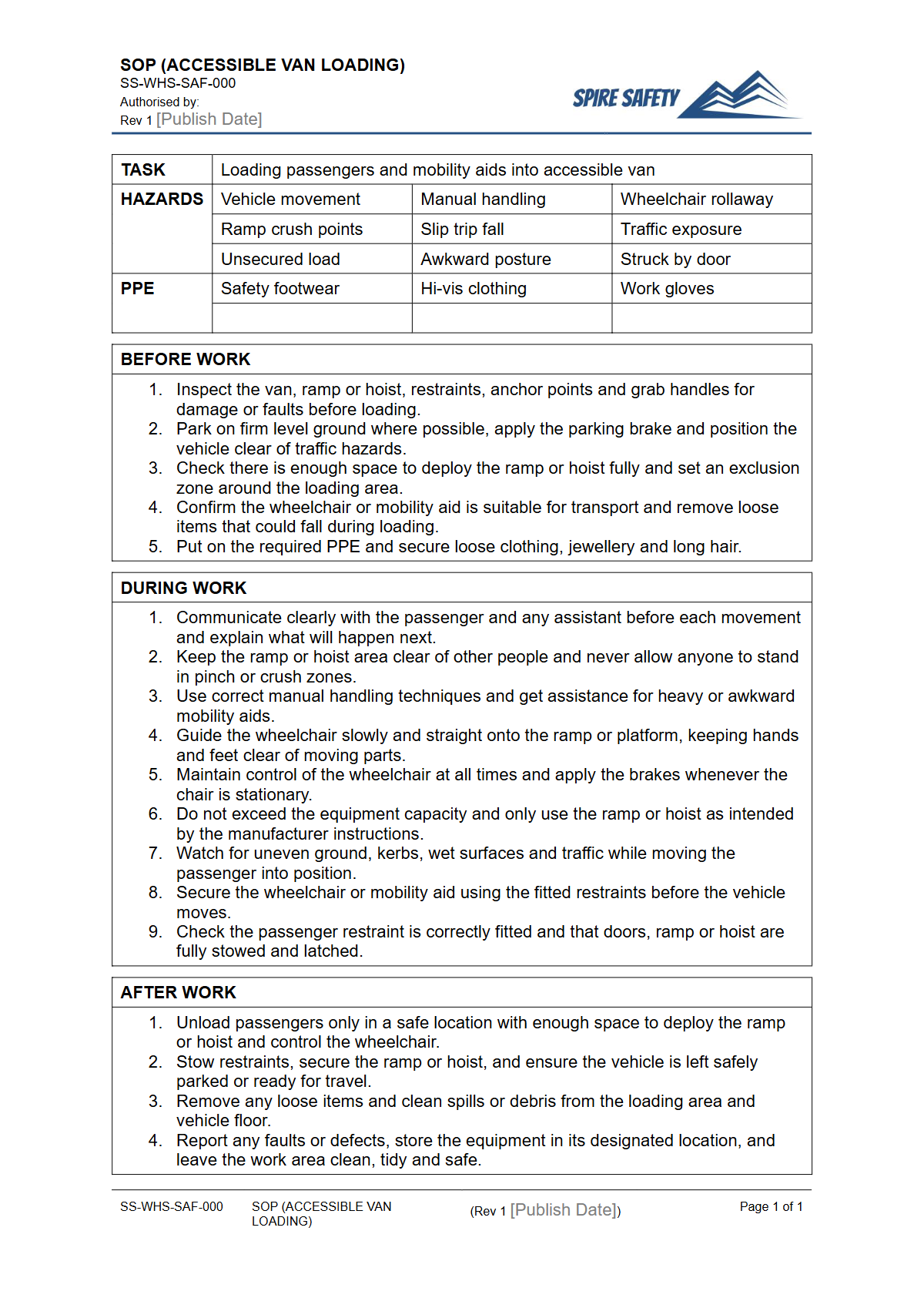
The primary purpose of this SOP is to guide workers through the process, from pre-start equipment checks to final passenger security. It prompts consideration of specific hazards associated with the task, including:
- Manual Tasks: Pushing, pulling, and guiding wheelchairs on inclined surfaces.
- Crush and Pinch Points: Dangers associated with ramp or lift mechanisms.
- Falls: Risk of the mobility device rolling off the ramp or instability during transfer.
- Equipment Failure: Potential for ramp, lift, or restraint system malfunction.
- Vehicle Movement: Uncontrolled movement of the van during loading or unloading.
By formally documenting the control measures for these hazards, you create a vital training and reference tool that promotes consistent, safe behaviour.
Video walkthrough
How to use the Free Safe Operating Procedure (Accessible Van Loading) Template
This template is provided in both DOCX for easy editing and PDF for straightforward distribution. The first step is to download the file and thoroughly review its contents.
It is designed as a comprehensive starting point, but it must be adapted to reflect the specific equipment and context of your workplace. Engage with your workers who perform the task to gather their valuable input during the customisation process. If you need expert help to tailor this document to your unique operational needs, consider our professional WHS consulting services.
Customisation is Key
Note: This document is a template only and must be customised to your workplace. We are not familiar with your specific vehicle, equipment, personnel, or operating environment. You must add site-specific information, including details on:
- Vehicle Make and Model: e.g., Mercedes-Benz Sprinter, Toyota HiAce Commuter, Kia Carnival.
- Ramp or Lift Type: Specify manufacturer and model, whether it is a manual fold-out ramp, an electric bi-fold ramp, or a platform lift.
- Restraint System: Detail the type of wheelchair tie-down and occupant restraint system (WTORS) used, including anchor point locations and tensioning instructions.
- Emergency Procedures: Outline steps for manual override of electric lifts/ramps in case of power failure.
- Communication Protocols: Define how workers should communicate with the passenger and any assistants throughout the process.
When to use it
A Safe Operating Procedure for accessible van loading should be a core part of your daily operations. It is not a document to be filed away; it should be actively used as a reference for training, task planning, and risk management.
It is particularly important to refer to the SOP during worker induction, for annual refresher training, and before any non-routine loading scenario. The principles of documenting vehicle-based tasks are similar across different equipment, as seen in our FREE Body Truck SOP Template, where clear steps are essential for safety.
Who should use it
This SOP is intended for any person involved in the task of transporting people who use mobility devices. This includes NDIS support workers, community transport drivers, aged care staff, and patient transport officers.
Supervisors and managers are responsible for ensuring the SOP is implemented, that workers are trained in its use, and that its effectiveness is regularly reviewed. Documenting procedures like this is a key way a PCBU (Person Conducting a Business or Undertaking) can demonstrate they are meeting their primary duty of care.
The existence and proper use of such documents are often reviewed during a formal WHS compliance auditing program.
The principle of creating an SOP applies to many hazardous tasks in the workplace, not just complex ones. Even seemingly simple tasks carry risks that must be managed through clear procedures, as shown by the need for our FREE Step Ladder SOP Template. Formalising your process for accessible van loading provides clarity, improves safety, and builds a stronger safety culture within your organisation.
For a wider selection of procedural templates and safety resources covering various tasks and equipment, browse our complete free WHS resources library.
Common mistakes
Common mistakes to avoid
- Using a generic procedure without adding vehicle-specific details (e.g., ramp type, anchor points).
- Failing to perform pre-operational checks on the ramp, lift, and wheelchair restraint systems.
- Neglecting to provide practical, hands-on training to staff on the specific van they will be using.
- Poor communication with the passenger during the loading and unloading process.
Legal references
Legal considerations
The following legal requirements may be relevant to this type of work.
- Work Health and Safety Act (Harmonised) — Provides the primary duties for protecting workers and other people from work health and safety risks.
- Work Health and Safety Regulations (Harmonised) — Sets out requirements supporting the management of workplace hazards and risks.
The following codes may be relevant to this type of work.
- Managing WHS Risks Code of Practice — Provides practical guidance on identifying hazards, assessing risks and applying effective controls.
- Work Health and Safety Consultation, Cooperation and Coordination Code of Practice — Provides practical guidance on consulting workers and coordinating with other duty holders.
- Managing the Work Environment and Facilities Code of Practice — Provides practical guidance on safe work environments, workplace facilities and related controls.
Did you know
Ramp Gradient
A common recommendation for unassisted manual wheelchair ramp access is a gradient no steeper than 1:12, meaning a 1-metre rise requires a 12-metre ramp length, highlighting the significant forces involved.
Manual Task Risk
Pushing a wheelchair up a ramp is a hazardous manual task. Safe Work Australia identifies the healthcare and social assistance industry as having one of the highest rates of serious workers' compensation claims.
FAQ
Frequently asked questions
01What is a Safe Operating Procedure for accessible van loading?
02Is this SOP template guaranteed to be WHS-aligned?
03Who is responsible for ensuring the accessible van loading SOP is followed?
04How often should we review our accessible van loading SOP?
Share this resource
Free Safe Operating Procedure (Accessible Van Loading) Template
Browse Categories
How To Use It
- 1Download and open in Word or PDF.
- 2Replace the placeholders with your business details.
- 3Get it reviewed by a WHS specialist before rollout.
Need it customised?
Our WHS consultants can adapt this template to your site, run a gap analysis, or audit what you already have in place.
Book a Free Consultation WHS consulting servicesor call 1300 156 382
Related templates
- Free Safe Operating Procedure (Accommodation Linen Sort) Template
- Free Safe Operating Procedure (Acid Cleaning) Template
- Free Safe Operating Procedure (Acid Transfer) Template
- Free Safe Operating Procedure (Adhesive Mixing) Template
- Free Safe Operating Procedure (Adult Change Table) Template
- Free Safe Operating Procedure (Aerosol Can Puncture) Template