
Free Safe Operating Procedure (AC Vacuum Pump) Template
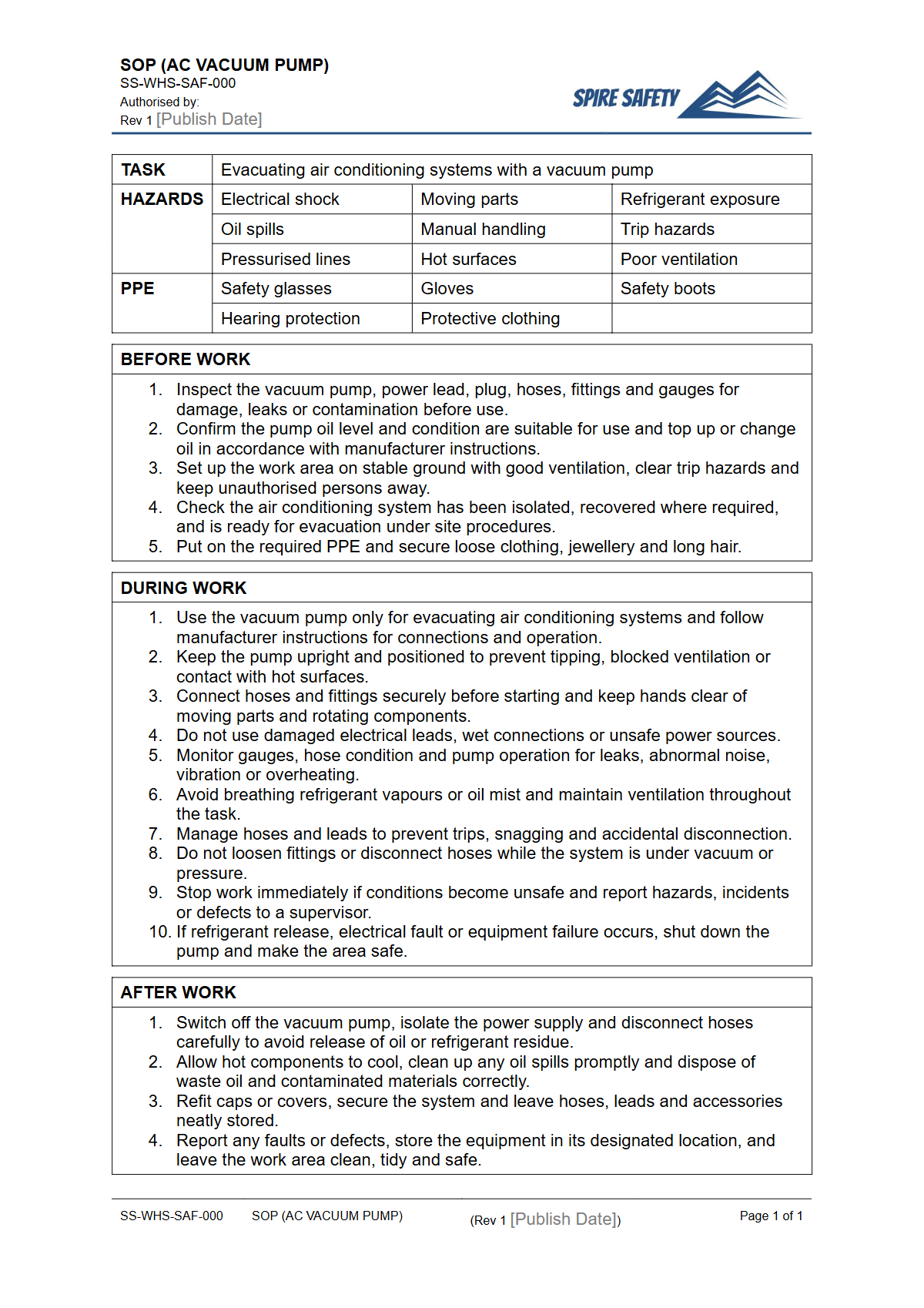
Download our free Safe Operating Procedure (AC Vacuum Pump) template. This user-friendly DOCX helps you outline safe work steps for HVAC technicians.
Free Safe Operating Procedure (AC Vacuum Pump) Template
DOCX • 126 KB + PDF
Updated Oct 2026
No signup required
Purpose of the Free Safe Operating Procedure (AC Vacuum Pump) Template
Operating an AC vacuum pump involves specific risks, including electrical hazards, high pressure, and exposure to refrigerant chemicals. This Free Safe Operating Procedure (AC Vacuum Pump) Template provides a structured framework for documenting the required steps to perform this task safely.
Using a standardised SOP helps your business meet its primary duty of care under WHS legislation by formalising safe work methods. It serves as a vital tool for worker training, competency assessment, and operational consistency, reducing the likelihood of incidents and injuries in your workshop or on-site.
A well-drafted SOP is a fundamental part of a safe system of work. It systematically breaks down a task into manageable steps, identifying potential hazards and specifying the control measures required to mitigate them.
This process is crucial for managing risks associated with plant and equipment. For tasks involving pressurised systems, this structured approach is not just best practice; it is an essential safety requirement.
For similar equipment, our free Air Compressor SOP template provides a comparable framework for documenting safe operation.
Video walkthrough
How to use the Free Safe Operating Procedure (AC Vacuum Pump) Template
This template is a starting point designed to be adapted to your specific workplace. Its effectiveness depends on its accurate customisation.
Download the DOCX file and consult with the workers who actually operate the AC vacuum pumps. Their experience is invaluable for identifying practical hazards and effective controls.
It is a legal requirement to consult with workers on matters affecting their health and safety.
Follow these steps to implement the SOP effectively:
- Step 1: Customise the Content. Review every section and update it to reflect the specific make and model of your AC vacuum pump, the types of refrigerants used, the work environment (workshop vs. mobile van), and your organisation's specific procedures.
- Step 2: Conduct a Risk Assessment. Use the template as a guide to perform a site-specific risk assessment for the task. Identify all foreseeable hazards and ensure the controls listed are adequate and reasonably practicable.
- Step 3: Add Specific Details. Fill in details such as the required Personal Protective Equipment (PPE), pre-start safety checks, step-by-step operating instructions, and procedures for cleaning, maintenance, and shutdown.
- Step 4: Train Your Team. Once finalised, formally train all relevant personnel on the SOP. Keep records of this training and verify that each operator is competent before they are authorised to use the equipment independently. Many tasks, such as accessing rooftop AC units, involve working at heights, often requiring a Safe Operating Procedure for step ladders as well.
Please note: This document is a template. We are not liable for the outcomes of your customisation and implementation.
You must ensure the final document is accurate and suitable for your workplace risks.
When to use it
An SOP for an AC vacuum pump should be a living document integrated into your daily operations. It is not a file to be created once and forgotten.
Use it during new worker induction and onboarding to establish a baseline of safe behaviour from day one. It should also be a key reference tool for refresher training to prevent complacency among experienced technicians.
Supervisors can use it for pre-start toolbox talks before a job, and it should be readily accessible near the equipment or in the service vehicle. Furthermore, this document is essential during a WHS compliance audit as evidence of your established safe work systems.
Who should use it
This Safe Operating Procedure is intended for use by a range of personnel within the refrigeration, air conditioning (HVAC), and automotive industries. This includes:
- HVAC Technicians and Mechanics: The primary users who perform the task and must follow the procedure to ensure their own safety and that of others.
- Apprentices and Trainees: As a critical learning tool to understand the correct, safe methods of operation under supervision.
- Supervisors and Team Leaders: To enforce safety standards, conduct training, and monitor compliance with the documented procedure.
- WHS Managers and Advisors: To develop, implement, and review safety protocols as part of the organisation's overall WHS management systems.
- Business Owners (PCBUs): To ensure they are fulfilling their legal obligations to provide a safe working environment and safe systems of work.
A comprehensive SOP ensures that everyone, regardless of their role or experience level, has a clear and consistent understanding of how to operate equipment safely. Automotive or fabrication workshops may also use tools covered by our Plasma Cutter SOP template to manage other common workshop hazards. You can explore a wide range of documents in our free WHS resources library.
Common mistakes
Common mistakes to avoid
- Using the template 'as-is' without customising it for the specific pump model and worksite.
- Failing to conduct thorough pre-start electrical safety checks, such as inspecting cords and ensuring proper grounding.
- Neglecting to wear appropriate PPE, especially safety glasses and thermal gloves when handling refrigerants.
- Not training all operators on the finalised procedure or verifying their competency before use.
Legal references
Legal considerations
The following legal requirements may be relevant to this type of work.
- Work Health and Safety Act (Harmonised) — Provides the primary duties for protecting workers and other people from work health and safety risks.
- Work Health and Safety Regulations (Harmonised) — Sets out requirements supporting the management of workplace hazards and risks.
The following codes may be relevant to this type of work.
- Managing WHS Risks Code of Practice — Provides practical guidance on identifying hazards, assessing risks and applying effective controls.
- Work Health and Safety Consultation, Cooperation and Coordination Code of Practice — Provides practical guidance on consulting workers and coordinating with other duty holders.
- Managing the Work Environment and Facilities Code of Practice — Provides practical guidance on safe work environments, workplace facilities and related controls.
Did you know
Refrigerant Risk
Improperly handling refrigerants during vacuuming can lead to severe cold burns (frostbite) on contact with skin or asphyxiation in poorly ventilated spaces.
Pump Maintenance
The oil in a vacuum pump must be changed regularly. Contaminated oil cannot achieve a deep vacuum, extending pump run times and potentially damaging the AC system components.
FAQ
Frequently asked questions
01What is a Safe Operating Procedure for an AC vacuum pump?
02Is using this template enough to be WHS-aligned?
03Who needs to be trained on this AC vacuum pump SOP?
04How often should an SOP be reviewed?
Share this resource
Free Safe Operating Procedure (AC Vacuum Pump) Template
Browse Categories
How To Use It
- 1Download and open in Word or PDF.
- 2Replace the placeholders with your business details.
- 3Get it reviewed by a WHS specialist before rollout.
Need it customised?
Our WHS consultants can adapt this template to your site, run a gap analysis, or audit what you already have in place.
Book a Free Consultation WHS consulting servicesor call 1300 156 382
Related templates
- Free Safe Operating Procedure (Access Control Panel) Template
- Free Safe Operating Procedure (Access Hatch Inspection) Template
- Free Safe Operating Procedure (Accessible Bus Loading) Template
- Free Safe Operating Procedure (Accessible Van Loading) Template
- Free Safe Operating Procedure (Accommodation Linen Sort) Template
- Free Safe Operating Procedure (Acid Cleaning) Template