
Free Safe Operating Procedure (Access Control Panel) Template
Need a Safe Operating Procedure for access control panels? Our free template helps you document safety measures for installation, maintenance, and operation.
Free Safe Operating Procedure (Access Control Panel) Template
DOCX • 126 KB + PDF
Updated Oct 2026
No signup required
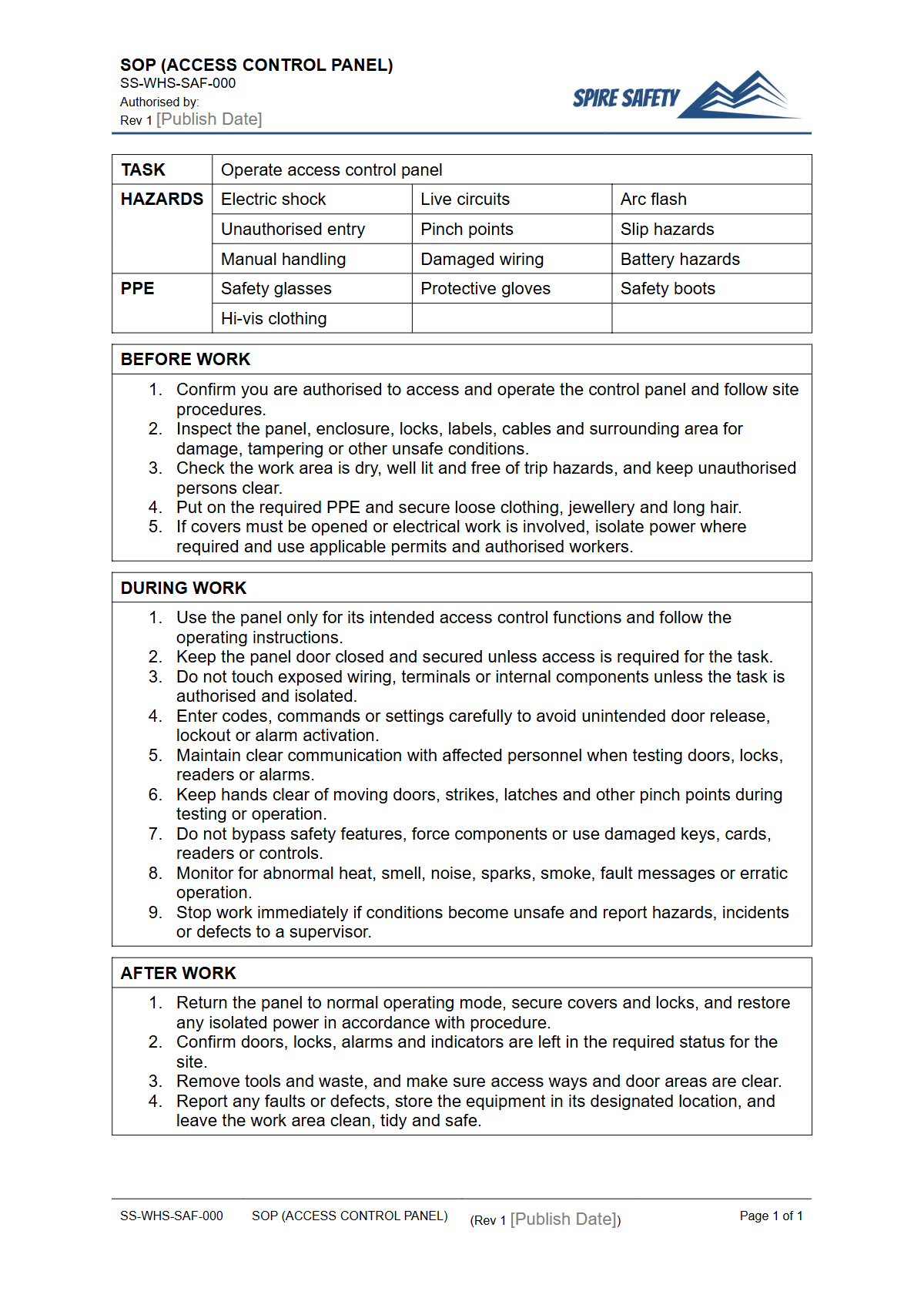
Purpose of the Free Safe Operating Procedure (Access Control Panel) Template
An access control panel is a critical component of a building's security and safety infrastructure. This Safe Operating Procedure (SOP) template provides a structured framework for documenting the step-by-step process required to safely install, commission, maintain, and troubleshoot these systems.
Using a standardised procedure helps ensure that all personnel perform these tasks consistently and safely, minimising the risk of electrical shock, system malfunction, or security breaches.
Documenting your processes is fundamental to creating a safe system of work. This SOP helps you meet your duties as a Person Conducting a Business or Undertaking (PCBU) to manage risks and provide clear instructions to workers.
Properly implemented SOPs form a key component of robust WHS management systems, demonstrating a commitment to proactive safety management and operational excellence.
Video walkthrough
How to use the Free Safe Operating Procedure (Access Control Panel) Template
This document is a template and must be customised to suit your specific workplace. Start by downloading the DOCX file and adapting it to reflect the unique models of access control panels used, the specific site conditions, and your organisation's internal safety policies.
It's crucial to consult with the security technicians, electricians, and other workers who will be using the procedure during its development.
Important: We have provided a comprehensive starting point, but you are responsible for ensuring the final document is accurate and relevant to your operations. This includes identifying all site-specific hazards, detailing precise control measures, and specifying the personal protective equipment (PPE) required for the task.
Failure to properly customise this template can undermine its effectiveness and create safety risks. For example, your site may have specific hazards related to working at heights to access panels, requiring reference to a Safe Operating Procedure for step ladders.
Once customised, the SOP should be used for training and as a pre-task reference for all workers involved in handling access control panels. It should be easily accessible to them at the point of work.
This SOP can be integrated with other electrical safety documents, similar to how a plasma cutter SOP outlines specific electrical hazards for that equipment.
When to use this Safe Operating Procedure
This Safe Operating Procedure should be used as a primary reference tool before and during any task involving an access control panel. Key situations include:
- Installation and Commissioning: Guiding technicians through the correct sequence for safely installing and activating new panels.
- Routine Maintenance: Ensuring preventative maintenance tasks like battery testing, connection checks, and firmware updates are performed safely.
- Troubleshooting and Repair: Providing a logical and safe workflow for diagnosing faults and carrying out repairs, including critical steps for de-energisation.
- Worker Training and Induction: Aiding in the training of new employees or contractors on the organisation's approved method for working with these systems.
A consistently used SOP also provides clear documentation of your work methods, which can be valuable as evidence of proactive safety management during a WHS compliance audit.
Who should use this Safe Operating Procedure
This SOP is designed for use by competent personnel who are authorised to work on access control systems. This typically includes:
- Licensed Security Technicians
- Qualified Electricians
- Maintenance and Facilities Management Staff
- IT Personnel (for networked systems)
- Supervisors and Managers responsible for overseeing these tasks
It is also a vital tool for supervisors to use during toolbox talks, for verifying competency, and for conducting workplace inspections and observations. PCBUs looking to establish or refine their safety documentation can benefit from external expertise through WHS consulting to ensure procedures are practical and effective.
Furthermore, when installation or maintenance requires modifications to the surrounding structure, workers may need to consult other relevant procedures. For instance, if cutting into walls or cabinets is needed, a circular saw Safe Operating Procedure would be an essential supplementary document to manage different hazards.
Common mistakes
Common mistakes to avoid
- Failing to specify the exact make and model of the access control panel in the procedure.
- Neglecting to include clear steps for de-energisation and lockout-tagout (LOTO) before commencing work.
- Using generic instructions that do not reflect site-specific hazards or environmental conditions.
- Forgetting to consult with the workers who actually perform the task when drafting the procedure.
Legal references
Legal considerations
The following legal requirements may be relevant to this type of work.
- Work Health and Safety Act (Harmonised) — Provides the primary duties for protecting workers and other people from work health and safety risks.
- Work Health and Safety Regulations (Harmonised) — Sets out requirements supporting the management of workplace hazards and risks.
The following codes may be relevant to this type of work.
- Managing WHS Risks Code of Practice — Provides practical guidance on identifying hazards, assessing risks and applying effective controls.
- Work Health and Safety Consultation, Cooperation and Coordination Code of Practice — Provides practical guidance on consulting workers and coordinating with other duty holders.
- Managing the Work Environment and Facilities Code of Practice — Provides practical guidance on safe work environments, workplace facilities and related controls.
Did you know
Integration is Key
Modern access control panels often integrate with other building systems like fire alarms, lifts, and CCTV, increasing the complexity of safety procedures required for installation and maintenance.
Low Voltage, High Risk
While many panels operate on low voltage, they are often connected to mains power. Incorrect handling during installation or maintenance can still pose significant electrical shock or fire risks.
FAQ
Frequently asked questions
01Is this access control panel SOP template suitable for all types of systems?
02What should be included in a Safe Operating Procedure for an access control panel?
03Who is responsible for creating and approving an SOP?
04How often should an SOP for an access control panel be reviewed?
Share this resource
Free Safe Operating Procedure (Access Control Panel) Template
Browse Categories
How To Use It
- 1Download and open in Word or PDF.
- 2Replace the placeholders with your business details.
- 3Get it reviewed by a WHS specialist before rollout.
Need it customised?
Our WHS consultants can adapt this template to your site, run a gap analysis, or audit what you already have in place.
Book a Free Consultation WHS consulting servicesor call 1300 156 382
Related templates
- Free Safe Operating Procedure (Access Hatch Inspection) Template
- Free Safe Operating Procedure (Accessible Bus Loading) Template
- Free Safe Operating Procedure (Accessible Van Loading) Template
- Free Safe Operating Procedure (Accommodation Linen Sort) Template
- Free Safe Operating Procedure (Acid Cleaning) Template
- Free Safe Operating Procedure (Acid Transfer) Template