
Free Safe Operating Procedure (Access Hatch Inspection) Template
Download our free Safe Operating Procedure (Access Hatch Inspection) template. This DOCX and PDF resource helps you outline safe inspection practices.
Free Safe Operating Procedure (Access Hatch Inspection) Template
DOCX • 126 KB + PDF
Updated Oct 2026
No signup required
Purpose of the Free Safe Operating Procedure (Access Hatch Inspection) Template
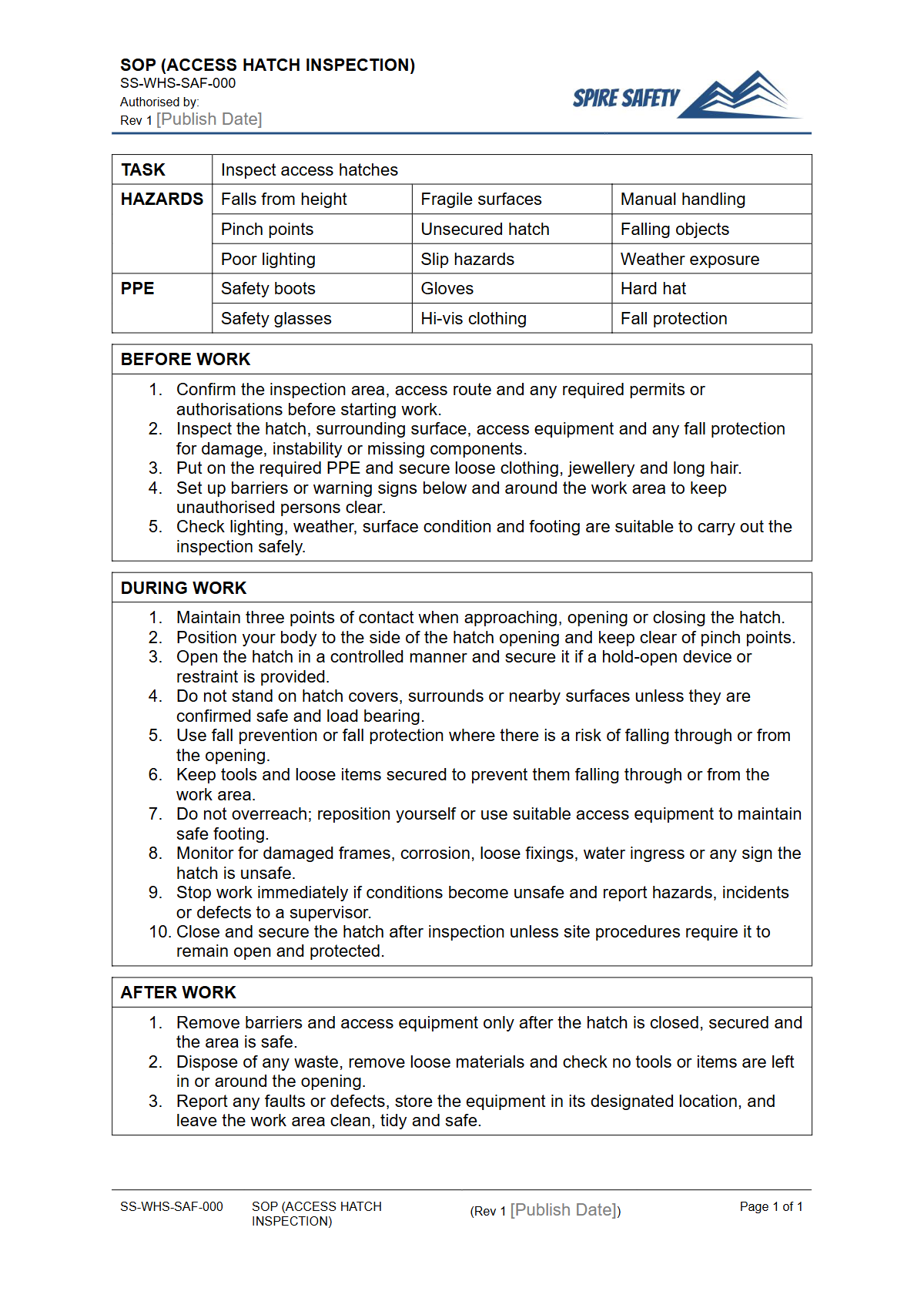
Effectively managing workplace safety requires clear, documented procedures for potentially hazardous tasks. This Free Safe Operating Procedure (Access Hatch Inspection) Template provides a structured starting point for organisations to formalise their inspection process for roof, ceiling, floor, and other access hatches.
Its primary purpose is to help you create a systematic guide for workers to follow, ensuring inspections are performed consistently and safely every time. By documenting the process, you can better manage risks such as falls from height, unsecured hatch covers, and potential confined space hazards.
The procedure guides users through pre-inspection checks, the inspection process itself, and post-inspection actions. It prompts consideration of personal protective equipment (PPE), isolation requirements, and communication protocols.
Proper use of an access hatch often involves working at height, even for short durations. Documenting the correct method for accessing the hatch, which might involve a specific tool like a ladder, is critical.
For related tasks, a dedicated step ladder SOP can provide more detailed guidance on ladder safety.
Key Objectives of this Safe Operating Procedure:
- To provide a clear, step-by-step sequence for inspecting access hatches.
- To identify potential hazards and specify control measures to mitigate risks.
- To ensure consistency in how inspections are carried out across all personnel.
- To create a record of inspection activities for compliance and due diligence purposes.
- To assist in training and competency verification for workers assigned the task.
Video walkthrough
How to use the Free Safe Operating Procedure (Access Hatch Inspection) Template
This Safe Operating Procedure for access hatch inspections is provided as a downloadable DOCX file, allowing for complete customisation. After downloading, a Person Conducting a Business or Undertaking (PCBU) must review and adapt the content to reflect the specific environment of their workplace.
This includes identifying the types of hatches on site, the unique hazards they present, and the control measures your organisation has implemented. Generic procedures are insufficient; site-specific details are essential for creating an effective safety document.
For this document to be effective, it should be integrated into your overall safety framework. A standalone procedure is less powerful than one that is part of a holistic system of policies, training records, and risk assessments.
Developing robust WHS management systems ensures that documents like this SOP are properly implemented, reviewed, and improved over time.
You must also ensure that all workers who perform access hatch inspections are trained on the final, customised procedure. This includes explaining the 'why' behind each step and verifying their understanding before they undertake the task unsupervised.
If your organisation lacks the internal expertise to adapt technical safety documents, engaging external WHS consulting services can provide the necessary guidance to ensure the procedure is robust and fit-for-purpose.
Important: This document is a template and must be customised to suit the specific hazards, risks, and control measures of your workplace. We are not responsible for the outcomes of its use.
When to use it
A Safe Operating Procedure for access hatch inspection should be used as the primary reference document whenever the task is performed. It standardises the approach and prevents ad-hoc, potentially unsafe work methods. Key times to use this SOP include:
- Scheduled Maintenance: As part of a regular preventative maintenance schedule (e.g., monthly, quarterly, or annually) to ensure hatches remain in safe working order. This is similar to routine checks on other plant, which would also be governed by a specific procedure, like our free Air Compressor SOP.
- Pre-Use Checks: Before a worker needs to use an access hatch to get to a work area, a brief check based on the SOP ensures it is safe to use at that moment.
- Post-Incident Investigations: When an incident or near-miss occurs involving an access hatch, the SOP serves as a benchmark to review whether correct procedure was followed.
- Following Repairs: After maintenance or repair work has been conducted on a hatch, an inspection following the SOP confirms it has been returned to a safe state.
Who should use it
This procedure is designed for use by various personnel within an organisation to ensure a coordinated approach to safety. The primary users include:
- Maintenance Staff and Technicians: The individuals physically carrying out the inspection tasks.
- Facility Managers and Supervisors: Those responsible for scheduling inspections, managing maintenance teams, and ensuring procedures are followed.
- WHS/OHS Officers: Safety professionals who may use the SOP for audits, incident investigations, and to develop training materials.
- Workers and Contractors: Any person who may be required to use an access hatch should be familiar with the inspection criteria to identify and report obvious defects before use.
By providing a clear and accessible guide, the SOP helps build a consistent safety culture. You can find many other task-specific templates in our free WHS resources library to support your organisation's safety efforts.
Common mistakes
Common mistakes to avoid
- Using the template without customising it for site-specific hatch types and hazards.
- Failing to adequately train workers on the finalised, site-specific procedure.
- Neglecting to keep records of completed inspections, creating a gap in due diligence.
- Forgetting to review and update the SOP after an incident or when workplace conditions change.
Legal references
Legal considerations
The following legal requirements may be relevant to this type of work.
- Work Health and Safety Act (Harmonised) — Provides the primary duties for protecting workers and other people from work health and safety risks.
- Work Health and Safety Regulations (Harmonised) — Sets out requirements supporting the management of workplace hazards and risks.
The following codes may be relevant to this type of work.
- Managing WHS Risks Code of Practice — Provides practical guidance on identifying hazards, assessing risks and applying effective controls.
- Work Health and Safety Consultation, Cooperation and Coordination Code of Practice — Provides practical guidance on consulting workers and coordinating with other duty holders.
- Managing the Work Environment and Facilities Code of Practice — Provides practical guidance on safe work environments, workplace facilities and related controls.
Did you know
A Leading Cause of Fatalities
According to Safe Work Australia, falls from height are a leading cause of workplace fatalities and serious injuries. Consistently inspecting access points like hatches is a critical control measure to prevent these incidents.
SOP vs SWMS
A Safe Operating Procedure (SOP) provides general, step-by-step instructions for a task, while a Safe Work Method Statement (SWMS) is a more detailed document required for specific 'high-risk construction work', outlining how risks will be managed.
FAQ
Frequently asked questions
01What should an access hatch inspection SOP include?
02How often should access hatches be inspected?
03Is a Safe Operating Procedure a legal requirement in Australia?
04What are the main hazards associated with access hatches?
Share this resource
Free Safe Operating Procedure (Access Hatch Inspection) Template
Browse Categories
How To Use It
- 1Download and open in Word or PDF.
- 2Replace the placeholders with your business details.
- 3Get it reviewed by a WHS specialist before rollout.
Need it customised?
Our WHS consultants can adapt this template to your site, run a gap analysis, or audit what you already have in place.
Book a Free Consultation WHS consulting servicesor call 1300 156 382
Related templates
- Free Safe Operating Procedure (Accessible Bus Loading) Template
- Free Safe Operating Procedure (Accessible Van Loading) Template
- Free Safe Operating Procedure (Accommodation Linen Sort) Template
- Free Safe Operating Procedure (Acid Cleaning) Template
- Free Safe Operating Procedure (Acid Transfer) Template
- Free Safe Operating Procedure (Adhesive Mixing) Template