
Free Verification of Competency (Abrasive Blast Pot) Template
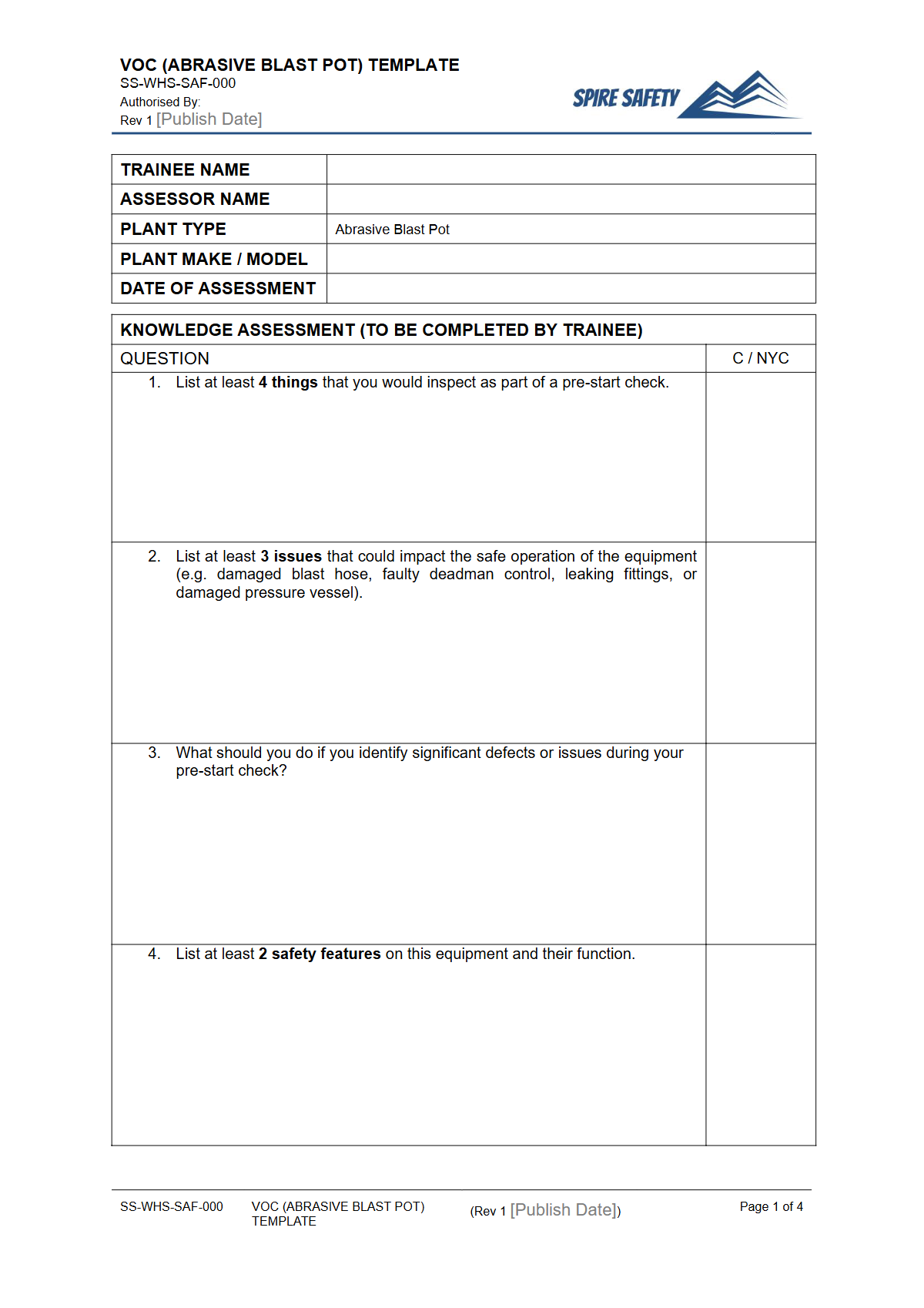
Download our Free Verification of Competency (Abrasive Blast Pot) Template to assess operator skills and safety. Aligned with Australian WHS practice.
Free Verification of Competency (Abrasive Blast Pot) Template
DOCX • 141 KB + PDF
Updated Oct 2026
No signup required
Purpose of the Free Verification of Competency (Abrasive Blast Pot) Template
Operating an abrasive blast pot involves significant risks, including exposure to hazardous dust like crystalline silica, high-pressure injection injuries, and noise. A formal licence or ticket confirms foundational knowledge, but it doesn't guarantee a worker can operate a specific machine safely in your unique work environment.
This is where a Verification of Competency (VOC) becomes essential. This Free Verification of Competency (Abrasive Blast Pot) Template provides a structured framework for employers to confirm that workers have the necessary skills, knowledge, and practical ability to perform the task safely and competently, fulfilling a key duty of care under Australian WHS legislation.
Using a VOC helps bridge the gap between formal training and on-the-job competence. It creates a documented record that an individual's skills have been verified against established criteria, which is a critical component of a robust safety management system.
It demonstrates due diligence and helps ensure that only qualified personnel are assigned to this high-risk task.
What this Verifications of Competency covers
This template is designed to guide an assessor through a comprehensive check of an operator's abilities. Key areas for verification include:
- Pre-operational Checks: Verifying the operator can correctly inspect the blast pot, hoses, nozzles, and associated safety features like the dead-man switch.
- Hazard Identification: Assessing the operator’s ability to recognise task-specific hazards, such as the type of blasting media being used, potential for airborne contaminants, and risks to nearby workers.
- Personal Protective Equipment (PPE): Ensuring the operator can select, fit, and use all required PPE, including the correct type of air-fed helmet, respiratory protection, and protective clothing.
- Safe Operation: Observing the operator's technique, control of the equipment, and adherence to safe work procedures during the blasting process.
- Shutdown Procedures: Confirming the operator knows how to safely depressurise and shut down the equipment, as well as perform basic clean-up and maintenance.
For organisations looking to integrate such procedures into a broader safety framework, a well-defined WHS management system provides the structure needed to manage risks consistently across all operations.
Video walkthrough
How to use the Free Verification of Competency (Abrasive Blast Pot) Template
Using this template effectively requires more than just a simple download. It should be integrated into your workplace's safety processes by a competent person.
First, download the template in your preferred format (DOCX for easy editing or PDF). Next, a supervisor, WHS advisor, or subject matter expert must review and adapt the document to reflect the specific make and model of the abrasive blast pot in use, your site-specific hazards, and your organisation's safe work procedures. Please note: This is a template, not a finished document. We cannot guarantee it covers every hazard in your specific workplace. You must customise it.
Once customised, a competent assessor—someone with extensive experience and knowledge of abrasive blasting operations—should use the document to conduct the assessment. This involves a combination of questioning to test knowledge and direct observation of the worker performing the task.
The assessor records their findings, signs off on the outcome, and identifies any training gaps that need to be addressed. This documented process is invaluable for record-keeping and demonstrating compliance.
For other high-pressure equipment, you might find our Free Pressure Cleaner VOC Template useful as well.
When to use it
A Verification of Competency for abrasive blasting is not a one-time event. It should be conducted at several key points to ensure ongoing safety and competence. Common triggers include:
- Pre-employment: To verify the skills claimed by a new hire before they commence work.
- Introduction of New Equipment: When a new or different model of blast pot is introduced to the workplace.
- Post-incident: As part of an investigation following an incident or near-miss involving the equipment.
- Identified Performance Issues: If a supervisor observes unsafe practices or a decline in an operator's performance.
- Periodic Reassessment: As part of a regular schedule (e.g., every 2-3 years) to ensure skills remain current, a practice often reviewed during WHS consulting engagements.
Who should use it
This resource is designed for any person or role responsible for workplace safety and operator competence. This typically includes:
- WHS/HSE Advisors and Managers: Who are responsible for developing and implementing safety procedures and ensuring compliance.
- Site Supervisors and Forepersons: Who are on the front line of overseeing work and have a direct responsibility to ensure their team operates equipment safely.
- Project Managers: Who need to ensure that all contractors and employees on their site are competent for the tasks they perform.
- Business Owners: Particularly in smaller organisations, where the owner may be directly responsible for all aspects of WHS.
The principles of competency verification apply to a wide range of mobile and stationary plant. For instance, similar checks are vital for operators using equipment for dust suppression, with our Verification of Competency (Water Cart) template providing a relevant example.
Ultimately, anyone in a position to direct and control work has a duty to ensure it is done safely, and this VOC template is a tool to help meet that obligation. The use of structured assessment tools can be extended to other common plant, such as those covered in our Verification of Competency (Cement Mixer) Template. For more tools and checklists, you can browse our complete free WHS resources library.
Common mistakes
Common mistakes to avoid
- Failing to customise the template for the specific equipment and site-specific risks.
- Using an assessor who lacks deep, practical experience with abrasive blasting operations.
- Treating the VOC as a paperwork exercise without meaningful observation and interaction.
- Not providing corrective actions or further training when an operator is found 'not yet competent'.
Legal references
Legal considerations
The following legal requirements may be relevant to this type of work.
- Work Health and Safety Act (Harmonised) — Provides the primary duties for protecting workers and other people from work health and safety risks.
- Work Health and Safety Regulations (Harmonised) — Sets out requirements supporting the management of workplace hazards and risks.
The following codes may be relevant to this type of work.
- Managing WHS Risks Code of Practice — Provides practical guidance on identifying hazards, assessing risks and applying effective controls.
- Work Health and Safety Consultation, Cooperation and Coordination Code of Practice — Provides practical guidance on consulting workers and coordinating with other duty holders.
- Managing the Work Environment and Facilities Code of Practice — Provides practical guidance on safe work environments, workplace facilities and related controls.
Did you know
The Danger of Dust
Abrasive blasting can generate high levels of hazardous dust. Sand containing crystalline silica is banned as a blasting abrasive in Australia because inhaling silica dust can lead to fatal lung diseases like silicosis.
High-Pressure Hazard
The pressure at the nozzle of an abrasive blaster can exceed 100 PSI. An accidental injection injury from this pressure can be extremely serious, causing severe tissue damage and requiring immediate specialist medical attention.
FAQ
Frequently asked questions
01Is a VOC the same as a licence for abrasive blasting?
02How often should an abrasive blast pot VOC be conducted?
03Who is a 'competent person' to conduct this verification?
04Can I use this template for different types of blast pots?
Share this resource
Free Verification of Competency (Abrasive Blast Pot) Template
Browse Categories
How To Use It
- 1Download and open in Word or PDF.
- 2Replace the placeholders with your business details.
- 3Get it reviewed by a WHS specialist before rollout.
Need it customised?
Our WHS consultants can adapt this template to your site, run a gap analysis, or audit what you already have in place.
Book a Free Consultation WHS consulting servicesor call 1300 156 382
Related templates
- Free Verification of Competency (Auger Attachment) Template
- Free Verification of Competency (Bottle Jack) Template
- Free Verification of Competency (Compaction Wheel) Template
- Free Verification of Competency (Concrete Core Drill) Template
- Free Verification of Competency (Concrete Scarifier) Template
- Free Verification of Competency (Concrete Screed) Template