
Free Verification of Competency (Concrete Core Drill) Template
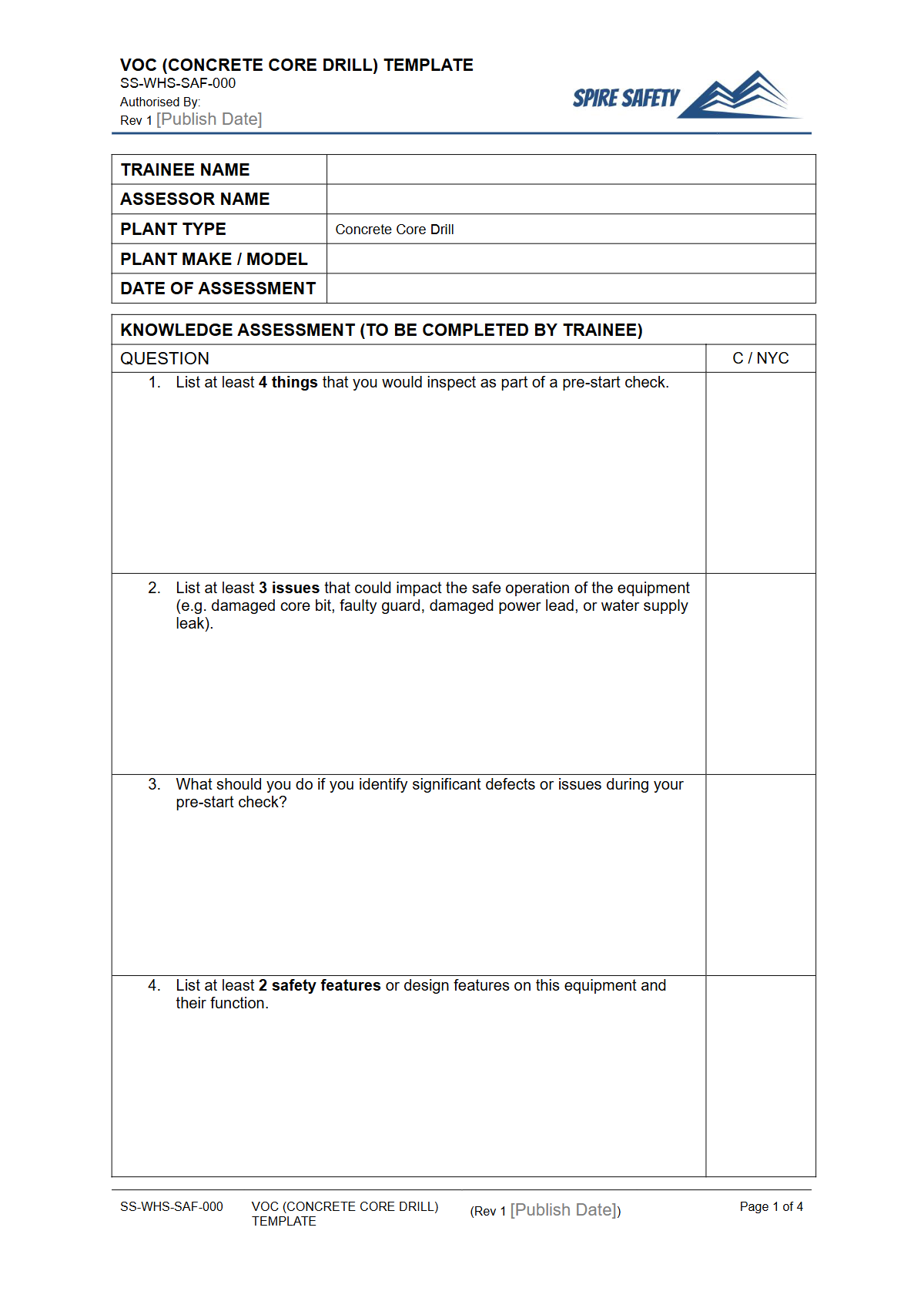
Download our free Verification of Competency (Concrete Core Drill) Template. This structured Word & PDF resource helps assess operator skills and safety.
Free Verification of Competency (Concrete Core Drill) Template
DOCX • 138 KB + PDF
Updated Oct 2026
No signup required
Purpose of the Free Verification of Competency (Concrete Core Drill) Template
A concrete core drill is a powerful piece of equipment that presents significant risks if operated incorrectly. This Free Verification of Competency (Concrete Core Drill) Template provides a structured framework for assessing and confirming that an operator has the necessary skills and knowledge to use this equipment safely and effectively.
As a Person Conducting a Business or Undertaking (PCBU), you have a primary duty of care to ensure the health and safety of your workers. This includes providing the necessary training, information, and supervision.
Using a VOC is a practical way to document this process and demonstrate due diligence.
This template is designed to be integrated into your overall safety processes, helping to minimise the risk of incidents related to kickback, electrical shock, water management, and exposure to respirable crystalline silica. It forms a critical component of robust WHS management systems, providing a clear record that a worker's skills have been formally verified against established criteria.
Video walkthrough
How to use the Free Verification of Competency (Concrete Core Drill) Template
Using this template is a straightforward process designed to be implemented by a competent person within your organisation. After downloading the document, you should review and adapt it to suit your specific operational needs.
The assessment should be a combination of theoretical questions and practical observation.
The process generally involves:
- Theory Assessment: The operator answers questions about the core drill's features, pre-start checks, potential hazards, and emergency procedures.
- Practical Observation: An assessor observes the operator performing tasks such as setting up the equipment, selecting the correct drill bit, managing water flow, drilling a core, and shutting down and cleaning the machine safely.
- Documentation: The assessor records the results, notes any areas for improvement, and signs off on the operator's competency. If competency is not verified, a plan for further training must be documented.
Important: This is a template, not a finished document. It is critical that you customise it to reflect the specific core drill models, tasks, environments, and hazards present in your workplace.
We cannot guarantee its suitability for your specific needs without thorough customisation. The process is similar for other plant, such as our Verification of Competency (Cement Mixer) Template.
When to use it
A Verification of Competency is not a one-time event. It should be conducted at several key points during a worker's employment to ensure their skills remain current and aligned with safety standards. Consider using this VOC template in the following situations:
- Pre-employment: To verify the skills and claims of a new hire before they begin work.
- Introduction of New Equipment: When a new make or model of concrete core drill is introduced to the workplace.
- Post-incident: After an incident or near-miss involving a core drill to identify and correct any gaps in knowledge or performance.
- Identified Skill Gaps: When a supervisor observes unsafe practices or identifies a need for refresher training.
- Periodic Re-verification: As part of a regular schedule (e.g., every 2-3 years) to ensure skills have not diminished over time. This can be identified during processes like regular WHS compliance auditing.
Who should use it
This template is intended for use by individuals responsible for workplace safety and operational supervision. This typically includes:
- Workplace Health and Safety (WHS) Managers
- Site Supervisors or Foremen
- Team Leaders
- Internal or External Trainers and Assessors
Crucially, the person conducting the VOC assessment must be competent themselves. This means they must have extensive theoretical knowledge and practical experience in operating a concrete core drill.
They must be able to confidently judge the operator's performance against best practice standards and identify any unsafe actions. Similar principles apply when assessing competence on other equipment, as detailed in our Verification of Competency (Magnetic Drill) Template.
What if a competent assessor is unavailable?
If your organisation does not have a person with the required expertise to confidently assess another worker, it is vital you do not proceed with the assessment internally. In this case, you should engage an external, qualified person or organisation to conduct the VOC. Seeking help from specialist WHS consulting services can provide access to competent assessors who can ensure the verification is robust and credible. While our other resources like the Free Drill Press VOC (Verification of Competency) Template are also helpful, they all rely on a competent assessor for proper implementation. You can find more templates and checklists in our free WHS resources library to support your safety programs.
Common mistakes
Common mistakes to avoid
- Using a generic template without customising it for the specific drills and tasks at the workplace.
- Having the assessment conducted by a supervisor who is not themselves competent or experienced with core drills.
- Treating the VOC as a 'tick-and-flick' paperwork exercise rather than a genuine assessment of skill.
- Failing to document corrective actions, such as retraining requirements, when a worker is found 'not yet competent'.
Legal references
Legal considerations
The following legal requirements may be relevant to this type of work.
- Work Health and Safety Act (Harmonised) — Provides the primary duties for protecting workers and other people from work health and safety risks.
- Work Health and Safety Regulations (Harmonised) — Sets out requirements supporting the management of workplace hazards and risks.
The following codes may be relevant to this type of work.
- Managing WHS Risks Code of Practice — Provides practical guidance on identifying hazards, assessing risks and applying effective controls.
- Work Health and Safety Consultation, Cooperation and Coordination Code of Practice — Provides practical guidance on consulting workers and coordinating with other duty holders.
- Managing the Work Environment and Facilities Code of Practice — Provides practical guidance on safe work environments, workplace facilities and related controls.
Did you know
Silica Dust Hazard
Drilling concrete releases respirable crystalline silica (RCS), a hazardous dust that can cause silicosis, a serious and irreversible lung disease. Effective dust control measures, such as on-tool water suppression or dust extraction, are critical during core drilling.
VOC vs. Licence
A Verification of Competency is different from a High Risk Work Licence (HRWL). While core drilling does not require a specific HRWL, a VOC is used to verify competence on plant and equipment that falls outside the formal licensing framework.
FAQ
Frequently asked questions
01What is a Verification of Competency (VOC) for a concrete core drill?
02Is a VOC a legal requirement in Australia for concrete core drills?
03Who can conduct a VOC assessment for a concrete core drill operator?
04How often should a VOC for a concrete core drill be refreshed?
Share this resource
Free Verification of Competency (Concrete Core Drill) Template
Browse Categories
How To Use It
- 1Download and open in Word or PDF.
- 2Replace the placeholders with your business details.
- 3Get it reviewed by a WHS specialist before rollout.
Need it customised?
Our WHS consultants can adapt this template to your site, run a gap analysis, or audit what you already have in place.
Book a Free Consultation WHS consulting servicesor call 1300 156 382
Related templates
- Free Verification of Competency (Concrete Scarifier) Template
- Free Verification of Competency (Concrete Screed) Template
- Free Verification of Competency (Crawler Crane) Template
- Free Verification of Competency (Dewatering Pump) Template
- Free Verification of Competency (Drum Lifter) Template
- Free Verification of Competency (Drum Trolley) Template