
Free Verification of Competency (Auger Attachment) Template
Download our free Verification of Competency (Auger Attachment) Template.
Free Verification of Competency (Auger Attachment) Template
DOCX • 138 KB + PDF
Updated Oct 2026
No signup required
Purpose of the Free Verification of Competency (Auger Attachment) Template
Operating an auger attachment, whether on an excavator, skid steer, or other host machine, involves significant risks. These include striking underground services, entanglement, and machine instability.
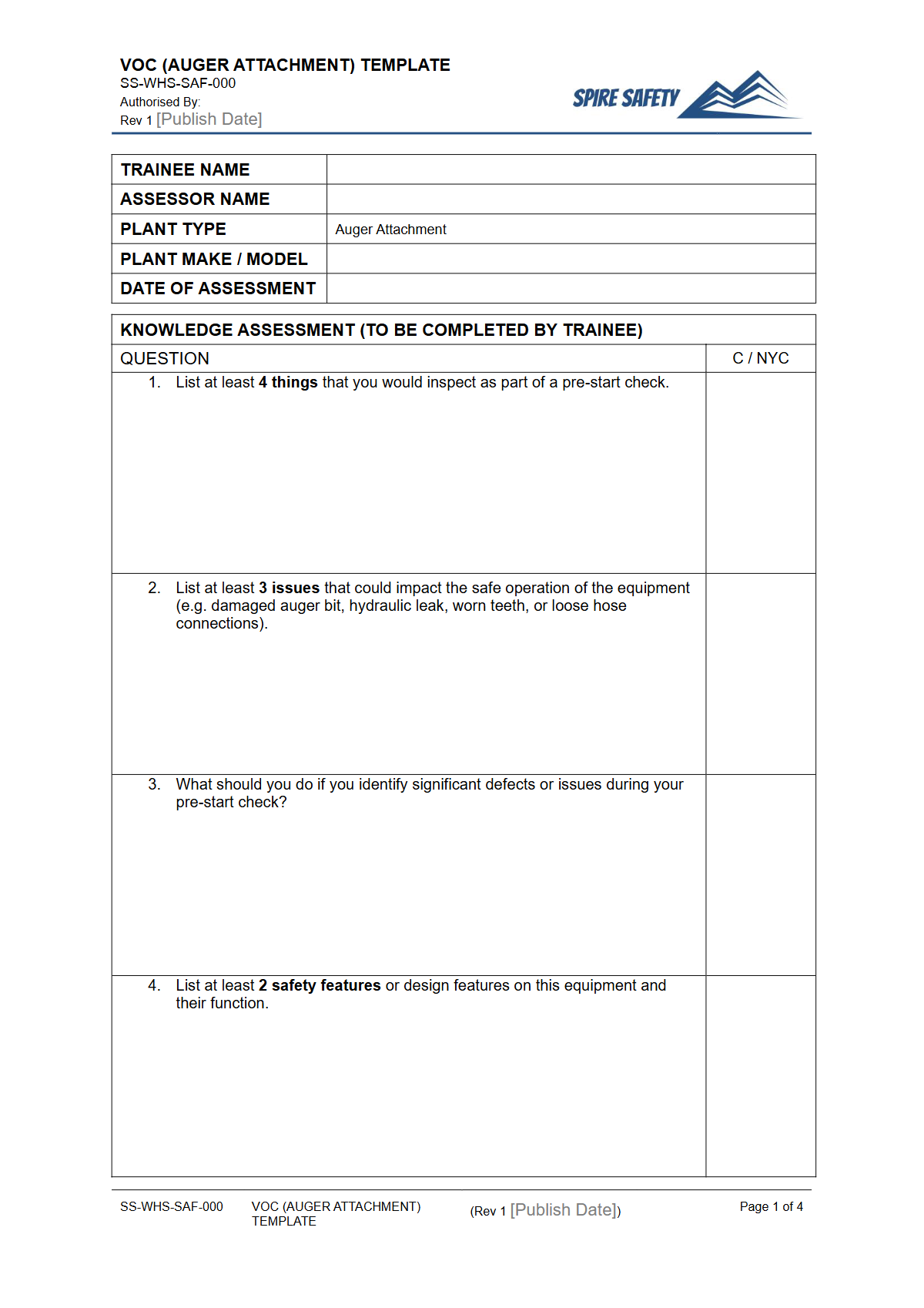
A Verification of Competency (VOC) is a formal process to confirm that an operator not only holds the relevant licence but can also operate the equipment safely and competently in a real-world setting. This Free Verification of Competency (Auger Attachment) Template provides a structured framework for assessing and documenting an operator's skills, knowledge, and safe work behaviour.
Using this template helps a Person Conducting a Business or Undertaking (PCBU) meet their primary duty of care by ensuring workers are competent for the tasks they perform. A documented VOC program demonstrates proactive risk management and is a vital component of a robust WHS management system. It provides clear evidence that you have taken steps to verify the current skills of your operators for high-risk plant.
Video walkthrough
How to use the Free Verification of Competency (Auger Attachment) Template
This template is designed as a starting point for assessing operators of auger attachments. A competent person—someone with the requisite knowledge and experience in both the assessment process and auger operations—should conduct the verification. The process typically involves several stages:
- Theory Assessment: Questioning the operator to confirm their understanding of the auger's functions, limitations, pre-start checks, emergency procedures, and specific site hazards (e.g., reading Dial Before You Dig plans).
- Practical Observation: Watching the operator perform a range of tasks, such as connecting the attachment, performing pre-start inspections, drilling holes of various depths and diameters, navigating the work area, and executing a safe shutdown and disconnection.
- Review of Evidence: Checking for a valid High Risk Work Licence or ticket for the host machine, logbooks, and any previous training records.
Note: This document is a template and is not a complete solution out of the box. It is essential that you customise this template to suit your specific auger model, the host machine it is attached to, your site conditions, and your organisation's safe work procedures.
We have provided a framework, but you must ensure it reflects the unique risks and control measures of your workplace.
While this resource focuses on the auger, the host machine is equally important. Ensure operators are also verified on the specific make and model of the prime mover by using a document like our Verification of Competency (Mini Excavator) Template if applicable.
When to use it
A Verification of Competency is not a one-time event. It should be conducted at various points in an operator's employment lifecycle to ensure their skills remain current and they are familiar with the specific equipment they are required to use. Key triggers for conducting a VOC include:
- Before an operator uses a specific type or model of auger for the first time.
- As part of pre-employment screening to validate a candidate's claimed experience.
- When an operator is assigned to a new host machine they are not familiar with.
- Following a significant period of absence from the role.
- After an incident, near-miss, or observation of unsafe behaviour.
- As part of a scheduled periodic assessment (e.g., every 1-2 years) to ensure skills have not degraded.
Determining the right frequency and triggers for VOCs within your organisation can be complex. For expert guidance on integrating VOCs into your safety framework, consider engaging professional WHS consulting services.
Who should use it
This template is intended for use by individuals responsible for ensuring plant safety and worker competency within an organisation. This includes:
- WHS Managers and Advisors: To implement a standardised and documented VOC program across the business.
- Site Supervisors and Foremen: To conduct on-the-job assessments of operators in their teams.
- Competent Assessors: As a tool to guide and record the verification process, ensuring all key criteria are covered consistently.
- Project Managers: To ensure that all contractors and their employees operating high-risk equipment on their site have been appropriately verified as competent.
It is critical that the person conducting the assessment is not only familiar with the VOC process but is also an expert in auger operations themselves. Their judgement is key to determining if an operator's skill level is satisfactory.
This process is distinct from assessing competency on other common construction plant, like that covered in our Verification of Competency (Rough Terrain Forklift), and requires specific expertise.
While augers are used for drilling into the ground, other drilling equipment exists in different contexts. For assessing competency on workshop machinery, you might need a specialised tool such as our Free Drill Press VOC (Verification of Competency) Template.
Common mistakes
Common mistakes to avoid
- Using a generic VOC that fails to address auger-specific hazards like entanglement or soil conditions.
- Forgetting to conduct a separate VOC for the host machine (e.g., excavator, skid steer) the auger is attached to.
- Appointing an assessor who lacks deep, practical experience with auger attachments.
- Treating the VOC as a 'tick and flick' paperwork exercise instead of a genuine practical assessment.
Legal references
Legal considerations
The following legal requirements may be relevant to this type of work.
- Work Health and Safety Act (Harmonised) — Provides the primary duties for protecting workers and other people from work health and safety risks.
- Work Health and Safety Regulations (Harmonised) — Sets out requirements supporting the management of workplace hazards and risks.
The following codes may be relevant to this type of work.
- Managing WHS Risks Code of Practice — Provides practical guidance on identifying hazards, assessing risks and applying effective controls.
- Work Health and Safety Consultation, Cooperation and Coordination Code of Practice — Provides practical guidance on consulting workers and coordinating with other duty holders.
- Managing the Work Environment and Facilities Code of Practice — Provides practical guidance on safe work environments, workplace facilities and related controls.
Did you know
Hidden Dangers
Striking underground services like gas, water, or electrical lines is one of the most significant risks when using augers. 'Dial Before You Dig' is a mandatory first step in the risk assessment process, not an option.
FAQ
Frequently asked questions
01What is the difference between a licence and a Verification of Competency (VOC)?
02Who is considered a 'competent person' to conduct an auger attachment VOC?
03How often should an operator's competency on an auger be re-verified?
04Does this template also cover the excavator or skid steer the auger is attached to?
Share this resource
Free Verification of Competency (Auger Attachment) Template
Browse Categories
How To Use It
- 1Download and open in Word or PDF.
- 2Replace the placeholders with your business details.
- 3Get it reviewed by a WHS specialist before rollout.
Need it customised?
Our WHS consultants can adapt this template to your site, run a gap analysis, or audit what you already have in place.
Book a Free Consultation WHS consulting servicesor call 1300 156 382
Related templates
- Free Verification of Competency (Bottle Jack) Template
- Free Verification of Competency (Compaction Wheel) Template
- Free Verification of Competency (Concrete Core Drill) Template
- Free Verification of Competency (Concrete Scarifier) Template
- Free Verification of Competency (Concrete Screed) Template
- Free Verification of Competency (Crawler Crane) Template