
Free Verification of Competency (Bottle Jack) Template
Download our free Verification of Competency (Bottle Jack) Template to assess operator skills.
Free Verification of Competency (Bottle Jack) Template
DOCX • 140 KB + PDF
Updated Oct 2026
No signup required
Purpose of the Free Verification of Competency (Bottle Jack) Template
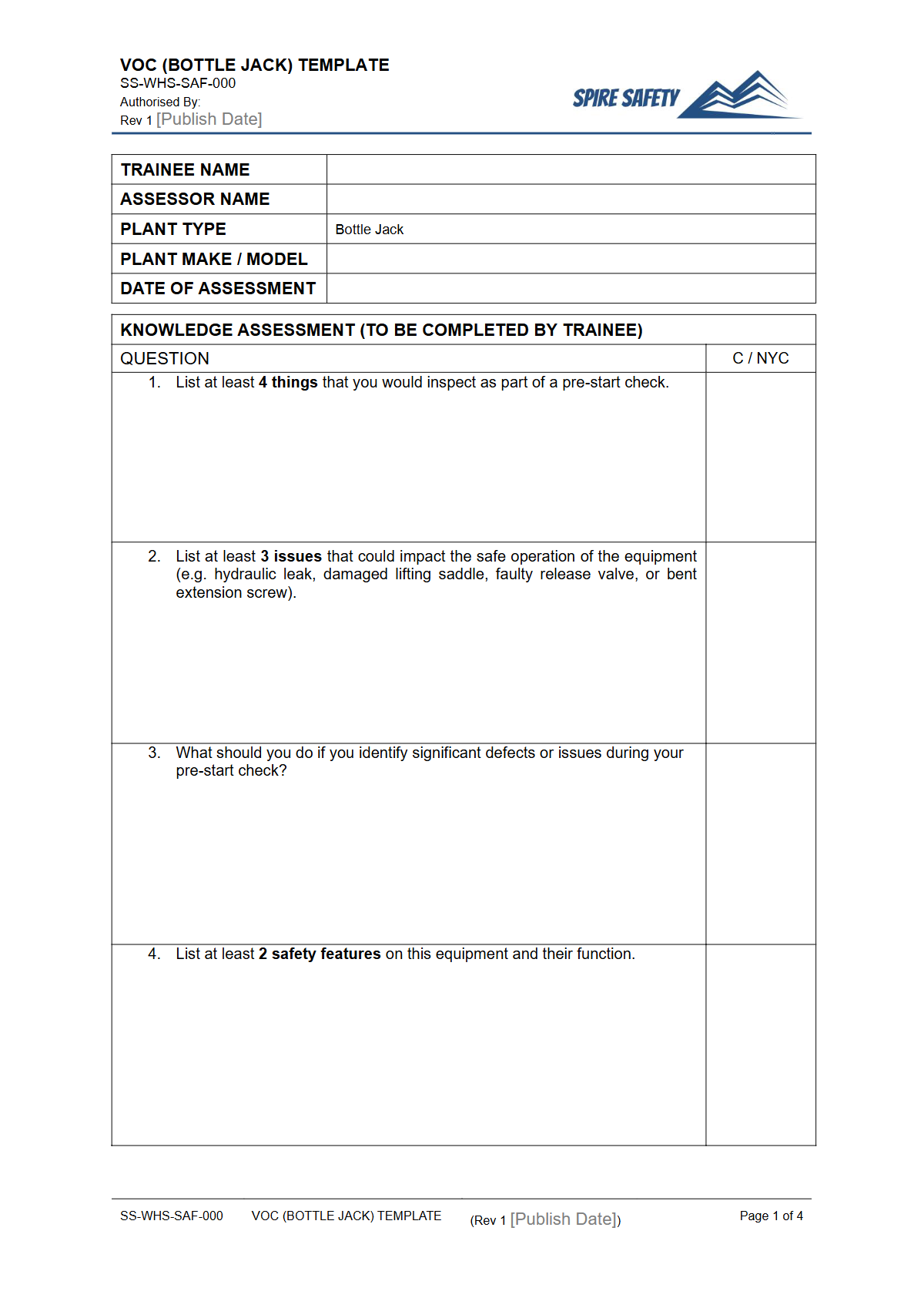
Ensuring workers can operate equipment safely and competently is a cornerstone of Australian workplace health and safety. This Free Verification of Competency (Bottle Jack) Template provides a structured framework for assessing and confirming that an individual has the necessary skills, knowledge, and experience to use a hydraulic bottle jack correctly.
A VOC is not just about initial training; it's a practical check to verify that a worker’s competence is current and aligned with your specific operational requirements and safety procedures.
A Person Conducting a Business or Undertaking (PCBU) has a primary duty of care to provide a safe work environment, which includes ensuring workers are competent for the tasks they perform. Using this template helps you document the verification process, demonstrating due diligence.
This formal assessment is an essential component of robust WHS management systems, creating a clear record of who is authorised to use specific plant and equipment on site.
Video walkthrough
How to Use the Free Verification of Competency (Bottle Jack) Template
This template is designed for practical, on-the-job assessment. The process involves an experienced assessor observing a worker as they perform tasks with a bottle jack, from pre-start inspection through to correct storage.
The assessor uses the checklist to record observations against key safety and operational criteria. These criteria cover selecting the right jack, checking its condition, positioning it correctly under a stable load point, lifting and lowering the load smoothly, and using appropriate support stands.
This resource acts as a solid foundation, similar in purpose to our Verification of Competency for a hydraulic impact wrench, but it requires site-specific adjustment.
Important Customisation Note
It is crucial to customise this template for your specific workplace. We've provided a comprehensive starting point, but you must add, remove, or modify sections to reflect the exact models of bottle jacks used, your site-specific hazards (e.g., uneven ground, confined spaces), and your company's safe work procedures.
A generic document is not sufficient; it must be a live document tailored to your operational context.
When to Use a Verifications of Competency
A VOC for a bottle jack should be conducted at several key points to manage risk effectively. It's not a one-time event. Consider using it for:
- New Workers: Before an employee or contractor uses a bottle jack for the first time, even if they claim prior experience.
- New Equipment: When a new make or model of bottle jack with different features or capacity is introduced to the workplace.
- Post-Incident: Following any incident or near-miss involving lifting operations to identify and correct behavioural or knowledge gaps.
- Observed Risk Behaviour: If a supervisor observes a worker using a jack incorrectly or taking unsafe shortcuts.
- Periodic Refreshers: As part of a scheduled competency review program, ensuring skills remain sharp over time. Regularly reviewing procedures is a key activity verified during a WHS compliance auditing process.
Who Should Conduct the Assessment
The person conducting the Verification of Competency must be competent themselves. This means they should be an experienced and credible operator who has extensive, current knowledge of using bottle jacks safely.
They should also understand the principles of assessment and be familiar with your organisation’s specific safety policies and procedures. The assessor's role is to objectively evaluate the worker's performance against the established criteria, provide constructive feedback, and determine if the worker is competent or requires further training.
This principle applies across all equipment, whether it's a simple tool or complex machinery like that covered in our Verification of Competency (Rough Terrain Forklift) template.
An effective assessor can distinguish between compliant technique and risky habits, ensuring the verification process genuinely confirms safety and capability. For specialised equipment or high-risk environments, you may consider engaging external WHS consulting experts to assist with developing your assessment framework. This ensures the criteria are robust and aligned with industry best practice, similar to how our free Drill Press VOC helps standardise assessments for common workshop machinery. You can find more templates like this in our free WHS resources library to build out your complete competency program.
Common mistakes
Common mistakes to avoid
- Using the jack on an uneven, unstable, or soft surface, leading to a risk of it tipping over.
- Failing to use appropriately rated vehicle stands after lifting, unsafely relying on the jack's hydraulics to support the load.
- Attempting to lift a load that exceeds the jack's stated Safe Working Load (SWL).
- Neglecting pre-use inspections for hydraulic fluid leaks, visible damage, or bent components.
Legal references
Legal considerations
The following legal requirements may be relevant to this type of work.
- Work Health and Safety Act (Harmonised) — Provides the primary duties for protecting workers and other people from work health and safety risks.
- Work Health and Safety Regulations (Harmonised) — Sets out requirements supporting the management of workplace hazards and risks.
The following codes may be relevant to this type of work.
- Managing WHS Risks Code of Practice — Provides practical guidance on identifying hazards, assessing risks and applying effective controls.
- Work Health and Safety Consultation, Cooperation and Coordination Code of Practice — Provides practical guidance on consulting workers and coordinating with other duty holders.
- Managing the Work Environment and Facilities Code of Practice — Provides practical guidance on safe work environments, workplace facilities and related controls.
Did you know
Hydraulic Power
Bottle jacks utilise Pascal's principle, where a small force applied to a small piston generates a much larger lifting force on a larger piston, allowing them to lift thousands of kilograms with minimal human effort.
Overload Risk
Most bottle jacks have a built-in pressure relief valve to prevent catastrophic failure from overloading, but relying on it is unsafe. Always know the jack's Safe Working Load (SWL) and the weight of the object you intend to lift.
FAQ
Frequently asked questions
01What is a Verification of Competency (VOC) for a bottle jack?
02Is a VOC legally required for using a bottle jack in Australia?
03How often should a bottle jack VOC be conducted?
04Can I use this template for other types of jacks, like a trolley jack?
Share this resource
Free Verification of Competency (Bottle Jack) Template
Browse Categories
How To Use It
- 1Download and open in Word or PDF.
- 2Replace the placeholders with your business details.
- 3Get it reviewed by a WHS specialist before rollout.
Need it customised?
Our WHS consultants can adapt this template to your site, run a gap analysis, or audit what you already have in place.
Book a Free Consultation WHS consulting servicesor call 1300 156 382
Related templates
- Free Verification of Competency (Compaction Wheel) Template
- Free Verification of Competency (Concrete Core Drill) Template
- Free Verification of Competency (Concrete Scarifier) Template
- Free Verification of Competency (Concrete Screed) Template
- Free Verification of Competency (Crawler Crane) Template
- Free Verification of Competency (Dewatering Pump) Template