
Free Verification of Competency (Compaction Wheel) Template
Download our free Verification of Competency (Compaction Wheel) Template.
Free Verification of Competency (Compaction Wheel) Template
DOCX • 139 KB + PDF
Updated Oct 2026
No signup required
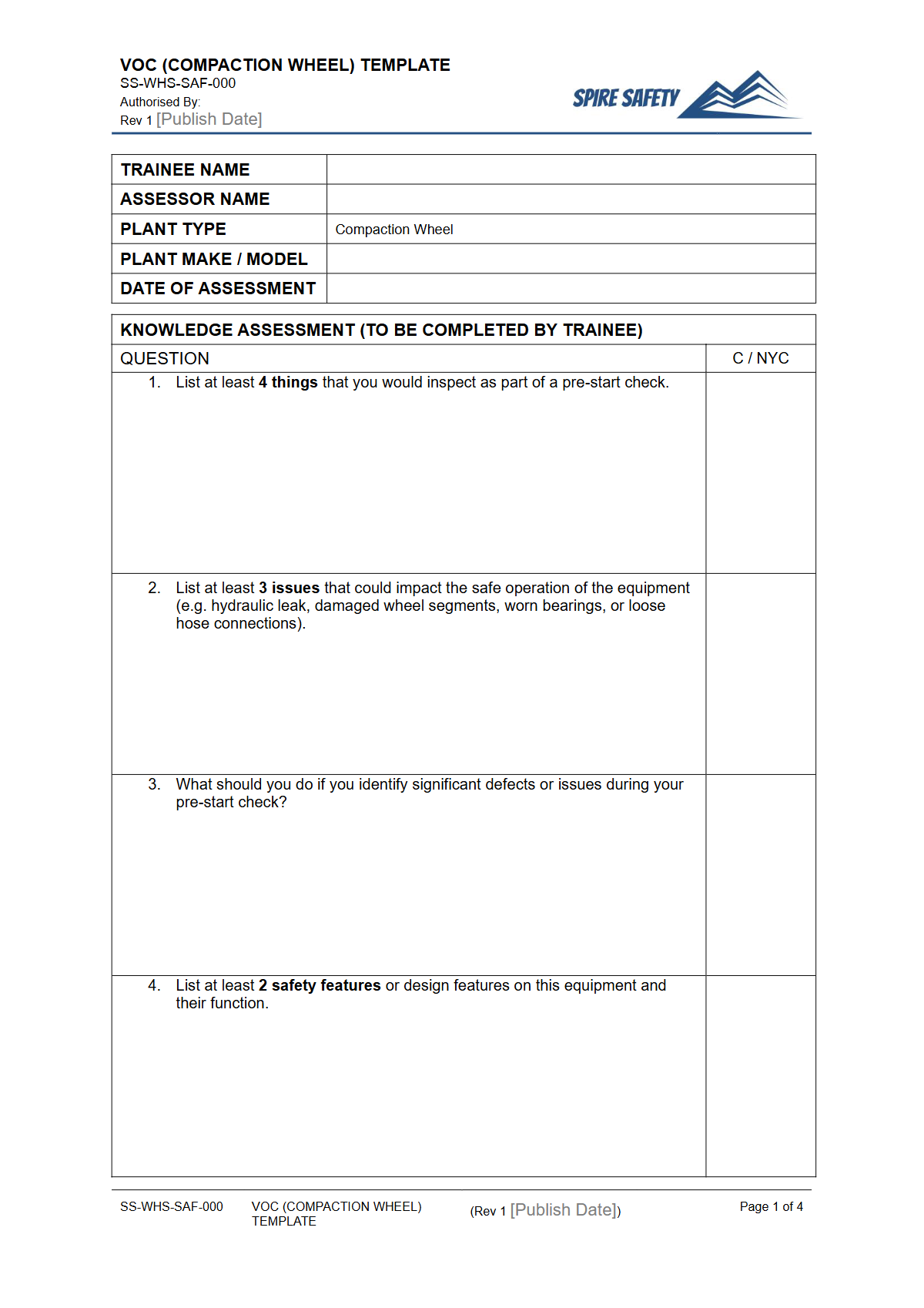
Purpose of the Free Verification of Competency (Compaction Wheel) Template
Operating a compaction wheel, also known as a padfoot roller, involves specific risks related to ground stability, interaction with other mobile plant, and potential rollovers. This free Verification of Competency (Compaction Wheel) template provides a structured method for a Person Conducting a Business or Undertaking (PCBU) to confirm that an operator can use this equipment safely and effectively in a live work environment.
It serves as a practical assessment tool that goes beyond initial licensing, verifying that a worker’s skills remain current and are suited to your specific site conditions and machinery.
Using a formal VOC process helps demonstrate due diligence in managing workplace risks associated with mobile plant. It confirms that operators understand not just the basic controls but also site-specific hazards, emergency procedures, and safe work method statements (SWMS).
Proper verification ensures operators are competent not only on the compaction wheel but also in the context of broader civil construction tasks. For teams involved in road surfacing, this resource complements our Asphalt Paver Verification of Competency (VOC) Template.
Video walkthrough
How to use the Free Verification of Competency (Compaction Wheel) Template
This template is designed for ease of use by supervisors, trainers, or WHS personnel. The process is straightforward:
- Download the template in your preferred format (DOCX for easy editing or PDF).
- Customise the checklist to align with the specific make and model of the compaction wheel used at your workplace, as well as your operational procedures and risk assessments.
- The assessment includes both a theory component (knowledge-based questions) and a practical observation checklist.
- A competent person observes the operator performing tasks detailed in the checklist, such as pre-start checks, safe manoeuvring on various gradients, compaction techniques, and shutdown procedures.
- The assessor documents the operator's performance, noting any areas of strength or where further training is required.
- Both the assessor and the operator sign the completed form to confirm the outcome. The record should then be stored securely as part of the worker's training file.
IMPORTANT: This document is a template only. We have developed it as a starting point, and you must customise it to reflect the specific compaction wheel models, site conditions, safe work procedures, and risks present in your workplace. Integrating this process is a key part of maintaining robust WHS management systems.
When to use it
A Verification of Competency should not be a one-off event. It is a vital tool for ongoing risk management and should be used in several scenarios, including:
- Pre-employment or prior to starting a new project: To verify the skills and qualifications of new hires or contractors.
- Introduction of new equipment: When a new make or model of compaction wheel is introduced to the workplace.
- Post-incident: Following any incident or near-miss involving a compaction wheel to identify and address any competency gaps.
- Identified performance issues: If a supervisor observes unsafe or inefficient operation.
- Periodic re-verification: As part of a regular schedule (e.g., every 2-3 years) to ensure skills remain current, particularly for operators who use the equipment infrequently. This proactive approach can be validated during a WHS compliance auditing program.
Who should use it
This template is intended for use by individuals responsible for workplace safety and operational supervision. This includes:
- Site Supervisors and Forepersons: They are on the front line and are best placed to observe operator behaviour and conduct practical assessments.
- WHS Managers and Advisors: They can use the template to implement a standardised competency framework across the organisation. They might also need to verify competency on related machinery, which our Verification of Competency (Water Cart) template can assist with.
- Project Managers: To ensure all operators on their site are competent and that project safety obligations are being met.
- Internal Trainers and Assessors: As a formal tool for conducting and documenting VOC assessments.
For organisations requiring assistance in developing a comprehensive competency program or for complex operational needs, engaging with professional WHS consulting services can provide expert guidance and support. Just as with specialised earthmoving equipment like trenchers, assessing compaction wheel operators is crucial for overall site safety, a process detailed in our Verification of Competency (Trencher) document.
Common mistakes
Common mistakes to avoid
- Using a generic checklist that doesn't cover the specific model of compaction wheel or site hazards.
- Treating the VOC as a paperwork exercise without meaningful observation of practical skills.
- Failing to document the assessment properly, including any corrective actions or requirements for retraining.
- Using an assessor who is not themselves competent and experienced with the specific type of compaction wheel.
Legal references
Legal considerations
The following legal requirements may be relevant to this type of work.
- Work Health and Safety Act (Harmonised) — Provides the primary duties for protecting workers and other people from work health and safety risks.
- Work Health and Safety Regulations (Harmonised) — Sets out requirements supporting the management of workplace hazards and risks.
The following codes may be relevant to this type of work.
- Managing WHS Risks Code of Practice — Provides practical guidance on identifying hazards, assessing risks and applying effective controls.
- Work Health and Safety Consultation, Cooperation and Coordination Code of Practice — Provides practical guidance on consulting workers and coordinating with other duty holders.
- Managing the Work Environment and Facilities Code of Practice — Provides practical guidance on safe work environments, workplace facilities and related controls.
Did you know
Padfoot vs. Smooth Drum
Compaction wheels, or padfoot rollers, are specifically designed for compacting cohesive soils like clay and silt. The 'pads' or 'feet' apply high pressure to knead and densify the soil, which is different from smooth drum rollers used for granular materials like sand or asphalt.
Compaction and Ground Stability
The primary goal of compaction is to increase the density of soil or other materials to improve their load-bearing capacity and stability. Insufficient compaction is a leading cause of foundation settlement and pavement failure in construction projects.
FAQ
Frequently asked questions
01What is a Verification of Competency (VOC) for a compaction wheel?
02Is a compaction wheel VOC the same as a licence or ticket?
03How often should a VOC for a compaction wheel be conducted?
04Who is qualified to conduct a compaction wheel VOC assessment?
Share this resource
Free Verification of Competency (Compaction Wheel) Template
Browse Categories
How To Use It
- 1Download and open in Word or PDF.
- 2Replace the placeholders with your business details.
- 3Get it reviewed by a WHS specialist before rollout.
Need it customised?
Our WHS consultants can adapt this template to your site, run a gap analysis, or audit what you already have in place.
Book a Free Consultation WHS consulting servicesor call 1300 156 382
Related templates
- Free Verification of Competency (Concrete Core Drill) Template
- Free Verification of Competency (Concrete Scarifier) Template
- Free Verification of Competency (Concrete Screed) Template
- Free Verification of Competency (Crawler Crane) Template
- Free Verification of Competency (Dewatering Pump) Template
- Free Verification of Competency (Drum Lifter) Template