
Free WHS Inspection (Chemical Plant) Template
Download our free WHS Inspection Template for Chemical Plants. A structured starting point for identifying hazards and managing risks. Get your DOCX & PDF now.
Free WHS Inspection (Chemical Plant) Template
DOCX • 128 KB + PDF
Updated Oct 2026
No signup required
Purpose of the Free WHS Inspection (Chemical Plant) Template
Operating a chemical plant involves managing significant inherent risks, from hazardous substances and complex machinery to the potential for fire, explosion, or catastrophic release. A systematic inspection program is a critical component of your safety management system.
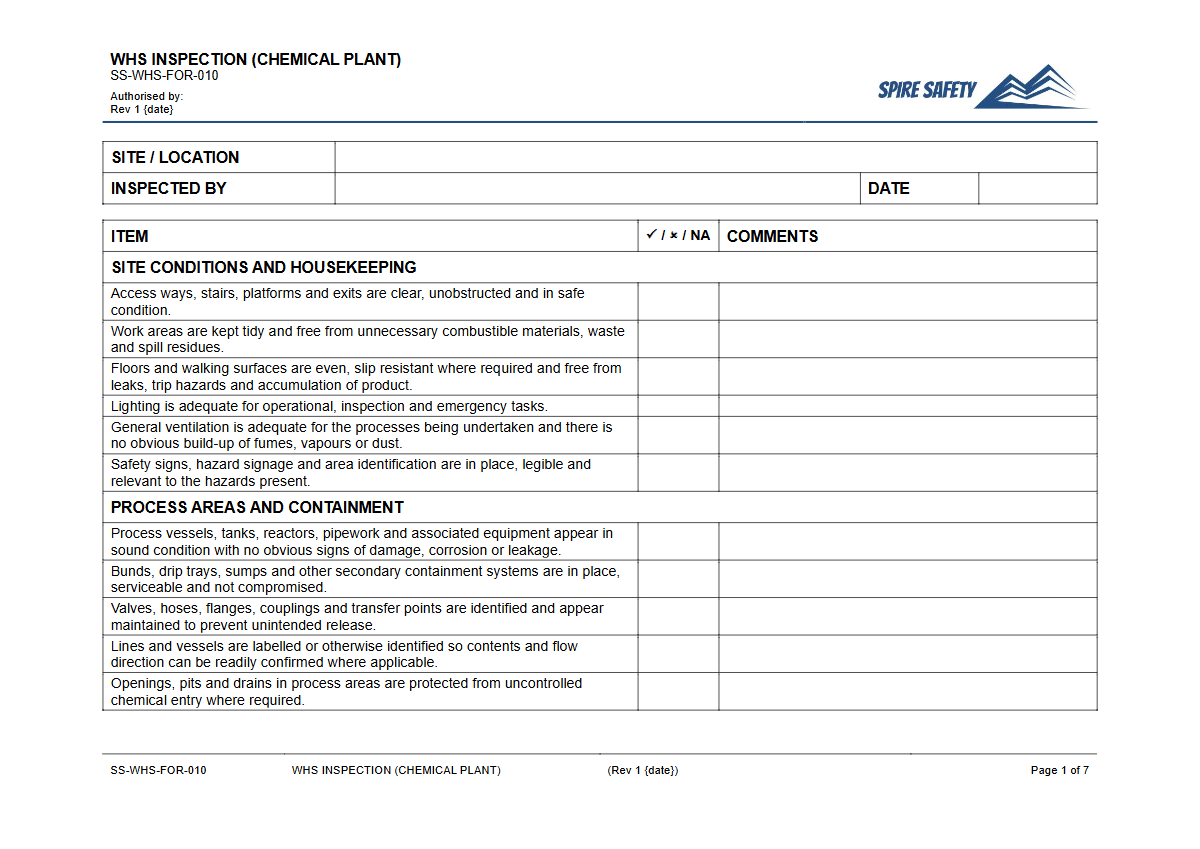
Our free WHS Inspection (Chemical Plant) Template provides a structured starting point for your organisation to conduct thorough and consistent safety checks. This document helps you formalise the process of identifying, documenting, and addressing hazards before they lead to an incident.
It is designed to prompt a review of key safety areas specific to chemical processing environments, helping you maintain a safer workplace.
Regular inspections help ensure that safety controls are in place and functioning as intended. They are a proactive measure to verify compliance with your own procedures and identify unsafe conditions or behaviours.
A key risk in any chemical facility is the loss of containment. To further support your team's readiness, consider using our Spill Prevention and Response Toolbox Talk to reinforce procedures for managing chemical spills effectively.
Video walkthrough
How to use the Free WHS Inspection (Chemical Plant) Template
Using this template effectively involves more than just downloading it. Follow these steps to integrate it into your WHS management practices:
- Download: Choose between the DOCX and PDF formats. The DOCX version is fully editable to suit your specific needs.
- Customise: This is the most critical step. Adapt the template to cover the specific hazards, chemicals, equipment, and processes unique to your site. Generic checklists are not sufficient for complex, high-risk environments.
- Schedule: Determine an appropriate frequency for inspections based on risk. This may include daily pre-start checks on critical equipment, weekly area inspections, and monthly site-wide reviews.
- Train: Ensure the personnel conducting the inspections are competent to do so. They must understand the hazards they are looking for and know the facility's safety procedures.
- Conduct & Document: Perform the inspection methodically. Document all findings, including both compliant and non-compliant items. Use photos where they can add clarity.
- Act: Develop and track corrective actions for all identified issues. Assign responsibility and set deadlines to ensure hazards are controlled in a timely manner.
Important: You must customise this template to reflect the specific machinery, chemicals, processes, and risks present in your workplace. We cannot know your specific site's hazards, so you must adapt this document to ensure it is fit for purpose.
If you require assistance tailoring safety documentation for a complex environment, our WHS consulting services can provide expert guidance.
Key Areas Covered in the Inspection
This template is structured to cover a broad range of WHS considerations relevant to a chemical plant. While you must add site-specific details, the key sections prompt review of:
- Chemical Storage and Handling: Assesses segregation of incompatible substances, correct labelling, bunding integrity, and availability of Safety Data Sheets (SDS).
- Process Safety and Equipment: Examines the condition of reactors, vessels, piping, and valves. It also includes checks on instrumentation, controls, and process alarms.
- Emergency Systems: Verifies the accessibility and functionality of fire suppression systems, emergency showers, eyewash stations, and communication equipment.
- Plant and Equipment: Covers the general condition of fixed and mobile plant. For specific high-risk machinery, dedicated assessments are required, such as a Grader Risk Assessment for earthmoving equipment used in site maintenance.
- Site Conditions and Housekeeping: Checks for clear access and egress, trip hazards, appropriate signage, and general workplace tidiness.
When to use it
Workplace inspections in a chemical plant are not a one-off event. They should be conducted at regular intervals and in response to specific triggers. Use this Inspection template for:
- Routine Safety Walks: Scheduled weekly or monthly inspections of designated plant areas.
- Pre-Commissioning: Before introducing new plant, equipment, or processes.
- Post-Maintenance: To verify that equipment is safe to return to service after repairs or modifications.
- After an Incident or Near Miss: To help identify root causes and contributing factors related to workplace conditions.
- Changes in Legislation or Standards: To verify that your current controls align with new requirements.
While regular inspections are a vital operational check, they should not be confused with formal audits. An inspection checks for compliance against a set standard, whereas an audit is a more comprehensive review of the entire safety management system itself. For a deeper evaluation of your systems, you may require formal WHS compliance auditing.
Who should use it
A collaborative approach to inspections often yields the best results. The personnel involved can include:
- Supervisors and Line Managers: They have direct responsibility for the safety of their teams and work areas.
- WHS/HSE Advisors: They provide technical expertise and can help ensure the inspection process is robust.
- Health and Safety Representatives (HSRs): As worker representatives, their involvement is crucial for consultation and identifying shop-floor hazards.
- Trained Operators or Maintenance Staff: Their intimate knowledge of the equipment and processes is invaluable for spotting subtle deviations from normal operating conditions.
These activities should be embedded within your organisation's broader safety framework. A strong inspection program is a key pillar supporting effective WHS management systems, demonstrating a commitment to proactively managing risk.
Common mistakes
Common mistakes to avoid
- Failing to customise the template for the specific chemicals, equipment, and processes on site.
- Treating the inspection as a 'tick and flick' exercise without genuine investigation or curiosity.
- Not following up on identified issues or implementing corrective actions in a timely manner.
- Assigning inspections to untrained or inexperienced personnel who may not recognise significant hazards.
Legal references
Legal considerations
The following legal requirements may be relevant to this type of work.
- Work Health and Safety Act (Harmonised) — Provides the primary duties for protecting workers and other people from work health and safety risks.
- Work Health and Safety Regulations (Harmonised) — Sets out requirements supporting the management of workplace hazards and risks.
The following codes may be relevant to this type of work.
- Managing WHS Risks Code of Practice — Provides practical guidance on identifying hazards, assessing risks and applying effective controls.
- Work Health and Safety Consultation, Cooperation and Coordination Code of Practice — Provides practical guidance on consulting workers and coordinating with other duty holders.
- Managing the Work Environment and Facilities Code of Practice — Provides practical guidance on safe work environments, workplace facilities and related controls.
Did you know
Process Safety Management
Many major chemical plant incidents are linked to failures in Process Safety Management (PSM), which focuses on preventing large-scale hazardous releases, distinct from personal safety issues like slips and trips.
Hierarchy of Control
When addressing hazards found during an inspection, the Hierarchy of Control must be applied. Elimination is the most effective control measure, while relying solely on Personal Protective Equipment (PPE) is the least effective.
FAQ
Frequently asked questions
01How often should a chemical plant be inspected?
02Is this template suitable for a Major Hazard Facility (MHF)?
03What is the difference between an inspection and a risk assessment?
04Can I use this template for other industrial sites?
Share this resource
Free WHS Inspection (Chemical Plant) Template
Browse Categories
How To Use It
- 1Download and open in Word or PDF.
- 2Replace the placeholders with your business details.
- 3Get it reviewed by a WHS specialist before rollout.
Need it customised?
Our WHS consultants can adapt this template to your site, run a gap analysis, or audit what you already have in place.
Book a Free Consultation WHS consulting servicesor call 1300 156 382