
Free WHS Inspection (Club) Template
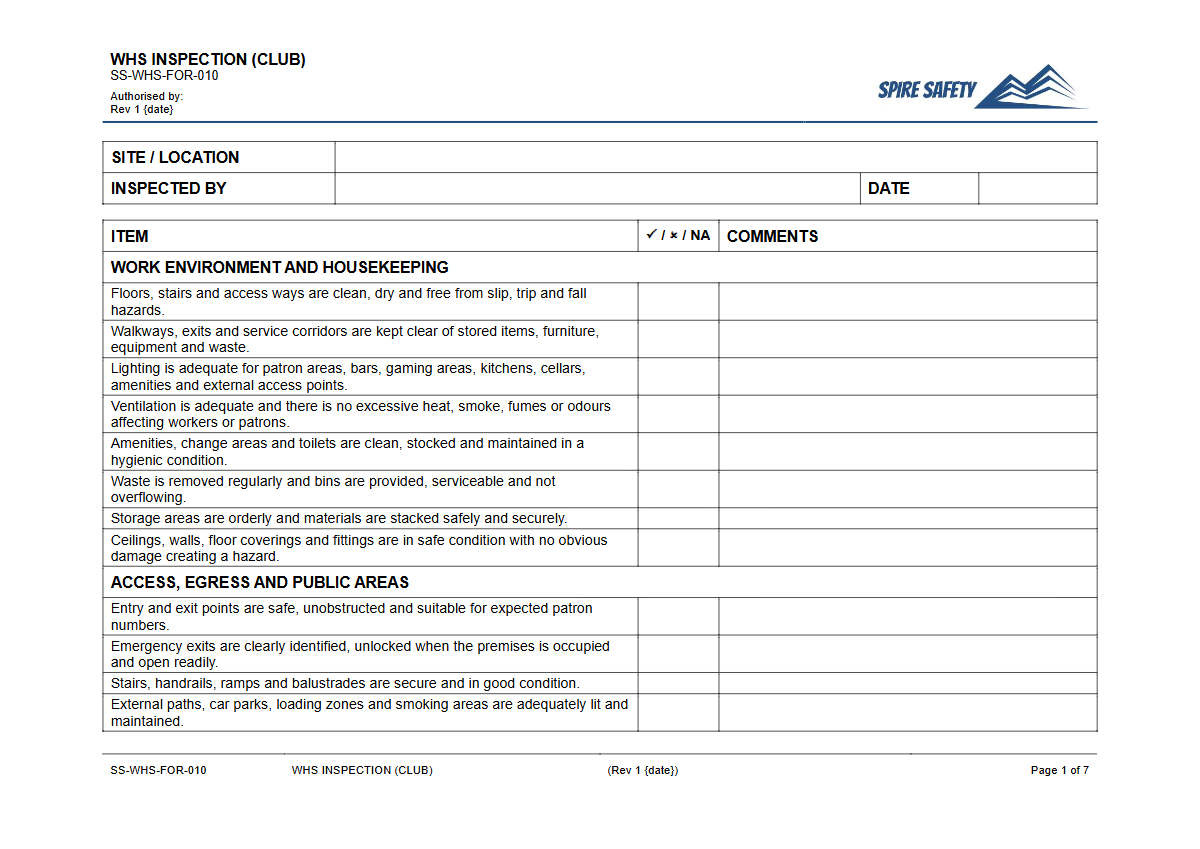
Download our Free WHS Inspection (Club) Template to formalise safety checks at your sports or community club. A structured starting point for managing risks.
Free WHS Inspection (Club) Template
DOCX • 128 KB + PDF
Updated Oct 2026
No signup required
Purpose of the Free WHS Inspection (Club) Template
Running a sports, community, or social club involves a legal duty of care to protect members, volunteers, staff, and visitors from harm. A key part of fulfilling this duty is conducting regular safety inspections.
Our Free WHS Inspection (Club) Template provides a structured starting point for your organisation to proactively identify, assess, and control hazards across your facilities and operations. Using this template helps formalise your safety processes, demonstrating due diligence and a commitment to providing a safe environment for everyone involved.
Regular inspections are fundamental to effective risk management. They help prevent incidents before they occur by catching potential issues like faulty equipment, unsafe structures, poor housekeeping, or inadequate emergency procedures.
This not only protects people but also safeguards the club against potential legal action, financial loss, and reputational damage. By systematically documenting your inspections, you create a valuable record of your safety efforts, which can be reviewed to identify trends and continuously improve your safety performance.
This aligns with the principles of an effective WHS management system, creating a framework for ongoing safety.
Video walkthrough
How to use the Free WHS Inspection (Club) Template
This template is available as a fully editable DOCX file and a print-ready PDF. It is designed to be a comprehensive starting point, covering common areas found in many club environments, such as clubrooms, kitchens, outdoor areas, and amenities.
However, it must be adapted to your specific circumstances.
To use the template effectively:
- Download the DOCX version and open it in your preferred word processor.
- Review each section and checklist item, adding, removing, or modifying points to reflect the unique layout, equipment, and activities of your club. For example, if your club has a gym, you may need to add specific checks for equipment like treadmills, which can be guided by a resource like our Free Pre-Start Checklist for Gym Treadmills.
- Add your club's name, logo, and the details of the person conducting the inspection.
- Save the customised document as your club's official inspection template. Print copies for manual completion or use it as a digital form.
- Train the designated personnel on how to complete the inspection thoroughly and what to do when a hazard is identified.
Important: This document is a template only. We have developed it as a guide, but its effectiveness depends on you customising it to suit the specific hazards and operational needs of your workplace.
You must ensure it covers all relevant risks at your club.
When to use it
The frequency of inspections depends on the level of risk associated with different areas and activities. Some areas may require daily checks, while others can be inspected weekly, monthly, or before major events.
For instance, high-traffic areas like kitchens and bar facilities might need daily walk-throughs to check for slip hazards and hygiene issues. You could formalise these with specific tools like a Free Pre-Start Checklist (Freezer) Template for key kitchen equipment.
Playing fields and outdoor equipment, such as those maintained with ride-on mowers, should be inspected before each use to ensure they are safe and free from hazards. You can adapt a specific checklist for this, such as our Free Pre-Start Checklist (Lawn Tractor) Template, for your groundskeeping machinery.
It is also best practice to conduct a comprehensive facility-wide inspection on a scheduled basis, such as quarterly or bi-annually, to review all aspects of the club's WHS environment. Independent WHS compliance auditing can supplement your internal inspections by providing an expert, third-party perspective.
Who should use it
This template is designed for anyone responsible for health and safety within a club setting. This can include a range of roles, depending on the size and structure of the organisation:
- Club Managers or CEOs: To oversee the implementation of safety procedures and supports your compliance efforts.
- WHS or Safety Officers: For conducting and documenting formal inspections as part of their duties.
- Committee Members: To fulfil their governance responsibilities regarding health and safety.
- Designated Volunteers: Appointed individuals trained to carry out safety checks in specific areas.
- Team Leaders or Coaches: To inspect their immediate areas of operation, such as training facilities or playing surfaces, before use.
Ultimately, the Person Conducting a Business or Undertaking (PCBU)—which is typically the club itself as an incorporated association—is responsible for ensuring these inspections happen. Delegating the task does not remove the PCBU's overall responsibility.
For those looking for more comprehensive safety documents, our free WHS resources library offers a wide range of additional templates and checklists.
Common mistakes
Common mistakes to avoid
- Using a generic checklist without customising it for the club's specific hazards and equipment.
- Failing to document inspection findings and corrective actions taken to address identified issues.
- Not providing adequate information or training to the person conducting the inspection.
- Conducting inspections irregularly or only after an incident has already occurred.
Legal references
Legal considerations
The following legal requirements may be relevant to this type of work.
- Work Health and Safety Act (Harmonised) — Provides the primary duties for protecting workers and other people from work health and safety risks.
- Work Health and Safety Regulations (Harmonised) — Sets out requirements supporting the management of workplace hazards and risks.
The following codes may be relevant to this type of work.
- Managing WHS Risks Code of Practice — Provides practical guidance on identifying hazards, assessing risks and applying effective controls.
- Work Health and Safety Consultation, Cooperation and Coordination Code of Practice — Provides practical guidance on consulting workers and coordinating with other duty holders.
- Managing the Work Environment and Facilities Code of Practice — Provides practical guidance on safe work environments, workplace facilities and related controls.
Did you know
Volunteer Duty of Care
Under model WHS laws, volunteers are legally considered 'workers' and are owed the same duty of care as paid employees. This means clubs must ensure their health and safety so far as is reasonably practicable.
FAQ
Frequently asked questions
01What are common hazards to look for in a sports club inspection?
02Are volunteers covered under Australian WHS laws?
03How often should a community club conduct WHS inspections?
04What is the difference between an inspection and an audit for a club?
Share this resource
Free WHS Inspection (Club) Template
Browse Categories
How To Use It
- 1Download and open in Word or PDF.
- 2Replace the placeholders with your business details.
- 3Get it reviewed by a WHS specialist before rollout.
Need it customised?
Our WHS consultants can adapt this template to your site, run a gap analysis, or audit what you already have in place.
Book a Free Consultation WHS consulting servicesor call 1300 156 382