
Free WHS Inspection (Commercial Laundry) Template
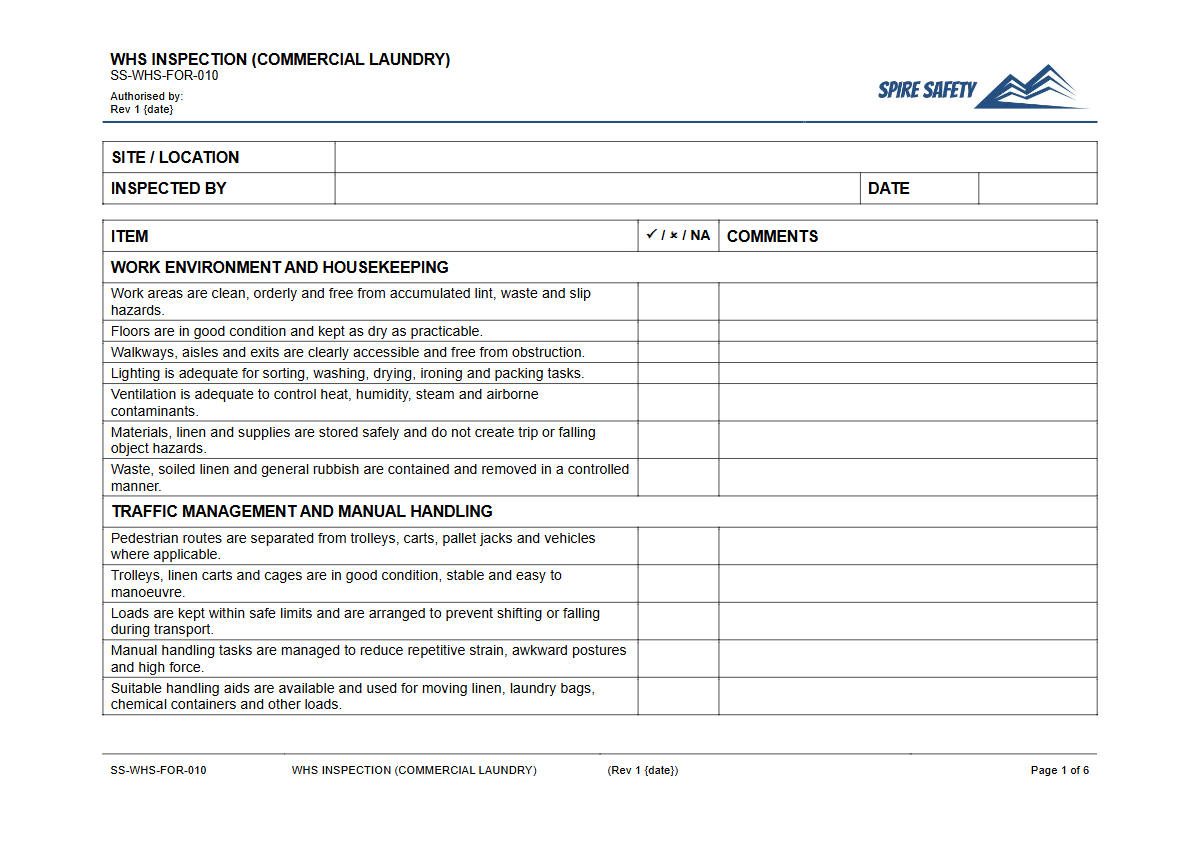
Download our free WHS Inspection Template for commercial laundries. This structured DOCX and PDF helps identify hazards and formalise safety checks.
Free WHS Inspection (Commercial Laundry) Template
DOCX • 127 KB + PDF
Updated Oct 2026
No signup required
Purpose of the Free WHS Inspection (Commercial Laundry) Template
Commercial laundry facilities contain a unique combination of hazards, including high-temperature equipment, powerful machinery, hazardous chemicals, and significant manual handling tasks. Conducting regular, thorough safety inspections is a critical part of a proactive approach to managing workplace health and safety.
This Free WHS Inspection (Commercial Laundry) Template provides a structured starting point for your organisation to formalise its inspection process. It is designed to help you systematically identify, assess, and control risks associated with laundry operations, from industrial washers and dryers to chemical storage and ergonomic stressors.
Using a standardised checklist helps ensure that no key areas are overlooked and creates a documented record of your safety efforts. This record is vital for demonstrating due diligence, tracking corrective actions, and continuously improving your safety performance.
It aligns with the principles of Australian WHS legislation, which requires a person conducting a business or undertaking (PCBU) to ensure a safe work environment so far as is reasonably practicable. Properly implemented, this process forms a key component of your overall WHS management system, helping to prevent injuries and incidents before they occur.
Video walkthrough
How to use the Free WHS Inspection (Commercial Laundry) Template
This template is provided as a fully editable DOCX file and a print-ready PDF. To begin, download the file and adapt it to the specific context of your workplace.
It is crucial to walk through your facility and add or remove checklist items to reflect your unique layout, equipment, chemicals, and work processes. An off-the-shelf template cannot cover every possible hazard in every workplace.
Important: This document is a template, not a finished safety document. We have drafted it as a helpful starting point, but you must customise it to your specific site, machinery (e.g., tunnel washers, flatwork ironers, presses), and procedures.
A generic checklist is insufficient for demonstrating compliance; your final document must reflect the actual risks present in your operations. If you are unsure how to conduct the necessary risk assessments to tailor this document, consider engaging professional WHS consulting services for guidance.
When to conduct a Laundry Inspection
The frequency of comprehensive workplace inspections depends on the level of risk. For a dynamic environment like a commercial laundry, a full inspection should be scheduled at regular intervals, such as monthly or quarterly. In addition to these planned checks, an inspection should also be triggered by specific events, including:
- After a near miss or incident has occurred.
- When new machinery or equipment is introduced.
- When new chemicals or work processes are implemented.
- If concerns are raised by workers or Health and Safety Representatives (HSRs).
These formal inspections are distinct from daily pre-start checks on specific pieces of plant. For example, while this template covers the overall environment, you might also use a separate, more frequent checklist like our Free Pre-Start Checklist for Commercial Ovens for high-risk thermal equipment before each shift.
Who should use this Inspection Template
Workplace inspections should be conducted by competent personnel who have a thorough understanding of the laundry's operations and associated hazards. This typically includes:
- WHS Managers or Officers
- Site Supervisors or Team Leaders
- Health and Safety Representatives (HSRs)
Involving a mix of management and workers in the inspection process can provide a more comprehensive view of the risks. It is essential that anyone using this template is trained in its use and understands the importance of accurately recording findings and initiating corrective actions.
The effectiveness of the inspection process can be verified through periodic WHS compliance auditing to ensure it is being completed correctly and is achieving its safety objectives.
Key Areas to Inspect
Your customised inspection should cover several key domains within the laundry environment:
Equipment and Machinery
Check that all machine guards are in place and functional, emergency stops are accessible and tested, and that equipment interlocks are working correctly. Inspect steam and hot water lines for leaks or damage, and ensure pressure relief valves on relevant equipment are certified.
For sites using lifting aids, a specific check similar to our Free Pre-Start Checklist (Electric Hoist) Template can be integrated.
Chemical and Environmental Safety
Verify that all chemicals are stored correctly, clearly labelled, and that Safety Data Sheets (SDS) are readily available. Check that appropriate personal protective equipment (PPE) is provided and used.
Assess environmental factors like ventilation (especially for heat and fumes), lighting, and noise levels. Pay close attention to housekeeping, looking for slip hazards from wet floors, trip hazards from clutter, and ensuring clear access to fire exits and equipment.
This is just one of many templates designed to assist Australian businesses. You can explore our complete free WHS resources library for more checklists, policies, and forms.
Common mistakes
Common mistakes to avoid
- Using the template without customising it for the specific equipment and chemicals at your site.
- Focusing only on machinery and neglecting environmental hazards like wet floors, poor ventilation, or chemical storage.
- Failing to assign responsibility and deadlines for correcting the hazards identified during the inspection.
- Not providing adequate training to the person or team conducting the inspection.
Legal references
Legal considerations
The following legal requirements may be relevant to this type of work.
- Work Health and Safety Act (Harmonised) — Provides the primary duties for protecting workers and other people from work health and safety risks.
- Work Health and Safety Regulations (Harmonised) — Sets out requirements supporting the management of workplace hazards and risks.
The following codes may be relevant to this type of work.
- Managing WHS Risks Code of Practice — Provides practical guidance on identifying hazards, assessing risks and applying effective controls.
- Work Health and Safety Consultation, Cooperation and Coordination Code of Practice — Provides practical guidance on consulting workers and coordinating with other duty holders.
- Managing the Work Environment and Facilities Code of Practice — Provides practical guidance on safe work environments, workplace facilities and related controls.
Did you know
Ergonomic Risk
Musculoskeletal injuries from manual tasks, like lifting wet laundry and pushing heavy carts, are one of the most common sources of injury for laundry workers.
Hidden Hazard
Lint and dust from textiles can pose a significant fire and explosion risk in commercial laundries if not managed through proper ventilation and regular, thorough cleaning.
FAQ
Frequently asked questions
01What is the difference between a pre-start check and a full laundry inspection?
02How often should a commercial laundry be inspected for WHS?
03What are the main hazards in a commercial laundry?
04Can I use this template for a small self-service laundromat?
Share this resource
Free WHS Inspection (Commercial Laundry) Template
Browse Categories
How To Use It
- 1Download and open in Word or PDF.
- 2Replace the placeholders with your business details.
- 3Get it reviewed by a WHS specialist before rollout.
Need it customised?
Our WHS consultants can adapt this template to your site, run a gap analysis, or audit what you already have in place.
Book a Free Consultation WHS consulting servicesor call 1300 156 382