
Free WHS Inspection (Construction Site) Template
Download our Free WHS Inspection (Construction Site) Template (DOCX/PDF). A structured starting point to identify hazards and manage risks on your site.
Free WHS Inspection (Construction Site) Template
DOCX • 128 KB + PDF
Updated Oct 2026
No signup required
Purpose of the Free WHS Inspection (Construction Site) Template
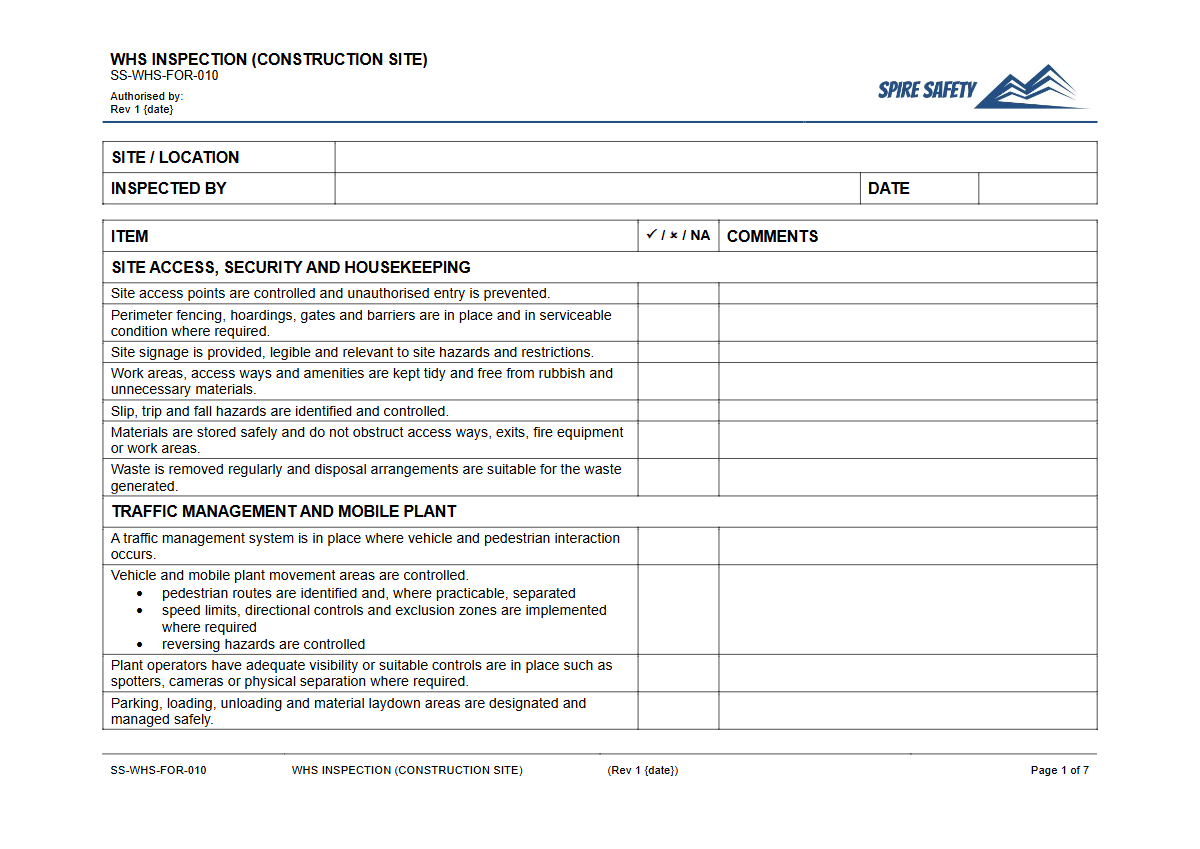
Regular site walk-throughs are a cornerstone of effective safety management in the construction industry. Our Free WHS Inspection (Construction Site) Template provides a structured starting point for your organisation to formalise this process.
This downloadable DOCX and PDF helps you systematically identify hazards, assess risks, and document safety conditions across your project, from excavation and scaffolding to site amenities and emergency procedures. By conducting regular, documented inspections, you can proactively address safety issues before they lead to incidents, demonstrate due diligence, and foster a stronger safety culture on site.
Using a standardised template ensures consistency and helps you track trends over time. It transforms a casual walk-around into a formal process that can be audited and reviewed.
This Inspection checklist serves as a critical tool for any Person Conducting a Business or Undertaking (PCBU) to meet their primary duty of care under Australian WHS laws. It is a key data-gathering component within comprehensive WHS management systems, feeding crucial information into your risk register and safety improvement plans.
Video walkthrough
How to use the Free WHS Inspection (Construction Site) Template
Using this template effectively involves more than just filling it out. Start by downloading the DOCX version and adapting it to your specific site.
No two construction sites are identical, so a generic checklist will always have gaps.
This template is a guide only. You must customise it to address the specific hazards, tasks, equipment, and environment of your construction site.
We recommend consulting with your workers and Health and Safety Representatives (HSRs) during this process, as they have direct, hands-on knowledge of the risks involved in their work.
Once customised, schedule the inspections at a regular frequency. Assign responsibility for conducting the inspection and for actioning any identified issues.
Findings should be documented clearly, with photos where appropriate. Corrective actions must be assigned to a specific person with a clear deadline for completion.
Finally, review completed inspection reports at safety meetings to discuss findings, track the closure of corrective actions, and identify any recurring problems that may indicate a systemic failure.
Key Inspection Areas
Your customised inspection should cover all relevant aspects of your site. Key areas to consider including are:
- Site Access and Security: Fencing, signage, visitor sign-in procedures, and prevention of unauthorised entry. Controlling who enters the site is fundamental and can be reinforced with regular communication tools like a Site Security and Unauthorised Access Toolbox Talk.
- Housekeeping: Clear access and egress routes, waste management, and control of slip, trip and fall hazards.
- Excavations and Trenches: Shoring, benching, access/egress, and spoil pile placement.
- Work at Height: Stability and condition of scaffolding, edge protection, and personal fall arrest systems.
- Plant and Equipment: Checking for fluid leaks, operational guards, warning devices, and operator competency is vital, as failures can have severe consequences, highlighted in a case where a company faced a $450,000 fine after an excavator incident.
- Electrical Safety: Condition of leads and tools, use of RCDs (Residual Current Devices), and 'lock out, tag out' procedures.
- Hazardous Materials: Correct storage, handling, labelling, and availability of Safety Data Sheets (SDS).
- Emergency Preparedness: Clearly marked and accessible first aid kits, fire extinguishers, and emergency evacuation plans.
When to use the WHS Inspection Template
The frequency of inspections should be based on risk. A full, comprehensive site inspection might be conducted weekly.
However, certain high-risk areas or activities may require daily checks. Consider conducting inspections:
- At the start and end of each day for specific high-risk tasks.
- Weekly, for a general site-wide review.
- Before a new phase of construction begins (e.g., prior to starting deep excavation or erecting major scaffolds).
- After any significant weather event, such as a major storm.
- Following a safety incident or near miss to identify contributing factors.
Who should use the WHS Inspection Template
A range of personnel can and should be involved in the site inspection process. This ensures different perspectives are captured and promotes a shared sense of ownership for safety. Key roles include:
- Site Managers
- Project Managers
- Supervisors and Foremen
- WHS/HSE Officers and Advisors
- Health and Safety Representatives (HSRs)
For high-risk construction work identified during an inspection, a detailed risk assessment and control plan is required. Our free Safe Work Method Statement (SWMS) template can guide you through this next step, ensuring controls are properly documented before work commences.
While regular internal inspections are crucial for day-to-day safety management, periodic, independent reviews can uncover systemic issues you might miss. These are often conducted as part of formal WHS compliance auditing to verify your WHS systems are both effective and robust.
Common mistakes
Common mistakes to avoid
- Failing to customise the template for site-specific hazards.
- 'Pencil-whipping' the form without conducting a thorough physical inspection.
- Not assigning clear responsibility and deadlines for corrective actions.
- Poor follow-up, allowing identified hazards to remain unaddressed.
Legal references
Legal considerations
The following legal requirements may be relevant to this type of work.
- Work Health and Safety Act (Harmonised) — Provides the primary duties for protecting workers and other people from work health and safety risks.
- Work Health and Safety Regulations (Harmonised) — Sets out requirements supporting the management of workplace hazards and risks.
The following codes may be relevant to this type of work.
- Managing WHS Risks Code of Practice — Provides practical guidance on identifying hazards, assessing risks and applying effective controls.
- Work Health and Safety Consultation, Cooperation and Coordination Code of Practice — Provides practical guidance on consulting workers and coordinating with other duty holders.
- Managing the Work Environment and Facilities Code of Practice — Provides practical guidance on safe work environments, workplace facilities and related controls.
Did you know
A High-Risk Industry
According to Safe Work Australia, the construction industry consistently accounts for a high proportion of serious workers' compensation claims and fatalities, making proactive inspections a critical risk management activity.
FAQ
Frequently asked questions
01What's the difference between a pre-start check and a site inspection?
02How often should I conduct a construction site WHS inspection?
03Who is responsible for actioning items from an inspection?
04Can this template be used for other industries besides construction?
Share this resource
Free WHS Inspection (Construction Site) Template
Browse Categories
How To Use It
- 1Download and open in Word or PDF.
- 2Replace the placeholders with your business details.
- 3Get it reviewed by a WHS specialist before rollout.
Need it customised?
Our WHS consultants can adapt this template to your site, run a gap analysis, or audit what you already have in place.
Book a Free Consultation WHS consulting servicesor call 1300 156 382