
Free WHS Inspection (Courier Depot) Template
Download our Free WHS Inspection (Courier Depot) Template to formalise safety reviews and manage risks. A structured starting point for your safety program.
Free WHS Inspection (Courier Depot) Template
DOCX • 128 KB + PDF
Updated Oct 2026
No signup required
Purpose of the Free WHS Inspection (Courier Depot) Template
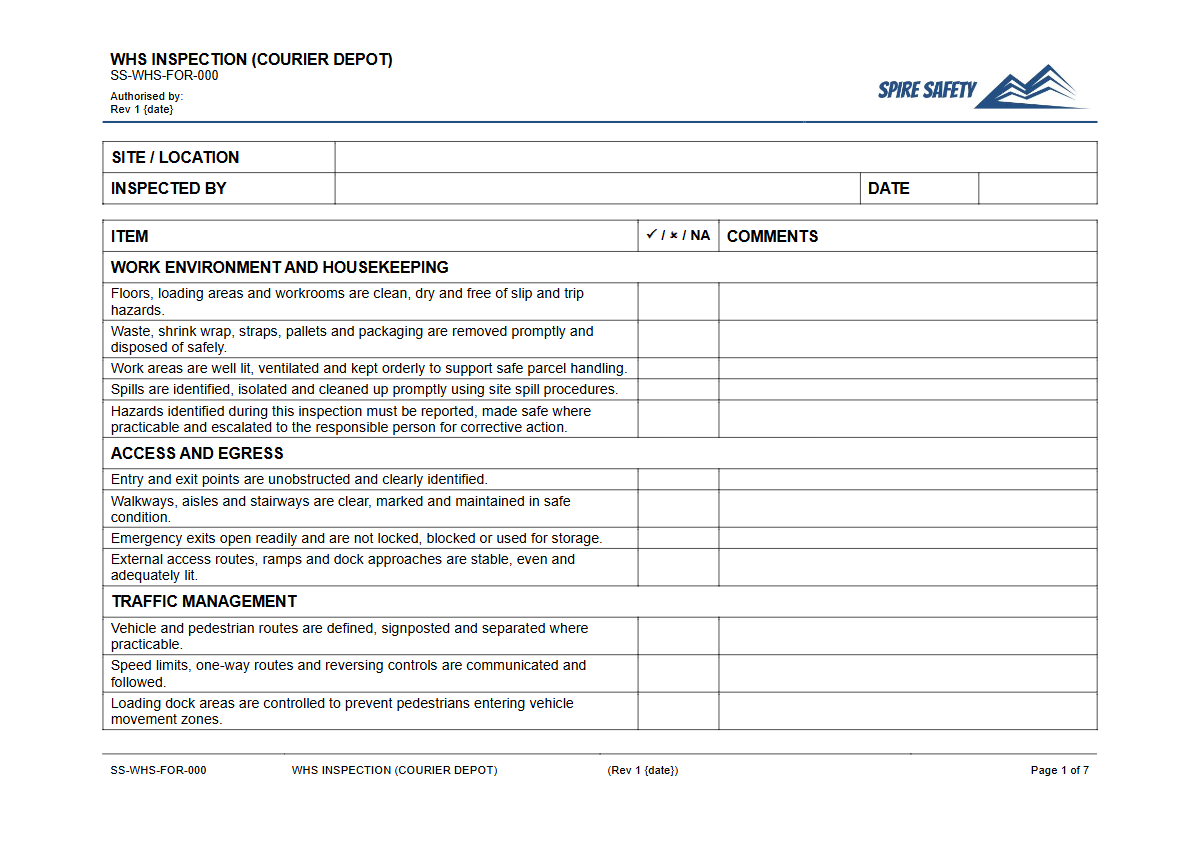
Courier and freight depots are dynamic environments with a unique combination of hazards, from vehicle movements and forklift operations to manual handling and repetitive tasks. This Free WHS Inspection (Courier Depot) Template provides a structured starting point for systematically identifying, assessing, and controlling these risks.
It helps organisations formalise their safety review process, moving beyond ad-hoc checks to a documented, regular inspection schedule. Using a standardised template ensures consistency, helps demonstrate due diligence, and creates a clear record of safety management activities.
Regular inspections are a critical component of any effective safety program. They help proactively identify unsafe conditions and at-risk behaviours before they lead to incidents or injuries.
This template is designed to guide a competent person through a thorough review of key areas in a courier depot, including traffic management, storage and racking, loading docks, plant and equipment, and worker amenities. It serves as a practical tool within a broader WHS management system, providing essential data for risk assessments and continuous improvement initiatives.
Video walkthrough
How to use the Free WHS Inspection (Courier Depot) Template
This template is provided in both DOCX and PDF formats for your convenience. The DOCX file is fully editable, allowing you to tailor it to the specific layout, equipment, and operational procedures of your workplace.
A generic template cannot account for every unique hazard, so customisation is essential for it to be effective.
To use the template:
- Download the DOCX version.
- Review the existing sections and checklist items. Add, remove, or modify items to reflect the specific hazards present in your depot. Consider areas like vehicle entry points, pedestrian walkways, conveyor systems, battery charging stations, and any specialised equipment.
- Involve your workers and their Health and Safety Representatives (HSRs) in the customisation process. Their direct experience is invaluable for identifying practical hazards and controls.
- Once customised, use the checklist to conduct your physical inspection. For each item, note whether the condition is satisfactory or requires action. Add specific comments, locations, and photographic evidence where necessary.
- Document any identified hazards, assess the associated risk level, and assign clear corrective actions with deadlines and responsible persons.
- Ensure the completed inspection report is signed, dated, and stored as a WHS record. The findings should be communicated to relevant managers, supervisors, and the Health and Safety Committee.
Note: This document is a template only. We have designed it as a starting point, but it must be customised to suit the specific needs, risks, and operational context of your business and workplace.
Compliance with WHS legislation is your responsibility.
When to use it
The frequency of depot inspections should be based on your risk assessment. High-risk, fast-paced environments like courier depots typically benefit from a schedule of regular inspections. This may include:
- Scheduled weekly or monthly inspections: A comprehensive review of the entire site or specific high-risk zones.
- Post-incident: To identify contributing factors and prevent recurrence after an incident or near miss.
- Following changes: After introducing new equipment, changing the layout, or altering work procedures.
- Before high-traffic periods: In preparation for seasonal peaks (e.g., Christmas) to ensure the site is prepared for increased volume and activity.
Supplementing these formal inspections with daily checks of specific equipment is also best practice. For example, using a dedicated electric hoist pre-start checklist ensures critical lifting gear is safe before each shift.
Similarly, for sites with controlled access, a daily check using a pre-start checklist for boom gates can prevent traffic management failures.
Who should use it
This template is designed for use by competent individuals tasked with overseeing workplace safety. This typically includes:
- Work Health and Safety (WHS) Managers or Officers
- Warehouse and Depot Managers
- Supervisors and Team Leaders
- Health and Safety Representatives (HSRs)
- Members of the Health and Safety Committee
The person conducting the inspection must be familiar with the depot's operations and have adequate knowledge to recognise hazards. For a more rigorous and independent evaluation of your safety systems, you may consider engaging external WHS compliance auditing services.
If your depot handles temperature-sensitive goods, your inspection process may also need to incorporate checks covered in resources like our freezer pre-start checklist template to ensure the integrity of cold chain equipment. For more templates and checklists, feel free to browse our complete free WHS resources library.
Common mistakes
Common mistakes to avoid
- Using the template without customising it for the specific depot layout and equipment.
- Failing to assign and follow up on corrective actions identified during the inspection.
- Treating the inspection as a 'tick-and-flick' exercise without genuine observation and engagement.
- Not involving workers or HSRs in the inspection process, missing out on valuable firsthand knowledge of risks.
Legal references
Legal considerations
The following legal requirements may be relevant to this type of work.
- Work Health and Safety Act (Harmonised) — Provides the primary duties for protecting workers and other people from work health and safety risks.
- Work Health and Safety Regulations (Harmonised) — Sets out requirements supporting the management of workplace hazards and risks.
The following codes may be relevant to this type of work.
- Managing WHS Risks Code of Practice — Provides practical guidance on identifying hazards, assessing risks and applying effective controls.
- Work Health and Safety Consultation, Cooperation and Coordination Code of Practice — Provides practical guidance on consulting workers and coordinating with other duty holders.
- Managing the Work Environment and Facilities Code of Practice — Provides practical guidance on safe work environments, workplace facilities and related controls.
Did you know
Transport Industry Risks
The transport, postal, and warehousing industry has one of the highest rates of serious workers' compensation claims in Australia, with vehicle incidents and muscular stress being leading causes of injury.
Manual Handling Impact
According to Safe Work Australia, injuries resulting from manual handling are particularly prevalent in the freight industry, accounting for a significant portion of all serious claims.
FAQ
Frequently asked questions
01What are the most common hazards in a courier depot?
02How often should WHS inspections be conducted in a courier depot?
03Who is responsible for conducting a courier depot inspection?
04What happens after a hazard is identified during an inspection?
Share this resource
Free WHS Inspection (Courier Depot) Template
Browse Categories
How To Use It
- 1Download and open in Word or PDF.
- 2Replace the placeholders with your business details.
- 3Get it reviewed by a WHS specialist before rollout.
Need it customised?
Our WHS consultants can adapt this template to your site, run a gap analysis, or audit what you already have in place.
Book a Free Consultation WHS consulting servicesor call 1300 156 382