
Free WHS Inspection (Dairy Farm) Template
Download our Free WHS Inspection (Dairy Farm) Template. This structured DOCX & PDF helps formalise safety inspections for dairy operations. Start today.
Free WHS Inspection (Dairy Farm) Template
DOCX • 129 KB + PDF
Updated Oct 2026
No signup required
Purpose of the Free WHS Inspection (Dairy Farm) Template
Dairy farming involves a unique set of hazards, from large animal handling and heavy machinery to wet working environments and chemical use. Our Free WHS Inspection (Dairy Farm) Template provides a structured starting point for systematically identifying, assessing, and controlling these risks.
Conducting regular, documented inspections is a fundamental part of a proactive safety culture. This template is designed to help you formalise that process, covering key areas of a typical dairy operation to help you meet your work health and safety duties.
Using this template helps create a consistent record of your safety efforts, which is crucial for demonstrating due diligence. It prompts you to look at everything from the condition of milking equipment and animal handling yards to the state of personal protective equipment (PPE) and chemical storage.
For specific machinery, a general inspection should be complemented by daily checks; for example, you can formalise daily equipment checks using a dedicated pre-start checklist for a feed mixer to ensure it's safe before each use.
Video walkthrough
How to use the Free WHS Inspection (Dairy Farm) Template
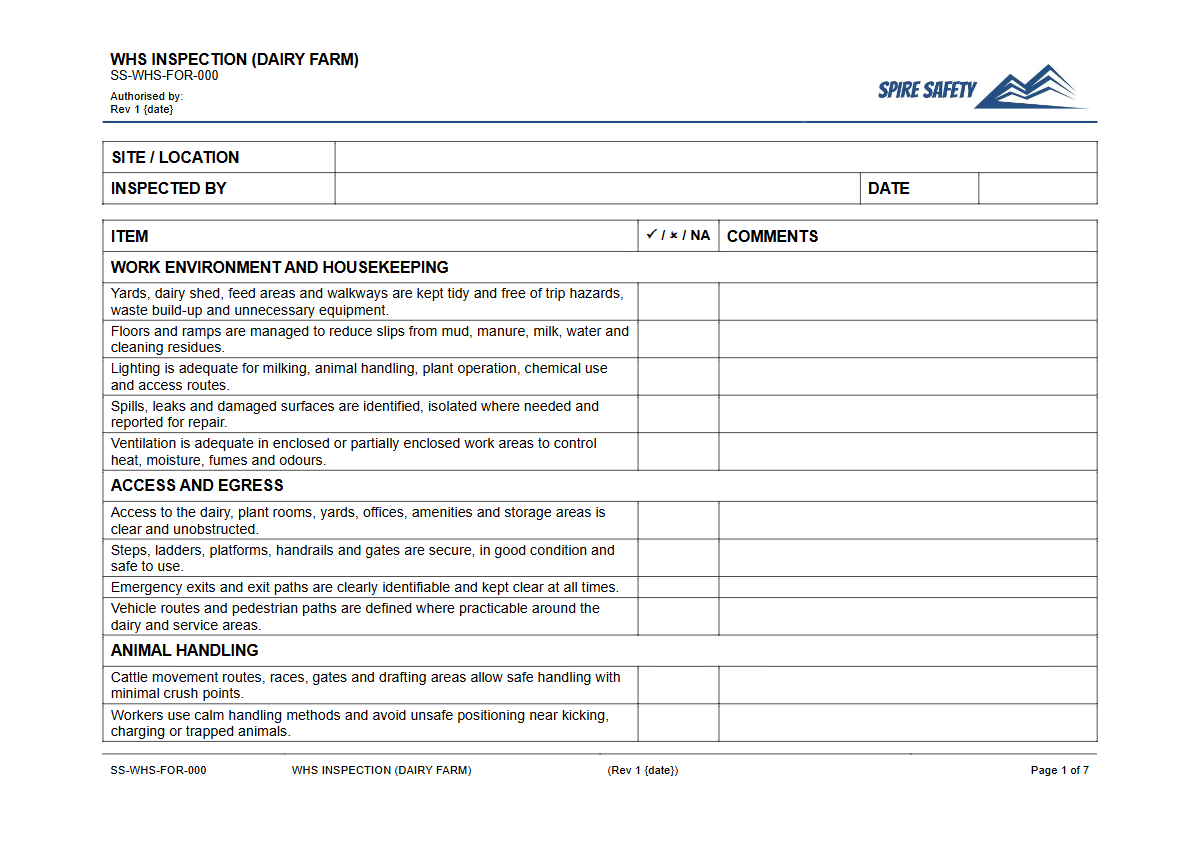
This resource is available as a DOCX file, allowing for full customisation, and a PDF for immediate printing. The checklist format is organised by farm area, making it easy to conduct a logical walkthrough of your property.
For each item, you can record your findings, note any hazards identified, assign a risk rating, and detail the corrective actions required. The template includes columns for assigning responsibility and tracking the completion of these actions.
Important: This document provides a general framework aligned with Australian WHS principles. To be effective, you must adapt it to the specific layout, equipment, tasks, and risks present on your farm.
We recommend involving your workers in the customisation process, as they have firsthand knowledge of the daily hazards they face. Integrating tailored inspection checklists is a key component of building effective WHS management systems.
Key Areas to Inspect on a Dairy Farm
Your customised inspection should cover all aspects of your operation. While our template provides a comprehensive list, key areas that demand regular attention include:
- Milking Parlour & Dairy: Check for slip, trip and fall hazards, electrical safety (especially in wet areas), functionality of emergency stops, hygiene standards, and ergonomic risks from repetitive tasks.
- Animal Handling Yards & Races: Inspect the structural integrity of gates, fences, and crushes. Ensure non-slip flooring is in good condition and that workers are trained in low-stress stock handling.
- Plant & Machinery: Regularly inspect tractors, quad bikes, feed-out wagons, and other vehicles. Confirm that guards, particularly for Power Take-Off (PTO) shafts, are in place and effective.
- Chemical & Medicine Storage: Ensure all chemicals are correctly labelled, stored securely, and that Safety Data Sheets (SDS) are readily accessible. Check that appropriate PPE is available and spill kits are stocked and in-date.
- Cold Storage: Any walk-in cold rooms or freezers should have safety latches that can be operated from the inside and an alarm system. Routine checks can be formalised using a specific pre-start checklist for a freezer.
- General Environment: Assess laneways for maintenance issues, check fencing around dams or effluent ponds, and be aware of overhead powerlines.
When to use it
The frequency of your inspections should be based on risk. High-risk areas or activities, like the milking parlour or operating mobile plant, may require weekly or even daily checks.
A comprehensive, farm-wide inspection using this template is recommended at least quarterly. It should also be used after an incident or near miss, when new machinery is introduced, when work processes change, or when concerns are raised by workers.
Some equipment, like vehicles used for property maintenance, benefit from daily checks using a pre-start checklist for a lawn tractor to catch issues early.
Who should use it
This Inspection template is designed for use by the Person Conducting a Business or Undertaking (PCBU)—typically the farm owner—as well as farm managers, supervisors, and designated Health and Safety Representatives (HSRs). While a specific person should be responsible for coordinating and signing off on the formal inspection, safety is a shared responsibility.
All workers should be trained and encouraged to identify and report hazards as part of their daily routine. To validate the effectiveness of your internal processes, you might consider periodic independent WHS compliance auditing to get an external perspective. For more templates and checklists covering a wide range of industries and equipment, explore our complete free WHS resources library.
Common mistakes
Common mistakes to avoid
- Using the template without customising it for the farm's specific machinery and layout.
- Failing to assign clear responsibility and deadlines for corrective actions.
- Conducting the inspection alone without involving workers who perform the tasks.
- Poor record-keeping, making it difficult to track trends or demonstrate due diligence.
Legal references
Legal considerations
The following legal requirements may be relevant to this type of work.
- Work Health and Safety Act (Harmonised) — Provides the primary duties for protecting workers and other people from work health and safety risks.
- Work Health and Safety Regulations (Harmonised) — Sets out requirements supporting the management of workplace hazards and risks.
The following codes may be relevant to this type of work.
- Managing WHS Risks Code of Practice — Provides practical guidance on identifying hazards, assessing risks and applying effective controls.
- Work Health and Safety Consultation, Cooperation and Coordination Code of Practice — Provides practical guidance on consulting workers and coordinating with other duty holders.
- Managing the Work Environment and Facilities Code of Practice — Provides practical guidance on safe work environments, workplace facilities and related controls.
Did you know
Quad Bike Safety
Quad bikes are a leading cause of death and serious injury on Australian farms. The ACCC has introduced a mandatory safety standard requiring all new and imported second-hand quad bikes to meet specific stability requirements and have an operator protection device (OPD) fitted.
Zoonotic Diseases
Zoonoses are diseases that can be transmitted from animals to humans. On dairy farms, workers can be at risk of infections like Q-fever, leptospirosis, and ringworm, making hygiene practices and vaccination critical control measures.
FAQ
Frequently asked questions
01What are the most common hazards on a dairy farm?
02How often should safety inspections be conducted on a dairy farm?
03Who is legally responsible for safety on a farm in Australia?
04Can this template be used for other types of farms?
Share this resource
Free WHS Inspection (Dairy Farm) Template
Browse Categories
How To Use It
- 1Download and open in Word or PDF.
- 2Replace the placeholders with your business details.
- 3Get it reviewed by a WHS specialist before rollout.
Need it customised?
Our WHS consultants can adapt this template to your site, run a gap analysis, or audit what you already have in place.
Book a Free Consultation WHS consulting servicesor call 1300 156 382