
Free WHS Inspection (Daycare Centre) Template
Download our free WHS Inspection (Daycare Centre) Template to formalise safety checks for your facility.
Free WHS Inspection (Daycare Centre) Template
DOCX • 128 KB + PDF
Updated Oct 2026
No signup required
Purpose of the Free WHS Inspection (Daycare Centre) Template
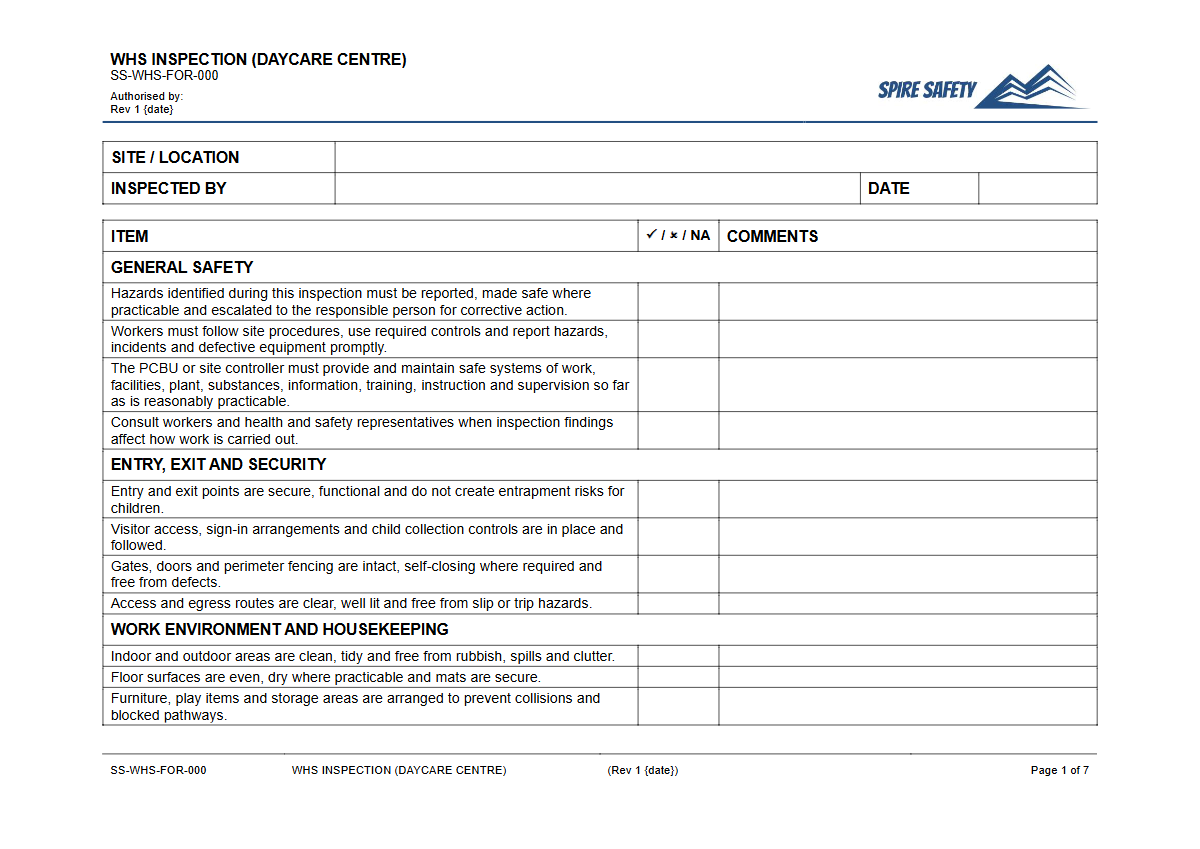
Operating a daycare centre involves managing a unique and dynamic risk profile to protect children, staff, and visitors. Our Free WHS Inspection (Daycare Centre) Template provides a structured starting point for systematically identifying potential hazards across your facility.
Regular, documented inspections are a cornerstone of effective safety management, demonstrating due diligence and a proactive commitment to health and safety. This template prompts you to assess common risk areas including indoor and outdoor play equipment, sleep areas, food preparation zones, hygiene stations, and emergency systems.
By using a standardised checklist, you can ensure consistency in your safety audits, track corrective actions, and maintain a safe environment. This process is fundamental to preventing incidents such as slips, trips, falls, and exposure to hazards.
It also supports your obligations under Australian WHS legislation by formalising your hazard identification and risk assessment procedures. Properly implemented, this inspection forms a key part of your broader WHS management system, helping to foster a strong safety culture within your organisation.
Video walkthrough
How to use the Free WHS Inspection (Daycare Centre) Template
This template is designed for ease of use and customisation. After downloading the DOCX file, you should adapt it to reflect the specific layout, equipment, and activities of your centre.
It serves as a comprehensive guide but is not exhaustive. Add, remove, or modify checklist items to ensure all relevant areas and potential hazards are covered, from the front gate to the back fence.
You will find sections covering general environment, play areas, amenities, and staff facilities. For specific pieces of equipment, you may want to integrate more detailed checks. For example, a commercial kitchen freezer requires specific safety checks that can be formalised using our Free Pre-Start Checklist (Freezer) Template.
Important Note
This document is a template only. It is not a substitute for professional legal or WHS advice.
You must customise this document to suit the specific needs and risks of your workplace. We assume no liability for the use or misuse of this document.
When to conduct an Inspection
The frequency of inspections should be determined by a risk-based approach. High-risk areas or equipment require more frequent checks than low-risk environments.
- Daily: Quick visual checks of high-traffic areas, outdoor play equipment, and gates should be conducted before children arrive.
- Weekly: A more thorough inspection of play areas, toys, and safety equipment like first aid kits and fire extinguishers.
- Monthly: A comprehensive walkthrough of the entire facility, including administrative areas, storage rooms, and kitchens.
- Quarterly/Annually: In-depth reviews of the inspection system itself, analysis of incident trends, and checks of items with less frequent use or degradation, such as building integrity and electrical systems. Regular reviews of your program's effectiveness can be supported by periodic WHS compliance auditing.
Who should conduct an Inspection
Safety is a shared responsibility, but formal inspections should be assigned to competent personnel. This typically includes the Centre Director or Manager, the nominated WHS Officer or Health and Safety Representative (HSR), and room leaders.
Involving a rotating team of educators can also bring fresh eyes to the process and increase overall safety awareness. All staff should be trained and encouraged to report hazards as they see them, regardless of the formal inspection schedule.
This ensures that a culture of safety is embedded in daily operations.
For specific tasks like grounds maintenance, using machinery such as a ride-on mower requires its own set of pre-operational checks. You can formalise this process with a tool like our Free Pre-Start Checklist (Lawn Tractor) Template to ensure equipment is safe before each use. Similarly, specific kitchen or care equipment, like bottle warmers, should have dedicated safety checks, which can be managed with our Free Pre-Start Checklist (Bottle Warmer) Template.
This template is one of many tools available to help you build a robust safety system. For more documents and checklists, you can browse our complete free WHS resources library.
Common mistakes
Common mistakes to avoid
- Using a generic checklist without customising it for the centre's specific layout and activities.
- Failing to document and track corrective actions for identified hazards.
- Performing inspections inconsistently, leading to missed hazards and an incomplete safety record.
- Not involving a range of staff members in the inspection process, resulting in less engagement and fewer identified risks.
Legal references
Legal considerations
The following legal requirements may be relevant to this type of work.
- Work Health and Safety Act (Harmonised) — Provides the primary duties for protecting workers and other people from work health and safety risks.
- Work Health and Safety Regulations (Harmonised) — Sets out requirements supporting the management of workplace hazards and risks.
The following codes may be relevant to this type of work.
- Managing WHS Risks Code of Practice — Provides practical guidance on identifying hazards, assessing risks and applying effective controls.
- Work Health and Safety Consultation, Cooperation and Coordination Code of Practice — Provides practical guidance on consulting workers and coordinating with other duty holders.
- Managing the Work Environment and Facilities Code of Practice — Provides practical guidance on safe work environments, workplace facilities and related controls.
Did you know
Child Safety
Slips, trips, and falls are the leading cause of non-fatal injuries for children in Australia. This makes regular, documented checks of floor surfaces, pathways, and playground areas a critical part of any daycare's WHS program.
Food Safety
Allergies are a significant risk in early childhood settings. Your WHS inspection should include checks for potential food cross-contamination in kitchens and ensure all food is correctly labelled, stored, and served according to your food safety plan.
FAQ
Frequently asked questions
01What specific hazards should a daycare inspection cover?
02How often should we inspect our outdoor play equipment?
03Is this template compliant with ACECQA requirements?
04Can I use a digital version of this inspection checklist?
Share this resource
Free WHS Inspection (Daycare Centre) Template
Browse Categories
How To Use It
- 1Download and open in Word or PDF.
- 2Replace the placeholders with your business details.
- 3Get it reviewed by a WHS specialist before rollout.
Need it customised?
Our WHS consultants can adapt this template to your site, run a gap analysis, or audit what you already have in place.
Book a Free Consultation WHS consulting servicesor call 1300 156 382