
Free WHS Inspection (Council Depot) Template
Download our Free WHS Inspection (Council Depot) Template to formalise safety checks and manage risks. A structured starting point for council WHS officers.
Free WHS Inspection (Council Depot) Template
DOCX • 127 KB + PDF
Updated Oct 2026
No signup required
Purpose of the Free WHS Inspection (Council Depot) Template
Council depots are dynamic and often high-risk environments, with hazards ranging from vehicle movements and heavy machinery to chemical storage and manual tasks. Systematically inspecting these areas is a fundamental part of a Person Conducting a Business or Undertaking's (PCBU) duty of care.
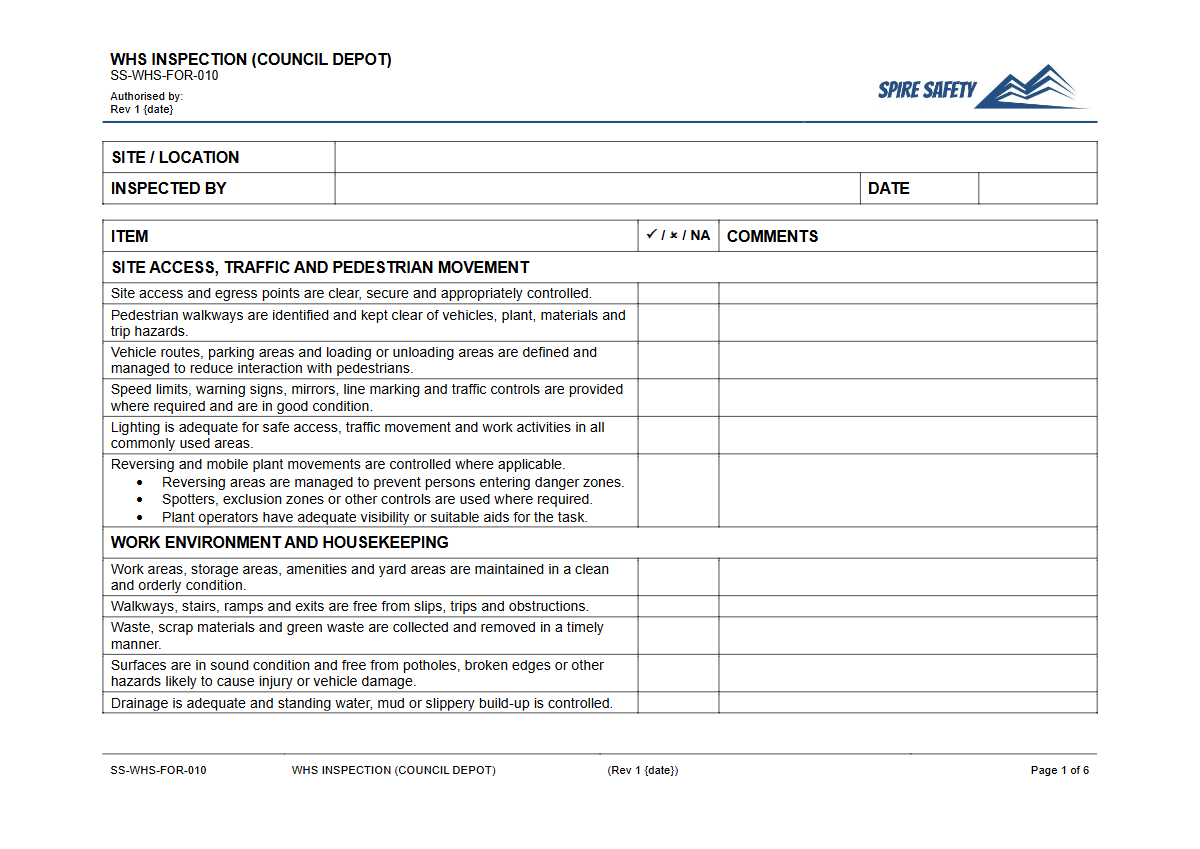
This Free WHS Inspection (Council Depot) Template provides a structured starting point for identifying hazards, assessing risks, and verifying that control measures are effective. Using a formal checklist helps ensure that inspections are consistent, thorough, and documented, forming a crucial part of your organisation's overall WHS management system.
The template is designed to guide an inspector through key areas of a typical council depot, promoting a proactive approach to safety. Regular, documented inspections help prevent incidents, demonstrate due diligence, and foster a positive safety culture where potential issues are identified and resolved before they can cause harm.
Video walkthrough
How to use the Free WHS Inspection (Council Depot) Template
Our template is provided as an easily editable DOCX file, allowing you to tailor it to your specific operational needs. The checklist is organised by common depot areas and hazard types, such as traffic management, workshops, chemical stores, and staff amenities.
The inspector can walk through the site, checking items off, making notes on non-conformances, and assigning corrective actions with due dates. For specific plant, you may need a more detailed pre-start check, like our Free Pre-Start Checklist (Lawn Tractor) Template.
Customisation is Essential
Every council depot is unique. The provided checklist covers common areas but may not address all specific hazards present at your site.
It is critical that you adapt this document to your workplace. We recommend you customise it to suit the specific hazards, equipment, and work processes at your council depot.
This may involve adding sections for specialised plant, local traffic rules, or specific environmental controls.
When to conduct a Depot Inspection
The frequency of formal depot inspections should be determined by a risk assessment, but a common schedule is monthly or quarterly. More frequent inspections may be necessary for high-risk areas like workshops or chemical storage zones. In addition to regular scheduling, an inspection should also be conducted:
- After an incident, accident, or near miss occurs.
- When new plant, equipment, or substances are introduced.
- When work processes or the layout of the depot changes.
- In response to concerns raised by workers or Health and Safety Representatives (HSRs).
- As part of a program of regular WHS compliance auditing to verify that procedures are being followed.
Who should use this Inspection Template
This template is designed for use by personnel with responsibility for workplace health and safety. This typically includes:
- Depot Managers or Supervisors
- Work Health and Safety (WHS) Officers or Advisors
- Health and Safety Representatives (HSRs)
- Members of the WHS Committee
Engaging workers in the inspection process is highly beneficial, as they have direct, hands-on knowledge of the tasks and associated risks. For example, the staff who operate specific equipment like yard boom gates will have invaluable insight. A formal check for such items can be done using our Free Pre-Start Checklist (Boom Gate) Template.
Key Areas Covered
While you must customise the template, its starting structure prompts a review of several critical areas:
- Traffic Management: Signage, pedestrian walkways, speed limits, and reversing vehicle controls.
- Plant and Equipment: Guarding, maintenance records, emergency stops, and operator competency. For specific high-risk machinery, dedicated checklists like a Free Pre-Start Checklist (Electric Hoist) Template are recommended.
- Hazardous Chemicals: Labelling, Safety Data Sheets (SDS), compliant storage, and spill kits.
- Workshops: Housekeeping, tool condition, ventilation, and electrical safety.
- Manual Tasks: Use of mechanical aids, ergonomic design of workstations, and worker training.
- Emergency Preparedness: Fire equipment, first aid kits, clear egress paths, and emergency contact information.
By using this template as a foundation, your organisation can build a robust inspection program that effectively manages risks and protects your workers. For more tools to support your safety systems, browse our complete free WHS resources library.
Common mistakes
Common mistakes to avoid
- Failing to customise the template for the depot's specific plant, chemicals, and layout.
- Not assigning clear responsibility and due dates for corrective actions.
- Conducting the inspection as a 'tick-and-flick' exercise without genuine observation or worker engagement.
- Neglecting to follow up and verify that identified issues have been effectively fixed.
Legal references
Legal considerations
The following legal requirements may be relevant to this type of work.
- Work Health and Safety Act (Harmonised) — Provides the primary duties for protecting workers and other people from work health and safety risks.
- Work Health and Safety Regulations (Harmonised) — Sets out requirements supporting the management of workplace hazards and risks.
The following codes may be relevant to this type of work.
- Managing WHS Risks Code of Practice — Provides practical guidance on identifying hazards, assessing risks and applying effective controls.
- Work Health and Safety Consultation, Cooperation and Coordination Code of Practice — Provides practical guidance on consulting workers and coordinating with other duty holders.
- Managing the Work Environment and Facilities Code of Practice — Provides practical guidance on safe work environments, workplace facilities and related controls.
Did you know
Vehicle Incidents
Vehicle incidents are a leading cause of workplace fatalities in Australia. Implementing and enforcing a clear traffic management plan is one of the most critical safety controls for any council depot.
Consultation is Key
Under WHS law, a PCBU must consult with workers on matters that affect their health and safety. Involving workers and their Health and Safety Representatives in depot inspections is a legal duty and leads to better safety outcomes.
FAQ
Frequently asked questions
01What are the most common hazards in a local council depot?
02How often should a council depot be formally inspected for WHS?
03Who is responsible for actioning items from a depot inspection?
04Can this template be used for mobile plant pre-start checks?
Share this resource
Free WHS Inspection (Council Depot) Template
Browse Categories
How To Use It
- 1Download and open in Word or PDF.
- 2Replace the placeholders with your business details.
- 3Get it reviewed by a WHS specialist before rollout.
Need it customised?
Our WHS consultants can adapt this template to your site, run a gap analysis, or audit what you already have in place.
Book a Free Consultation WHS consulting servicesor call 1300 156 382