
Free WHS Inspection (Council Workshop) Template
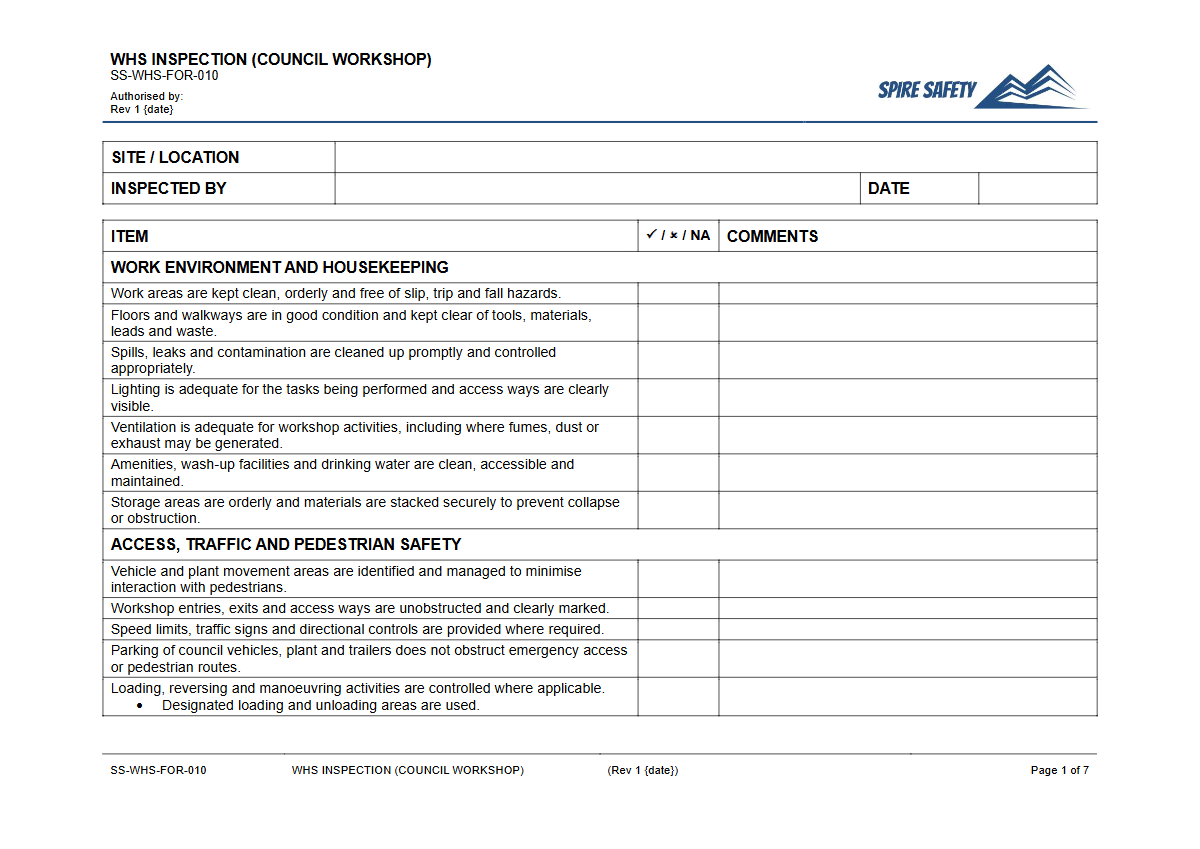
Download our Free WHS Inspection (Council Workshop) Template to formalise safety checks for plant, equipment, and work areas.
Free WHS Inspection (Council Workshop) Template
DOCX • 128 KB + PDF
Updated Oct 2026
No signup required
Purpose of the Free WHS Inspection (Council Workshop) Template
Council workshops are dynamic environments filled with a diverse range of plant, equipment, and hazardous substances. This complexity creates significant WHS risks that must be actively managed.
Our Free WHS Inspection (Council Workshop) Template provides a structured starting point for organisations to formalise their safety inspection processes, ensuring a methodical check of key risk areas. Regularly inspecting the physical environment, machinery, and work practices is fundamental to preventing incidents, promoting a positive safety culture, and meeting due diligence requirements under Australian WHS legislation.
This template is designed to guide supervisors, managers, and health and safety representatives through a comprehensive review of the workshop. It covers common areas of concern such as the condition of tools and equipment, chemical storage, traffic management, electrical safety, and housekeeping.
Using a formal checklist helps ensure consistency in inspections, facilitates the recording of findings, and creates a paper trail for corrective actions. This process is a critical component of any effective safety management system.
Video walkthrough
How to use the Free WHS Inspection (Council Workshop) Template
This document serves as a comprehensive baseline for developing a site-specific inspection checklist. Download the DOCX file and adapt it to reflect the unique layout, equipment, and processes of your council workshop.
A generic checklist is a good start, but true effectiveness comes from customisation.
Follow these steps for effective implementation:
- Customise the Checklist: Walk through your workshop and add or remove items to match your specific machinery (e.g., vehicle hoists, welders, lathes), storage areas (e.g., fuel depots, chemical stores), and common tasks. For specific mobile plant, you may also want a dedicated free pre-start checklist for a lawn tractor to supplement daily checks.
- Schedule and Assign: Determine the frequency of inspections (e.g., monthly, quarterly) and assign responsibility to a competent person, such as a workshop supervisor or a member of the safety committee.
- Conduct the Inspection: The assigned inspector should systematically walk through the workshop, observing conditions and work practices, and noting any non-conformances, hazards, or opportunities for improvement on the checklist.
- Document and Report: Complete the form, ensuring all findings are clearly documented. The report should be submitted to the relevant manager or committee for review.
- Implement Corrective Actions: The most critical step is to assign, track, and close out all identified corrective actions. An inspection that doesn't lead to action is a wasted effort. This documented follow-up is essential for demonstrating due diligence and is a core principle of broader WHS management systems.
Note: This template is a guide only. We have designed it to be aligned with good WHS practice, but it must be customised for your specific workplace.
You are responsible for ensuring your safety processes meet all legislative requirements.
When to use it
Formal workshop inspections should be conducted on a regular, scheduled basis. The appropriate frequency depends on the size and complexity of the workshop, the nature of the work performed, and the level of risk.
A common schedule is monthly or quarterly. In addition to these routine checks, this inspection template is valuable:
- After a significant change in the workshop, such as the introduction of new major plant or a change in layout.
- Following an incident, accident, or near-miss to identify contributing environmental or equipment factors.
- As part of an organisation's annual WHS planning and review cycle.
- In response to specific concerns raised by workers or health and safety representatives.
These formal inspections supplement, but do not replace, the need for daily pre-start checks on specific equipment. For example, operators should still complete a daily pre-start checklist for an electric hoist before use.
Who should use it
This inspection template is designed for use by individuals with responsibility for workplace safety and a good understanding of the workshop environment. This typically includes:
- Workshop Supervisors and Managers: They hold primary responsibility for the safety of their area and are best placed to conduct or oversee inspections.
- Health and Safety Representatives (HSRs): Conducting inspections is a key function of an HSR, and this template provides a structured tool to assist them.
- WHS Advisors or Officers: Safety professionals can use this template to conduct their own inspections or to guide and train supervisors in the process.
- WHS Committee Members: A joint inspection involving both management and worker representatives can be a powerful way to build engagement and identify hazards.
The results of the inspection are relevant to everyone in the organisation, from the workers who need to be aware of identified hazards to senior management who must ensure adequate resources are allocated for corrective actions. Findings can also serve as important inputs for formal WHS compliance auditing activities. For more tools to enhance your safety program, explore our complete free WHS resources library.
Common mistakes
Common mistakes to avoid
- Using a generic template without customising it for the workshop's specific plant, chemicals, and tasks.
- Completing the checklist without physically verifying each item (a 'pencil-whip' inspection).
- Failing to document, assign, and track corrective actions for identified hazards.
- Not involving workers or their safety representatives in the inspection process, missing valuable insights from those doing the work.
Legal references
Legal considerations
The following legal requirements may be relevant to this type of work.
- Work Health and Safety Act (Harmonised) — Provides the primary duties for protecting workers and other people from work health and safety risks.
- Work Health and Safety Regulations (Harmonised) — Sets out requirements supporting the management of workplace hazards and risks.
The following codes may be relevant to this type of work.
- Managing WHS Risks Code of Practice — Provides practical guidance on identifying hazards, assessing risks and applying effective controls.
- Work Health and Safety Consultation, Cooperation and Coordination Code of Practice — Provides practical guidance on consulting workers and coordinating with other duty holders.
- Managing the Work Environment and Facilities Code of Practice — Provides practical guidance on safe work environments, workplace facilities and related controls.
Did you know
A Leading Cause of Injury
According to Safe Work Australia, machinery operators and drivers have one of the highest rates of serious workers' compensation claims. Regular, thorough inspections are a key control for preventing machinery-related incidents.
FAQ
Frequently asked questions
01What should be included in a council workshop inspection?
02How often should council workshops be formally inspected?
03Who is responsible for conducting workshop safety inspections?
04What happens if a hazard is identified during an inspection?
Share this resource
Free WHS Inspection (Council Workshop) Template
Browse Categories
How To Use It
- 1Download and open in Word or PDF.
- 2Replace the placeholders with your business details.
- 3Get it reviewed by a WHS specialist before rollout.
Need it customised?
Our WHS consultants can adapt this template to your site, run a gap analysis, or audit what you already have in place.
Book a Free Consultation WHS consulting servicesor call 1300 156 382