
Free WHS Inspection (Council Yard) Template
Download our Free WHS Inspection (Council Yard) Template to systematically identify hazards and manage risks. A structured DOCX for your workplace safety.
Free WHS Inspection (Council Yard) Template
DOCX • 129 KB + PDF
Updated Oct 2026
No signup required
Purpose of the Free WHS Inspection (Council Yard) Template
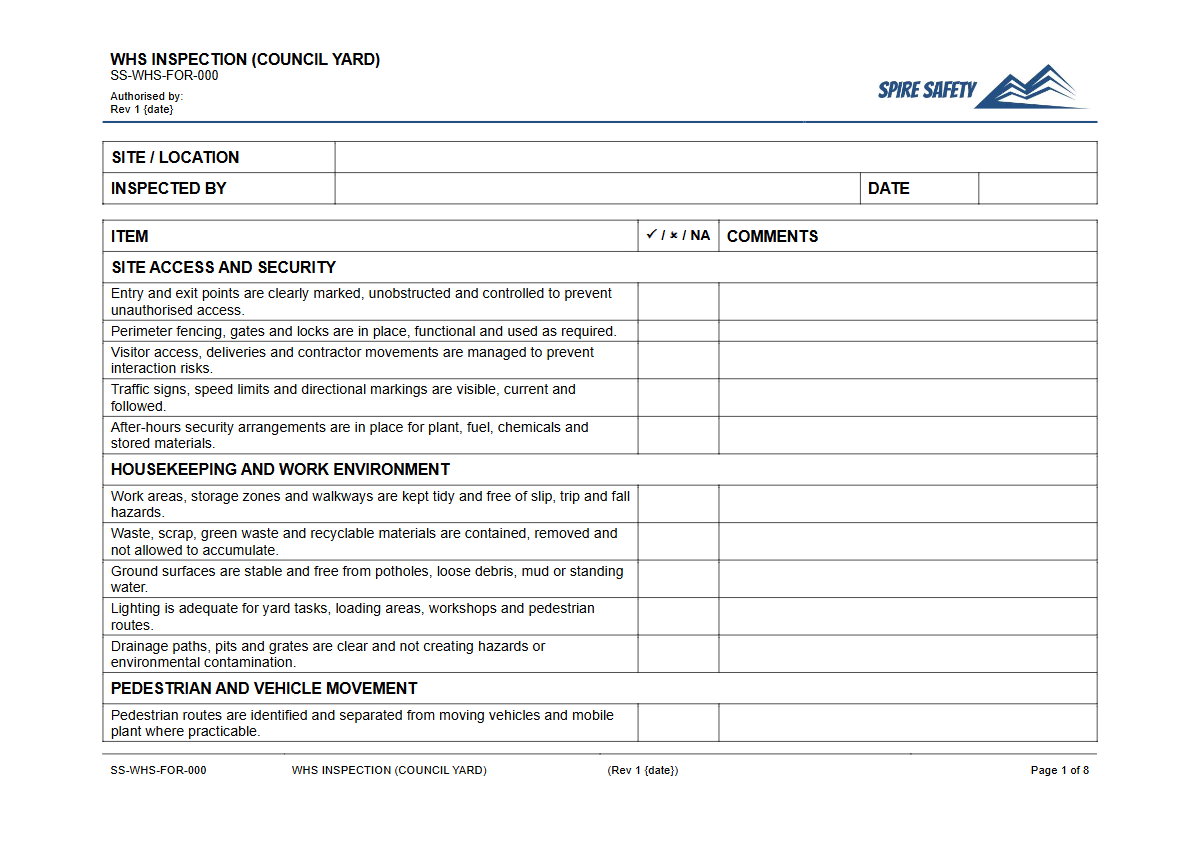
Council yards are dynamic and often hazardous environments, with a unique combination of vehicle movement, heavy machinery, chemical storage, and diverse manual tasks. This Free WHS Inspection (Council Yard) Template provides a structured starting point for systematically identifying and controlling health and safety risks specific to these settings.
Regular inspections are a fundamental part of a proactive safety culture, helping your organisation meet its duty of care. This template, available as a customisable DOCX file, guides you through key areas to check, from traffic management to plant safety and emergency preparedness.
Video walkthrough
How to use the Free WHS Inspection (Council Yard) Template
To get started, download the template in your preferred format (DOCX or PDF). The DOCX version is fully editable, allowing you to tailor the checklist to the specific layout, equipment, and procedures of your council depot.
It is crucial that you customise this document to reflect your unique operational risks. A generic checklist is not sufficient; we have provided a comprehensive foundation, but you must adapt it to your workplace.
The template includes sections for traffic flow, plant and equipment, storage areas, and worker facilities. You can add or remove items, such as specific checks for your groundskeeping fleet using a dedicated pre-start checklist for lawn tractors.
The Inspection Process
Conducting the inspection involves more than just ticking boxes. It requires a thorough walkthrough of the yard, careful observation, and consultation with workers and supervisors. Follow these steps for an effective inspection:
- Plan the inspection: Schedule a time and notify the relevant area supervisors.
- Gather tools: Use this template, a pen or tablet, and a camera to document findings.
- Walk the site: Systematically cover all areas listed in the checklist. Observe work practices and the physical environment.
- Talk to workers: Ask them about any safety concerns or near misses they have experienced.
- Document findings: Clearly record any identified hazards, non-conformances, or areas for improvement. Note the location and take photos where necessary.
- Develop corrective actions: For each hazard identified, assign a corrective action, a responsible person, and a due date.
- Track and review: Follow up to ensure all corrective actions are completed and have effectively controlled the risk.
The findings from your inspections can be a vital input for your broader WHS management systems, helping to drive continuous improvement and demonstrate due diligence.
When to use it
Regular, scheduled inspections are key to maintaining a safe council yard. The ideal frequency depends on the size, complexity, and risk level of your operations, but a common schedule is monthly or quarterly.
In addition to routine checks, this inspection template should be used whenever there is a significant change in the workplace, such as the introduction of new plant or equipment, a change in the yard layout, or after an incident or near miss. These event-triggered inspections help ensure that new risks are not introduced and that control measures remain effective. For a higher level of assurance, you might consider engaging external experts for periodic WHS compliance auditing.
Who should use it
This template is designed for use by anyone with responsibility for workplace health and safety in a council depot setting. This includes:
- WHS Managers and Advisors
- Depot or Yard Supervisors and Team Leaders
- Health and Safety Representatives (HSRs)
- Maintenance Managers
- Members of the WHS Committee
Inspections are most effective when conducted by a team, combining the formal knowledge of a supervisor with the practical, on-the-ground experience of a worker from the area. This collaborative approach fosters a better understanding of the risks and leads to more practical and effective control measures.
A thorough check of site access points, for example, can be complemented by reviewing records from your boom gate pre-start checklist to identify recurring faults.
For organisations looking to develop a more robust safety framework beyond individual checklists, expert guidance can be invaluable. Our WHS consulting services can help you integrate tools like this inspection template into a comprehensive safety strategy. This structured approach ensures that hazards associated with all equipment, including specialised groundskeeping tools, are properly managed, perhaps even using a specific pre-start checklist for aerators where applicable. Feel free to browse our entire free WHS resources library for more templates and guides to support your safety efforts.
Common mistakes
Common mistakes to avoid
- Using a generic checklist without customising it for the specific site layout and equipment.
- Failing to assign and track corrective actions, leaving identified hazards uncontrolled.
- Conducting inspections inconsistently or only after an incident has occurred.
- Neglecting to consult with workers who perform the tasks and have firsthand knowledge of the risks.
Legal references
Legal considerations
The following legal requirements may be relevant to this type of work.
- Work Health and Safety Act (Harmonised) — Provides the primary duties for protecting workers and other people from work health and safety risks.
- Work Health and Safety Regulations (Harmonised) — Sets out requirements supporting the management of workplace hazards and risks.
The following codes may be relevant to this type of work.
- Managing WHS Risks Code of Practice — Provides practical guidance on identifying hazards, assessing risks and applying effective controls.
- Work Health and Safety Consultation, Cooperation and Coordination Code of Practice — Provides practical guidance on consulting workers and coordinating with other duty holders.
- Managing the Work Environment and Facilities Code of Practice — Provides practical guidance on safe work environments, workplace facilities and related controls.
Did you know
Vehicle Incidents
Vehicle incidents are a leading cause of workplace fatalities in Australia. In council yards, this risk is amplified by the constant interaction between heavy vehicles, light vehicles, mobile plant, and pedestrians in confined spaces.
FAQ
Frequently asked questions
01What are the most common hazards in a council yard?
02How often should council yard WHS inspections be conducted?
03Who is responsible for conducting a council yard inspection?
04Does this template cover electrical safety for workshop tools?
Share this resource
Free WHS Inspection (Council Yard) Template
Browse Categories
How To Use It
- 1Download and open in Word or PDF.
- 2Replace the placeholders with your business details.
- 3Get it reviewed by a WHS specialist before rollout.
Need it customised?
Our WHS consultants can adapt this template to your site, run a gap analysis, or audit what you already have in place.
Book a Free Consultation WHS consulting servicesor call 1300 156 382