
Free WHS Inspection (Cool Room) Template
Download our Free WHS Inspection (Cool Room) Template (DOCX & PDF) to formalise safety checks and manage workplace hazards. Get your structured template today.
Free WHS Inspection (Cool Room) Template
DOCX • 127 KB + PDF
Updated Oct 2026
No signup required
Purpose of the Free WHS Inspection (Cool Room) Template
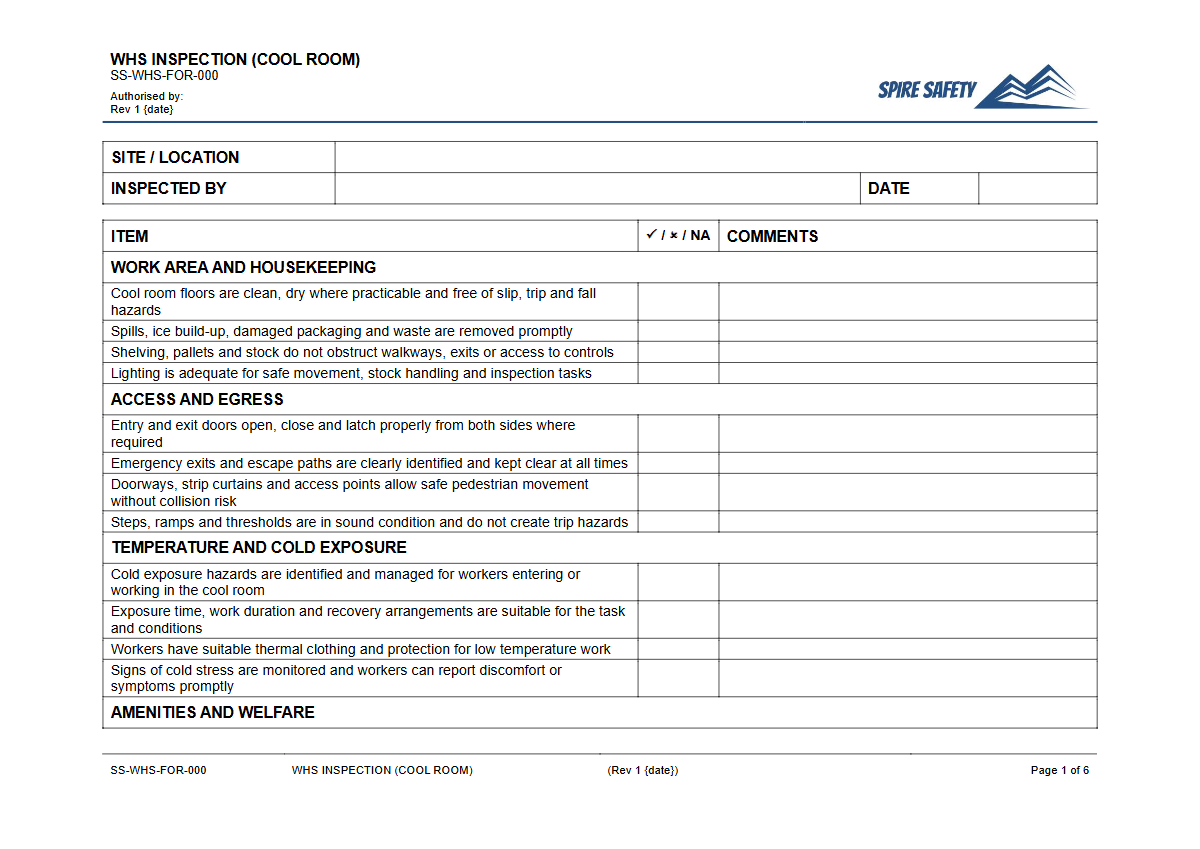
Regularly inspecting workplace equipment and environments is a cornerstone of effective safety management. This Free WHS Inspection (Cool Room) Template provides a structured starting point for organisations to formalise their inspection process for walk-in refrigerators and cold storage areas.
Using a standardised checklist helps ensure that key hazards are consistently checked, from slip and trip risks to the mechanical and electrical integrity of the unit. It creates a documented record of due diligence, which is vital for demonstrating proactive risk management.
By systematically identifying potential issues before they lead to incidents, you can protect workers from harm and prevent costly equipment failures. This Inspection template is designed to integrate into your broader safety framework, forming a critical component of your overall WHS management systems.
Video walkthrough
How to use the Free WHS Inspection (Cool Room) Template
This document is a foundational template that must be adapted to your specific workplace. Before use, a competent person should review and customise the checklist to reflect the unique layout, equipment, and operational risks associated with your cool room.
This may involve adding or removing items based on the model of the unit, the types of goods stored, and the specific tasks performed by workers.
To use the template effectively, schedule regular inspections and assign responsibility to a trained individual. The inspector should walk through the checklist, physically verifying each item and noting any non-conformances, defects, or potential hazards.
All findings should be clearly documented, with corrective actions assigned and tracked through to completion. For daily operator checks, you may also find our free Pre-Start Checklist (Cool Room) Template a useful complementary resource.
Important Customisation Note
This is a generic template aligned with Australian WHS principles. It is not a complete, out-of-the-box solution.
We have no knowledge of your specific cool room, operational procedures, or risk profile. You MUST customise this document to suit the specific hazards and control measures relevant to your workplace.
If you are unsure about your obligations, seek professional safety advice.
The principles of thorough inspection apply to all refrigerated storage. If your workplace also uses other cold storage units, consider adapting this process or using a specific checklist, such as our free Pre-Start Checklist (Freezer) Template, to ensure all equipment is covered.
When to use this Inspection Template
The frequency of formal inspections should be determined by a risk assessment. Factors to consider include the age and condition of the cool room, the intensity of its use, and any manufacturer recommendations.
A common approach is to schedule detailed inspections on a monthly or quarterly basis.
This formal inspection should supplement, not replace, daily pre-start checks and general operator vigilance. It is also wise to conduct an inspection after any significant event, such as a major clean, maintenance activity, repair, or a suspected malfunction. The records generated from these inspections are invaluable inputs for periodic safety reviews and formal WHS compliance auditing.
Who should use this Inspection Template
This template is designed for use by any person responsible for workplace safety and maintenance. This typically includes WHS Managers, Health and Safety Representatives (HSRs), supervisors, and maintenance personnel.
The person conducting the inspection must be competent to do so; they should be familiar with the cool room's operation and trained to recognise the hazards outlined in the checklist.
In environments like commercial kitchens or food processing facilities, where various types of equipment are in use, a systematic approach to inspections is crucial. This same structured process can be applied to other plant, and you may find our free Pre-Start Checklist (Blender) Template useful for managing smaller equipment hazards.
Ultimately, this document is a tool to assist a Person Conducting a Business or Undertaking (PCBU) in meeting their primary duty of care to provide a safe working environment. If this template isn't the right fit, you can browse our entire free WHS resources library for other checklists and forms.
Common mistakes
Common mistakes to avoid
- Failing to customise the template for the specific cool room and its uses.
- Not training staff properly on how to identify the hazards listed in the inspection.
- Poor record-keeping, making it difficult to track trends or prove due diligence.
- Neglecting to follow up and close out corrective actions identified during the inspection.
Legal references
Legal considerations
The following legal requirements may be relevant to this type of work.
- Work Health and Safety Act (Harmonised) — Provides the primary duties for protecting workers and other people from work health and safety risks.
- Work Health and Safety Regulations (Harmonised) — Sets out requirements supporting the management of workplace hazards and risks.
The following codes may be relevant to this type of work.
- Managing WHS Risks Code of Practice — Provides practical guidance on identifying hazards, assessing risks and applying effective controls.
- Work Health and Safety Consultation, Cooperation and Coordination Code of Practice — Provides practical guidance on consulting workers and coordinating with other duty holders.
- Managing the Work Environment and Facilities Code of Practice — Provides practical guidance on safe work environments, workplace facilities and related controls.
Did you know
Slips, Trips, and Falls
Slips, trips, and falls are a leading cause of workplace injury in Australia. Condensation and spills on smooth cool room floors create a significant and often underestimated slip hazard.
Entrapment Risk
A person trapped in a cool room can suffer from hypothermia in a surprisingly short time. Modern cool rooms are required to have internal emergency door releases and alarms to prevent this.
FAQ
Frequently asked questions
01What is the difference between an inspection and a pre-start check for a cool room?
02How often should cool room WHS inspections be conducted?
03What are the main hazards to look for in a cool room inspection?
04Does using this template make my business WHS-aligned?
Share this resource
Free WHS Inspection (Cool Room) Template
Browse Categories
How To Use It
- 1Download and open in Word or PDF.
- 2Replace the placeholders with your business details.
- 3Get it reviewed by a WHS specialist before rollout.
Need it customised?
Our WHS consultants can adapt this template to your site, run a gap analysis, or audit what you already have in place.
Book a Free Consultation WHS consulting servicesor call 1300 156 382