
Free WHS Inspection (Community Centre) Template
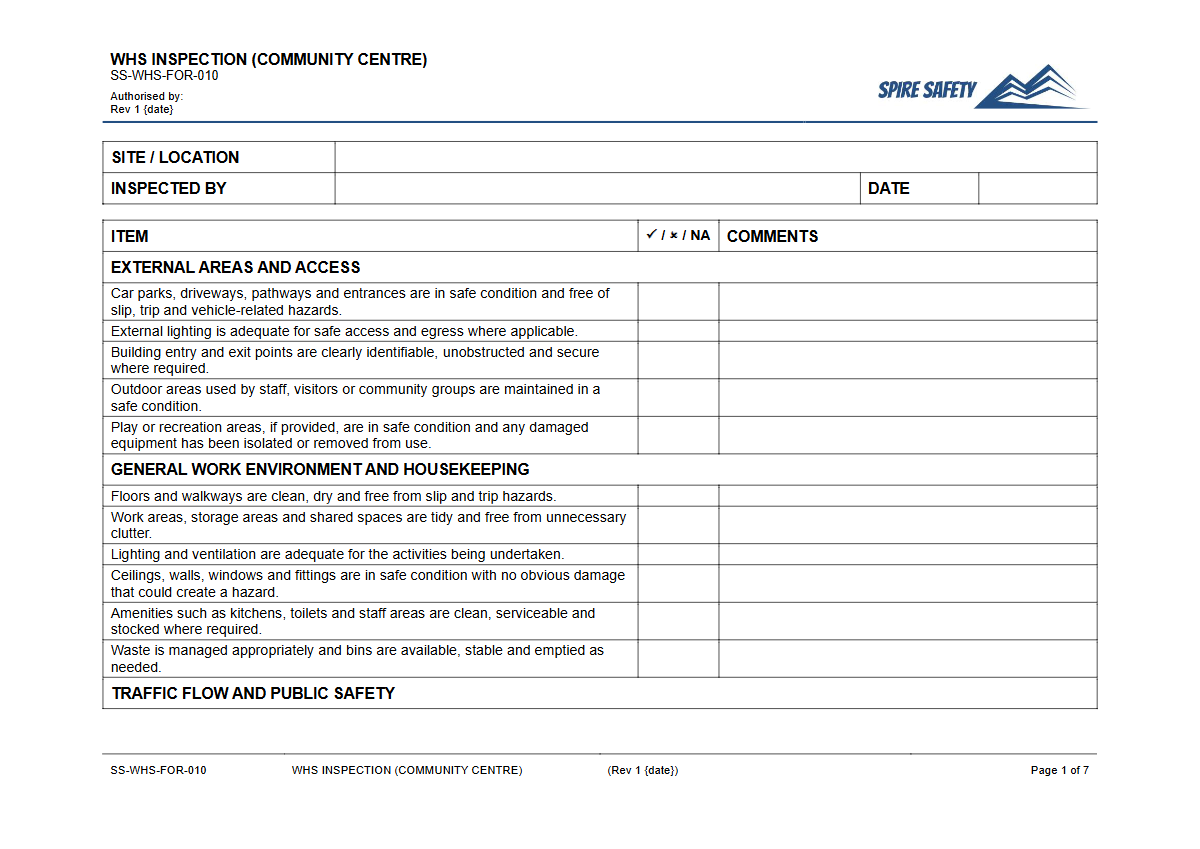
Download our Free WHS Inspection (Community Centre) Template. This structured document helps you identify and manage hazards specific to community spaces.
Free WHS Inspection (Community Centre) Template
DOCX • 128 KB + PDF
Updated Oct 2026
No signup required
Purpose of the Free WHS Inspection (Community Centre) Template
A community centre is a dynamic environment with a diverse range of visitors, activities, and potential hazards. Our Free WHS Inspection (Community Centre) Template provides a structured starting point for systematically identifying and managing these risks.
Regular inspections are fundamental to meeting your duties as a Person Conducting a Business or Undertaking (PCBU). They help you proactively address issues such as slip and trip hazards, electrical safety, fire preparedness, accessibility, and general amenity before they lead to an incident.
Using this template helps formalise your safety processes, creating a documented record of your due diligence. It serves as a practical tool within your overall safety framework, demonstrating a commitment to the health and safety of staff, volunteers, and the public.
Integrating such procedures is a core component of developing a robust WHS management system, ensuring safety is managed methodically rather than reactively.
Video walkthrough
How to use the Free WHS Inspection (Community Centre) Template
This document is a comprehensive guide designed for regular walkthroughs of your facility. It is provided as an editable DOCX file and a print-ready PDF.
To begin, download the template and add your organisation’s name, the date of the inspection, and the names of the inspectors. The checklist is categorised by common areas found in a community centre, such as entryways, kitchens, activity rooms, outdoor areas, and amenities.
You should walk through each area, checking off items and making specific notes on any identified hazards or non-conformances. For each issue, record the required corrective action, assign responsibility to a specific person, and set a realistic completion date.
For example, when inspecting kitchen equipment, you may identify the need for more detailed daily checks on specific appliances; our Free Pre-Start Checklist (Freezer) Template can assist with this.
When assessing outdoor spaces, consider the condition of pathways, lighting, and any grounds maintenance equipment. If your centre uses specific machinery, you may need supplementary documents like our Free Pre-Start Checklist (Lawn Tractor) Template to ensure it is inspected properly before use.
Important: This template is a starting point and is not a substitute for a comprehensive risk assessment. You must customise it to reflect the specific layout, activities, equipment, and unique hazards of your community centre.
We have done our best to provide a thorough list, but only you can ensure it covers all aspects of your specific operations.
When to conduct an Inspection
The frequency of inspections depends on the nature and scale of your centre's operations. A good practice is to schedule comprehensive inspections on a monthly or quarterly basis.
This regular rhythm helps you catch gradual wear and tear or emerging hazards. In addition to these routine checks, inspections should also be conducted before and after major events, following any incident or near miss, or whenever significant changes are made to the facility, such as new construction or the introduction of new equipment.
While this template is ideal for internal checks, you may also require more in-depth, third-party reviews to ensure you are meeting all your legal obligations. These formal reviews are a key part of ongoing safety assurance, and engaging external experts for WHS compliance auditing can provide valuable, impartial insight into your safety performance.
Who should use this Inspection template
This template is designed for use by Centre Managers, Operations Coordinators, WHS representatives, or designated committee members responsible for facility management. To be effective, the inspection process should involve consultation with staff and volunteers who use the spaces daily, as they often have the most immediate insight into potential risks and practical solutions.
The findings and corrective actions should be communicated clearly to all relevant parties.
If your centre provides specialised services, such as care for people with mobility challenges, your inspections must account for specific equipment. For instance, ensuring hoists and lifts are in safe working order is critical, and a resource like our Free Pre-Start Checklist (Patient Hoist) Template can supplement your general inspection.
If you identify complex hazards or are unsure how to manage certain risks, seeking professional advice is a prudent step. An external perspective can help clarify your duties and establish practical controls.
Explore our specialist WHS consulting services if you require tailored support for your organisation.
Common mistakes
Common mistakes to avoid
- Using a generic checklist without customising it for the specific facility.
- Failing to document and track corrective actions for identified hazards.
- Not involving staff and volunteers who use the spaces every day.
- Forgetting to inspect less frequently used areas like storage rooms or plant rooms.
Legal references
Legal considerations
The following legal requirements may be relevant to this type of work.
- Work Health and Safety Act (Harmonised) — Provides the primary duties for protecting workers and other people from work health and safety risks.
- Work Health and Safety Regulations (Harmonised) — Sets out requirements supporting the management of workplace hazards and risks.
The following codes may be relevant to this type of work.
- Managing WHS Risks Code of Practice — Provides practical guidance on identifying hazards, assessing risks and applying effective controls.
- Work Health and Safety Consultation, Cooperation and Coordination Code of Practice — Provides practical guidance on consulting workers and coordinating with other duty holders.
- Managing the Work Environment and Facilities Code of Practice — Provides practical guidance on safe work environments, workplace facilities and related controls.
Did you know
The Role of Volunteers
Under model WHS laws, volunteers are considered 'workers' and are owed the same duty of care as paid employees. This means PCBUs must ensure, so far as is reasonably practicable, the health and safety of their volunteers.
Common Hazards
Slips, trips, and falls are one of the most common causes of injury in public-access buildings. Simple measures like good housekeeping, adequate lighting, and non-slip flooring can significantly reduce risk.
FAQ
Frequently asked questions
01What should be included in a community centre safety inspection?
02How often should a community centre be inspected for WHS?
03Who is responsible for WHS in a community centre?
04Is this template suitable for all types of community centres?
Share this resource
Free WHS Inspection (Community Centre) Template
Browse Categories
How To Use It
- 1Download and open in Word or PDF.
- 2Replace the placeholders with your business details.
- 3Get it reviewed by a WHS specialist before rollout.
Need it customised?
Our WHS consultants can adapt this template to your site, run a gap analysis, or audit what you already have in place.
Book a Free Consultation WHS consulting servicesor call 1300 156 382