
Free WHS Inspection (Compost Facility) Template
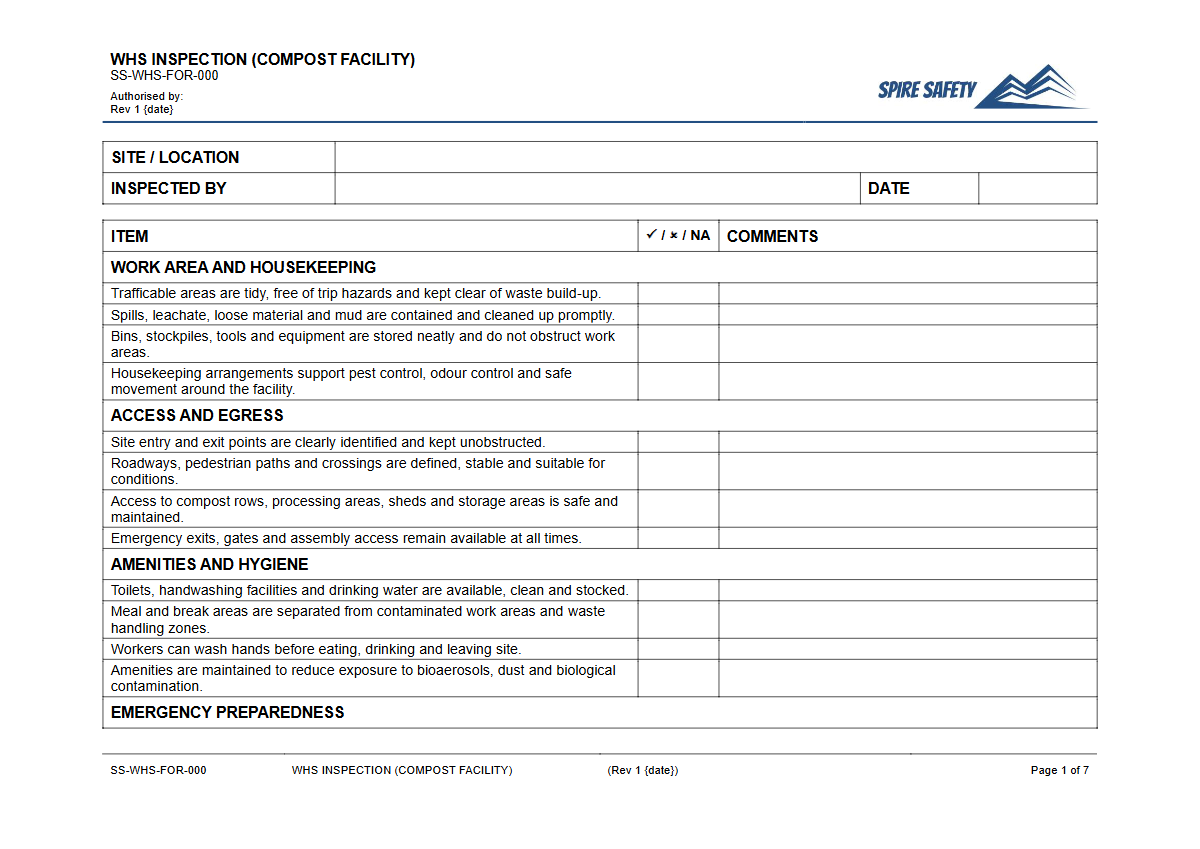
Streamline safety checks at your organic recycling site with our Free WHS Inspection (Compost Facility) Template.
Free WHS Inspection (Compost Facility) Template
DOCX • 128 KB + PDF
Updated Oct 2026
No signup required
Purpose of the Free WHS Inspection (Compost Facility) Template
Compost facilities present a unique combination of health and safety risks, from mobile plant and machinery to biological hazards and confined spaces. This Free WHS Inspection (Compost Facility) Template provides a structured starting point for systematically identifying, assessing, and controlling these hazards.
Regular inspections are a fundamental part of a proactive safety culture, helping your organisation meet its duty of care obligations under WHS legislation. Using this template helps to formalise the process, ensuring that key safety elements are consistently checked and that records are maintained for due diligence and continuous improvement.
A thorough inspection process is a cornerstone of any robust safety framework. By regularly reviewing your site's condition, equipment, and procedures, you can identify potential issues before they lead to incidents.
This includes checking the safety of machinery like loaders and grinders, managing risks from bioaerosols and dust, ensuring proper traffic management, and verifying that emergency procedures are in place and effective. A systematic approach helps demonstrate that the PCBU is taking all reasonably practicable steps to ensure a safe working environment.
Video walkthrough
How to use the Free WHS Inspection (Compost Facility) Template
This template is designed to be a comprehensive starting point, but it requires customisation to be effective for your specific workplace. No two compost facilities are identical, and your inspection checklist must reflect the unique machinery, processes, layout, and hazards present at your site.
To use this document effectively:
- Download the DOCX file and open it in your preferred word processor.
- Add your company branding, site details, and specific emergency contact information.
- Walk through your facility and add or remove checklist items to match your actual plant, equipment, and operational areas. For instance, you might add specific checks for machinery not listed, such as those covered in our free Pre-Start Checklist (Feed Mixer) Template.
- Consult with your workers and Health and Safety Representatives (HSRs) during the customisation process. Their direct experience is invaluable for identifying practical hazards and effective controls.
- Integrate the finalised inspection into your site's regular WHS schedule and procedures.
Important: This is a template document. We are not WHS consultants for your business just because you download it.
To ensure it meets your specific needs and legal obligations, you must customise this template by adding, removing, or changing items to suit your compost facility's unique environment, equipment, and work processes.
When to use it
Workplace inspections should be conducted at regular, scheduled intervals to ensure ongoing safety. The frequency depends on the level of risk and the nature of the work. For a dynamic environment like a compost facility, we suggest:
- Routine Inspections: Conducted weekly or monthly to cover all key operational areas.
- Post-Incident: An inspection of the relevant area and process should be performed immediately following any incident, accident, or near miss to identify causal factors and prevent recurrence.
- Before Change: Complete an inspection before introducing new plant, equipment like an aerator using our pre-start checklist, substances, or work procedures to proactively identify any new risks.
- Periodic Deep Dives: Supplement routine checks with less frequent but more thorough site-wide inspections on a quarterly or bi-annual basis. These broader reviews can be part of a formal WHS compliance audit to verify the effectiveness of your entire safety system.
Who should use it
This inspection template can be used by various personnel, depending on your organisation's structure. Typically, those responsible for conducting inspections include:
- Supervisors and Team Leaders: They are on the front line and have direct oversight of daily operations and worker behaviour.
- WHS Managers or Officers: They use the inspection findings to analyse trends, update risk assessments, and report to management.
- Health and Safety Representatives (HSRs): As representatives of their work group, HSRs can use this template to conduct inspections for their designated area.
- Senior Management: Managers should participate in or review inspections to demonstrate leadership and commitment to safety.
Regardless of who performs the inspection, they must be competent to do so. This means they should have adequate training and knowledge to recognise hazards specific to compost facilities, from the operation of a lawn tractor moving green waste to the risks of stockpile collapse.
These inspections are a critical data source for your overarching WHS management system, providing the information needed to make informed decisions about risk control.
Common mistakes
Common mistakes to avoid
- Using the generic template without customising it for specific site plant and hazards.
- Failing to document corrective actions for issues identified during the inspection.
- Neglecting to consult with workers who operate the equipment and perform the tasks daily.
- Completing the checklist without physically verifying the items ('pencil-whipping').
Legal references
Legal considerations
The following legal requirements may be relevant to this type of work.
- Work Health and Safety Act (Harmonised) — Provides the primary duties for protecting workers and other people from work health and safety risks.
- Work Health and Safety Regulations (Harmonised) — Sets out requirements supporting the management of workplace hazards and risks.
The following codes may be relevant to this type of work.
- Managing WHS Risks Code of Practice — Provides practical guidance on identifying hazards, assessing risks and applying effective controls.
- Work Health and Safety Consultation, Cooperation and Coordination Code of Practice — Provides practical guidance on consulting workers and coordinating with other duty holders.
- Managing the Work Environment and Facilities Code of Practice — Provides practical guidance on safe work environments, workplace facilities and related controls.
Did you know
Bioaerosol Risk
The process of turning and aerating compost can release high concentrations of bioaerosols, which include bacteria and fungal spores. Inhaling these can cause respiratory issues, making respiratory protective equipment (RPE) a critical control measure.
FAQ
Frequently asked questions
01What are the main WHS hazards at a compost facility?
02How often should we inspect our compost site?
03Can I use this template for a risk assessment?
04What should happen after the inspection is completed?
Share this resource
Free WHS Inspection (Compost Facility) Template
Browse Categories
How To Use It
- 1Download and open in Word or PDF.
- 2Replace the placeholders with your business details.
- 3Get it reviewed by a WHS specialist before rollout.
Need it customised?
Our WHS consultants can adapt this template to your site, run a gap analysis, or audit what you already have in place.
Book a Free Consultation WHS consulting servicesor call 1300 156 382