
Free WHS Inspection (Cold Storage) Template
Download our Free WHS Inspection (Cold Storage) Template (DOCX & PDF). A structured starting point to help formalise safety checks in your workplace.
Free WHS Inspection (Cold Storage) Template
DOCX • 128 KB + PDF
Updated Oct 2026
No signup required
Purpose of the Free WHS Inspection (Cold Storage) Template
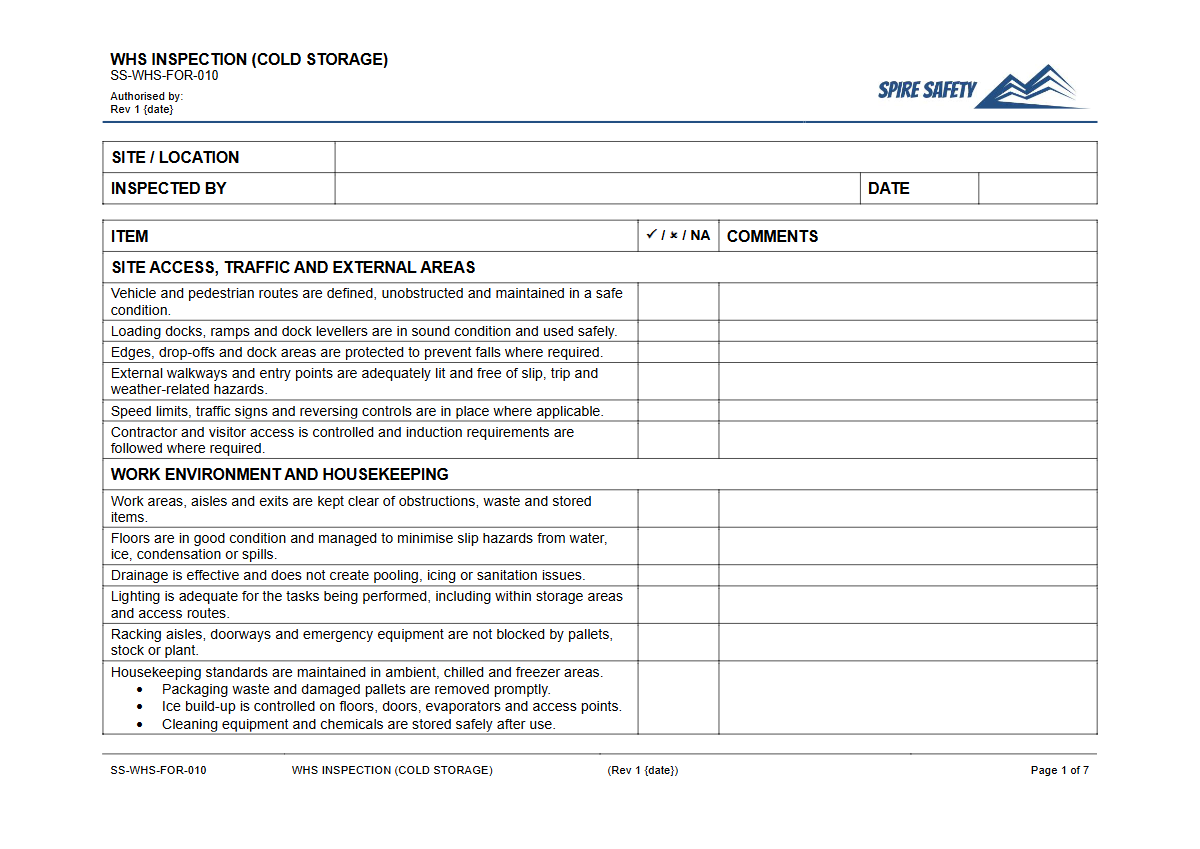
Operating cold storage facilities involves managing a unique set of WHS risks, from slips and falls on ice to cold stress and machinery hazards. This Free WHS Inspection (Cold Storage) Template provides a structured starting point for systematically checking your cold rooms, freezers, and associated areas.
Regular inspections are a fundamental part of a proactive safety culture, helping your organisation identify potential hazards before they cause injury or illness. Using a formal template ensures consistency, aids in record-keeping, and demonstrates a commitment to workplace safety.
The document is designed to guide a competent person through a thorough check of key safety elements. It covers structural integrity, temperature monitoring, emergency systems, housekeeping, and personal protective equipment (PPE) availability.
For equipment-specific daily checks within the facility, consider using our free Pre-Start Checklist (Freezer) template as a complementary tool to ensure operators inspect units before each use.
Video walkthrough
How to use the Free WHS Inspection (Cold Storage) Template
This template is a foundational document designed for customisation. A Person Conducting a Business or Undertaking (PCBU) has the primary duty of care and must ensure safety procedures are specific to the risks in their workplace. To effectively use this resource:
- Download the template in your preferred format (DOCX for easy editing or PDF).
- Customise the checklist to reflect the specific layout, equipment, and operating procedures of your cold storage areas. Add or remove items to make the inspection relevant and comprehensive.
- Determine an appropriate inspection schedule (e.g., weekly, monthly) based on a risk assessment of the area.
- Assign responsibility for conducting the inspections to a competent person, such as a supervisor, WHS representative, or trained worker.
- Ensure all findings, including hazards and corrective actions, are documented clearly. Use the records to track recurring issues and verify that controls have been implemented effectively.
For mobile plant used within or around your storage facilities, such as forklifts or elevating work platforms, you will need separate inspection processes. Our free Pre-Start Checklist (Electric Hoist) template is another example of a machine-specific checklist that helps formalise daily safety checks.
We strongly recommend that you customise this cold storage inspection document to suit your specific site requirements; it is a template, not a complete solution.
Implementing Corrective Actions
Simply identifying a hazard is not enough. Your procedure should include a clear process for reporting and rectifying issues found during the inspection.
This involves assigning responsibility for the corrective action, setting a realistic completion date, and verifying that the fix has been effective. This 'plan-do-check-act' cycle is a cornerstone of effective safety management and continuous improvement.
Documenting these actions provides crucial evidence of your organisation's proactive approach to safety.
When to use this Inspection Template
Regular, scheduled inspections are vital for maintaining a safe environment. This template should be used as part of your routine safety activities, with the frequency determined by your risk assessment.
Typically, a thorough workplace inspection of a cold storage facility might be conducted weekly or monthly. Additional inspections should also be triggered by certain events, such as after a plant breakdown or repair, following an incident or near miss, or when changes are made to the layout or work procedures within the area.
Controlling access to storage areas is also a key part of site safety. If your facility uses automated entry systems, remember to include them in your inspection schedule.
You can adapt our free Boom Gate Pre-Start Checklist to help formalise checks on access control equipment.
Who should use it
This inspection should be carried out by a person with the knowledge and experience to identify hazards specific to cold storage environments. This could include a WHS Manager, a Health and Safety Representative (HSR), a line manager or supervisor, or a worker who has received specific training.
Involving workers in the inspection process can be highly beneficial, as they have direct, hands-on experience with the operational risks. The findings should be reviewed by management to ensure necessary resources are allocated for any required corrective actions.
Formal inspections like this are an integral component of robust WHS management systems. They provide the practical, on-the-ground data needed to confirm that policies and procedures are working as intended. A well-documented inspection history is a key input for safety reporting and management reviews.
Furthermore, the records generated from these inspections are essential evidence during a formal audit process. An external auditor performing WHS compliance auditing will look for documented proof of hazard identification, risk assessment, and control implementation.
Consistent use of this template can help provide that evidence trail. You can find more helpful templates in our extensive library of free WHS resources.
Common mistakes
Common mistakes to avoid
- Neglecting to check and clear ice build-up on floors, racking, and doorways.
- Failing to provide, maintain, and enforce the use of appropriate thermal personal protective equipment (PPE).
- Not regularly testing emergency alarms, internal door release mechanisms, and emergency lighting.
- Keeping incomplete or inconsistent inspection records, which prevents the analysis of recurring safety issues.
Legal references
Legal considerations
The following legal requirements may be relevant to this type of work.
- Work Health and Safety Act (Harmonised) — Provides the primary duties for protecting workers and other people from work health and safety risks.
- Work Health and Safety Regulations (Harmonised) — Sets out requirements supporting the management of workplace hazards and risks.
The following codes may be relevant to this type of work.
- Managing WHS Risks Code of Practice — Provides practical guidance on identifying hazards, assessing risks and applying effective controls.
- Work Health and Safety Consultation, Cooperation and Coordination Code of Practice — Provides practical guidance on consulting workers and coordinating with other duty holders.
- Managing the Work Environment and Facilities Code of Practice — Provides practical guidance on safe work environments, workplace facilities and related controls.
Did you know
Cold Stress Risks
Exposure to cold can impair judgment and physical coordination long before hypothermia sets in, significantly increasing the risk of accidents with machinery or from slips and falls.
Ammonia Hazards
Many large-scale cold storage facilities use ammonia as a refrigerant. It is toxic and flammable, making leak detection systems, ventilation, and emergency procedures critical safety components.
FAQ
Frequently asked questions
01How often should cold storage facilities be inspected?
02What are the main hazards in a cold storage facility?
03Is this template sufficient for WHS compliance?
04What PPE is required for working in cold storage?
Share this resource
Free WHS Inspection (Cold Storage) Template
Browse Categories
How To Use It
- 1Download and open in Word or PDF.
- 2Replace the placeholders with your business details.
- 3Get it reviewed by a WHS specialist before rollout.
Need it customised?
Our WHS consultants can adapt this template to your site, run a gap analysis, or audit what you already have in place.
Book a Free Consultation WHS consulting servicesor call 1300 156 382