
Free WHS Inspection (Childcare Centre) Template
Download our free WHS Inspection (Childcare Centre) Template to proactively manage risks and ensure a safe environment. Based on Australian WHS principles.
Free WHS Inspection (Childcare Centre) Template
DOCX • 127 KB + PDF
Updated Oct 2026
No signup required
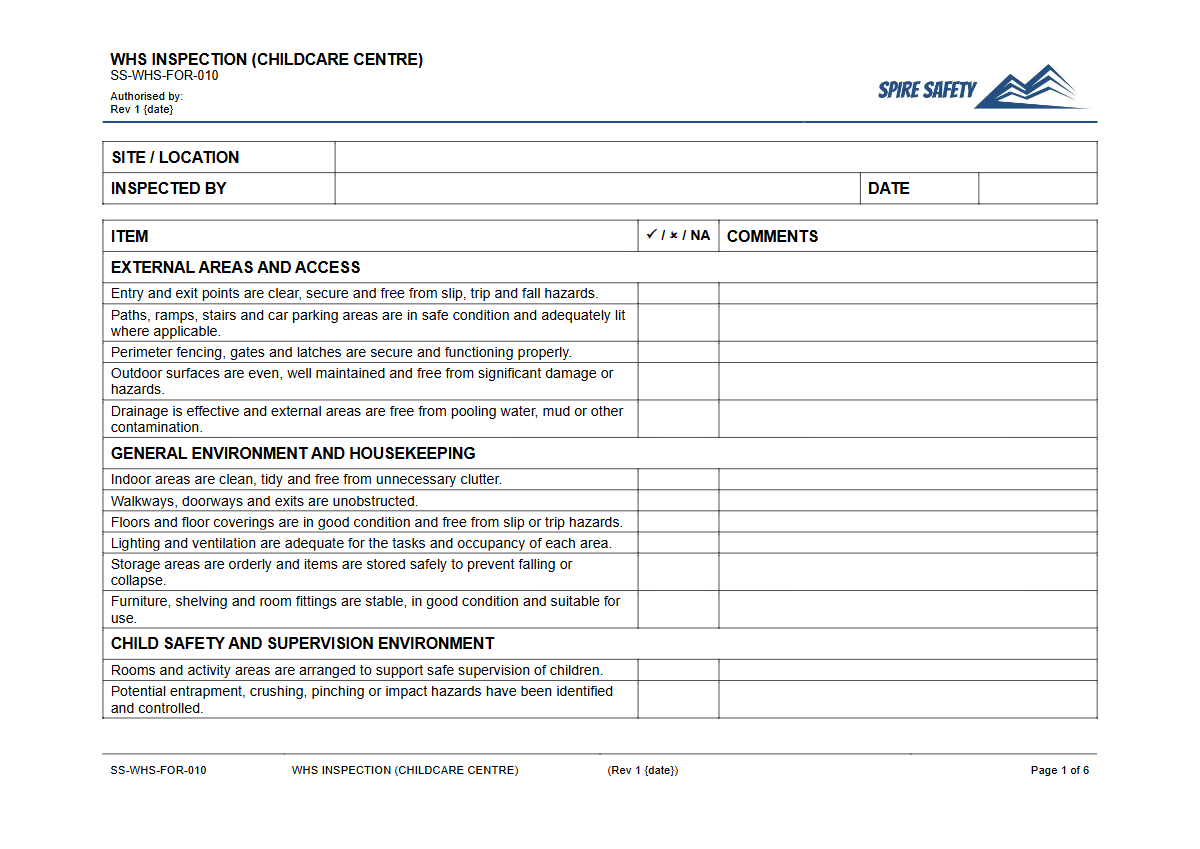
Purpose of the Free WHS Inspection (Childcare Centre) Template
Ensuring the safety and wellbeing of children and staff is the highest priority in any early learning environment. This free WHS Inspection (Childcare Centre) Template provides a structured starting point for systematically identifying and managing hazards specific to your facility.
Developed in alignment with Australian WHS principles, this template helps Centre Directors and WHS Representatives formalise their safety checks, covering everything from play equipment to food preparation areas. It is an essential tool for proactive risk management.
The primary purpose of this template is to provide a comprehensive framework for regular safety assessments. It prompts users to look critically at various aspects of the centre's environment and operations to identify potential risks before they cause harm. The checklist is categorised to cover key risk areas in a childcare setting, including:
- Indoor and outdoor play areas and equipment
- General building safety (e.g., exits, lighting, security)
- Hygiene and infection control facilities (e.g., nappy change stations, bathrooms)
- Food preparation and kitchen safety
- Storage of hazardous substances like cleaning chemicals
- Emergency equipment and procedures
By using a structured checklist, you ensure a consistent and thorough approach every time. This helps in creating a safer environment for children to learn and play, and for educators to work.
For specific pieces of equipment, you may need more detailed checks, such as using a pre-start checklist for a bottle warmer to ensure it functions correctly and safely each day.
Video walkthrough
How to use the Free WHS Inspection (Childcare Centre) Template
This template is available in both DOCX and PDF formats. The DOCX file can be easily edited in Microsoft Word or Google Docs to suit your centre's specific needs, while the PDF is ready for immediate printing and use.
To get started:
- Download the template in your preferred format.
- Thoroughly review and customise the checklist. Add or remove items to reflect the unique equipment, layout, and activities at your centre.
- Train the relevant staff on how to conduct the inspection effectively.
- Integrate the inspection into your regular schedule and broader safety framework.
Important Note: This document is a template only. As every workplace is different, it is your responsibility to customise it to address the specific hazards present in your childcare centre.
We provide this as a starting point, but you must adapt it to ensure it is suitable for your operations. A well-customised template is a key component when you develop comprehensive WHS management systems.
When to use it
Regular and systematic inspections are key to effective WHS management. This inspection template should be used as part of a planned schedule, which could be weekly, fortnightly, or monthly, depending on your risk assessment and centre's needs. Beyond routine checks, it is also crucial to conduct an inspection:
- Following any incident, accident, or near miss to identify contributing factors.
- When new play equipment, furniture, or appliances are introduced.
- After significant changes to the centre's layout or building structure.
- Before and after special events that might introduce temporary hazards.
Maintaining a consistent schedule and documenting your findings are critical for demonstrating due diligence. These records are invaluable during internal reviews or formal WHS compliance audits.
Who should use it
Responsibility for safety inspections can be assigned to one or more competent individuals. Typically, this includes:
- Centre Directors or Managers
- Nominated Supervisors
- Work Health and Safety (WHS) Representatives or Committee Members
- Room Leaders or senior educators responsible for specific areas
Involving a team in the inspection process can provide different perspectives and foster a stronger safety culture across the organisation. A thorough inspection also covers ancillary tasks and equipment.
For instance, kitchen staff should have clear procedures for their appliances, which could be supported by a pre-start checklist for a blender. If your centre manages its own grounds, a pre-start checklist for a lawn tractor ensures machinery is safe before use. Integrating these specific checks into your overall inspection program creates a robust safety net.
If you require assistance in defining roles, responsibilities, or training needs for your team, consider engaging expert WHS consulting to guide your approach. The goal is to empower staff to proactively identify and control risks in their own work areas.
Common mistakes
Common mistakes to avoid
- Using a generic template without customising it for the specific centre's hazards.
- Completing the checklist as a 'tick and flick' exercise without genuine observation or verification.
- Failing to document and implement corrective actions for issues identified during the inspection.
- Not keeping records of completed inspections and the actions taken.
Legal references
Legal considerations
The following legal requirements may be relevant to this type of work.
- Work Health and Safety Act (Harmonised) — Provides the primary duties for protecting workers and other people from work health and safety risks.
- Work Health and Safety Regulations (Harmonised) — Sets out requirements supporting the management of workplace hazards and risks.
The following codes may be relevant to this type of work.
- Managing WHS Risks Code of Practice — Provides practical guidance on identifying hazards, assessing risks and applying effective controls.
- Work Health and Safety Consultation, Cooperation and Coordination Code of Practice — Provides practical guidance on consulting workers and coordinating with other duty holders.
- Managing the Work Environment and Facilities Code of Practice — Provides practical guidance on safe work environments, workplace facilities and related controls.
Did you know
Leading Cause of Injury
Slips, trips and falls are consistently one of the leading causes of serious injury in Australian workplaces, including childcare centres, affecting both staff and children.
Sun Safety Duty
Australia has one of the highest rates of skin cancer in the world. Childcare providers have a clear duty of care to implement and enforce comprehensive sun safety policies.
FAQ
Frequently asked questions
01Is this childcare inspection checklist compliant with Australian WHS laws?
02How often should I conduct a WHS inspection in a childcare centre?
03What are the most common hazards in a childcare centre?
04Can I use this template for family day care?
Share this resource
Free WHS Inspection (Childcare Centre) Template
Browse Categories
How To Use It
- 1Download and open in Word or PDF.
- 2Replace the placeholders with your business details.
- 3Get it reviewed by a WHS specialist before rollout.
Need it customised?
Our WHS consultants can adapt this template to your site, run a gap analysis, or audit what you already have in place.
Book a Free Consultation WHS consulting servicesor call 1300 156 382