
Free WHS Inspection (Civil Works Site) Template
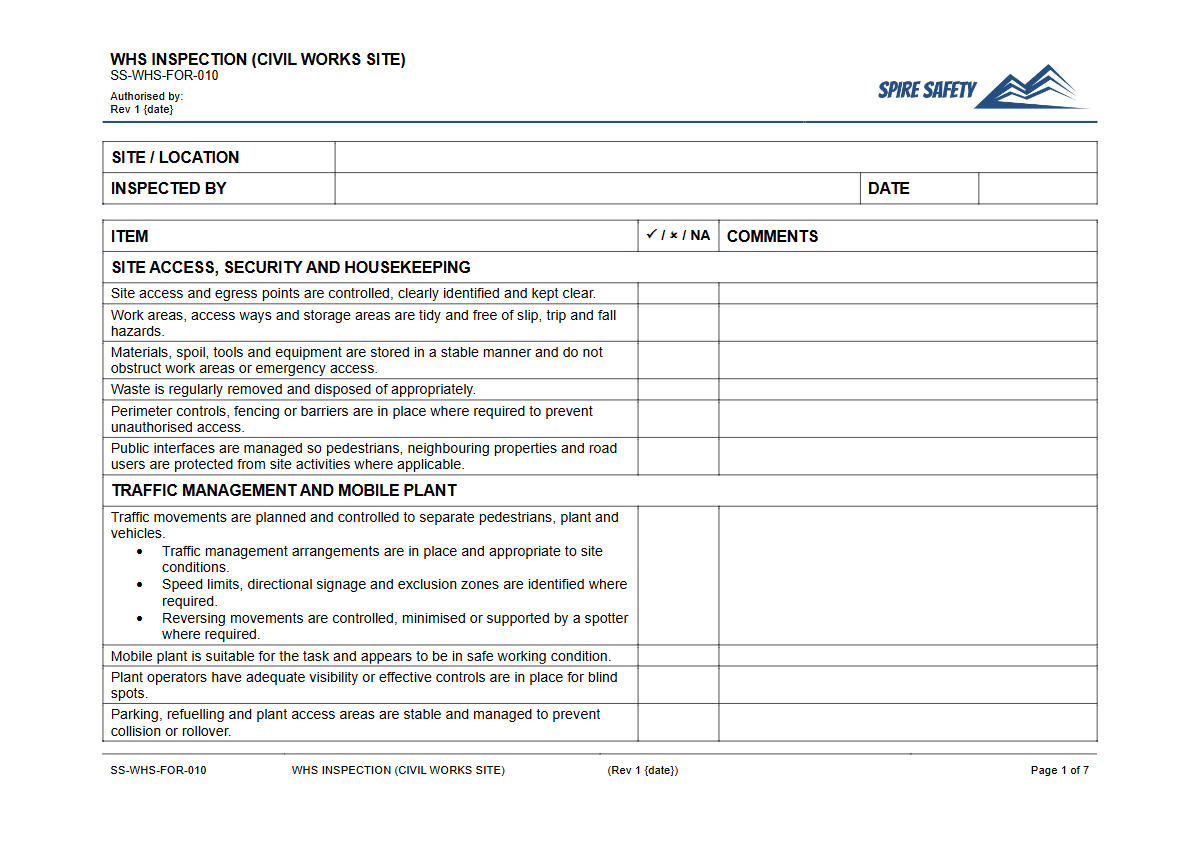
Formalise your safety checks with our Free WHS Inspection (Civil Works Site) Template. This structured document helps identify hazards on civil projects.
Free WHS Inspection (Civil Works Site) Template
DOCX • 128 KB + PDF
Updated Oct 2026
No signup required
Purpose of the Free WHS Inspection (Civil Works Site) Template
Civil construction sites are dynamic and high-risk environments, featuring hazards like heavy mobile plant, deep excavations, public interaction, and environmental sensitivities. A systematic approach to safety is essential.
This Free WHS Inspection (Civil Works Site) Template provides a structured starting point for organisations to formalise their safety inspection processes, ensuring key risk areas are regularly checked.
Using a standardised template helps drive consistency and thoroughness in your safety checks. It allows supervisors and WHS personnel to proactively identify unsafe conditions, non-compliant activities, and emerging hazards before they cause an incident.
Documented inspections create a historical record of site conditions and safety diligence, forming a critical component of your overall safety framework. These records can be a valuable input for your broader WHS management systems and continuous improvement efforts.
Video walkthrough
How to use the Free WHS Inspection (Civil Works Site) Template
This resource is designed to be a practical tool for your team on the ground. Begin by downloading the template in your preferred format; DOCX for easy customisation or PDF for immediate printing.
The core of this process is adapting the document to fit the unique context of your project.
IMPORTANT: This template provides a solid foundation, but it is not a complete, off-the-shelf solution. We have designed it as a starting point that you must customise to reflect the specific hazards, equipment, environment, and legal requirements of your particular civil works site.
You should add, remove, and modify checklist items in consultation with your team and after conducting a site-specific risk assessment. If you are unsure about your legal obligations, seek advice from qualified safety professionals.
Key Inspection Areas
Our template prompts you to assess a range of critical areas common to civil works. During customisation, you should refine these to match your project's scope:
- Site Establishment & Security: Check for adequate fencing, signage, visitor management, and first aid facilities. Ensuring the site is secure from unauthorised entry is paramount, a topic covered in our Site Security and Unauthorised Access Toolbox Talk Template.
- Excavation, Trenching & Groundworks: Inspect shoring and benching, access and egress points, spoil heap locations, and controls for preventing falls into excavations.
- Mobile Plant & Equipment: Verify operator competency, traffic management controls, pre-start checks, and safe operation. Some sites may use smaller lifting gear, where a specific checklist like our Free Pre-Start Checklist (Electric Hoist) Template would be used in addition to this broader site inspection.
- Environmental Controls: Assess sediment and erosion controls, waste management, and spill kits. This is critical for preventing pollution, a subject detailed in our Stormwater and Waterway Protection Toolbox Talk Template.
- High-Risk Work: Review controls for tasks like working at heights, electrical work, and operating cranes.
- General Housekeeping: Look for trip hazards, clear access ways, and proper storage of materials.
When to use an Inspection Template
The frequency of inspections on a civil works site should be risk-based. Due to the constantly changing nature of these projects, regular inspections are crucial.
Consider conducting them at scheduled intervals such as daily for high-risk areas or weekly for the entire site. They are also vital at key project milestones: before a major concrete pour, prior to opening a new area to traffic, or after a significant weather event.
An inspection should also be performed following any incident or near-miss to identify contributing factors.
Who should use this Inspection resource
This template is intended for use by personnel with the authority and competence to identify hazards and direct corrective actions. This typically includes Site Supervisors, Project Managers, Forepersons, and WHS Advisors.
To be effective, the inspection process should involve consultation with the workers performing the tasks, as they have direct knowledge of the risks involved. The person conducting the inspection must be competent to recognise the specific hazards present in a civil construction environment, from spotting tension cracks near an excavation to understanding traffic management principles.
The findings from the inspection should be formally documented, with clear responsibilities and deadlines assigned for any corrective actions. Following up to ensure these actions are completed is the most important part of the process. Regularly verifying the effectiveness of your inspection program through independent checks can provide valuable assurance, which is a key objective of formal WHS compliance auditing.
Common mistakes
Common mistakes to avoid
- Using a generic template without customising it for the specific site, plant, and tasks.
- Failing to formally track and close out the corrective actions identified during the inspection.
- Conducting the inspection as a 'tick-and-flick' exercise without genuine observation and engagement.
- Not involving the workers and health and safety representatives (HSRs) who are performing the work.
Legal references
Legal considerations
The following legal requirements may be relevant to this type of work.
- Work Health and Safety Act (Harmonised) — Provides the primary duties for protecting workers and other people from work health and safety risks.
- Work Health and Safety Regulations (Harmonised) — Sets out requirements supporting the management of workplace hazards and risks.
The following codes may be relevant to this type of work.
- Managing WHS Risks Code of Practice — Provides practical guidance on identifying hazards, assessing risks and applying effective controls.
- Work Health and Safety Consultation, Cooperation and Coordination Code of Practice — Provides practical guidance on consulting workers and coordinating with other duty holders.
- Managing the Work Environment and Facilities Code of Practice — Provides practical guidance on safe work environments, workplace facilities and related controls.
Did you know
A Proactive Measure
Regular site inspections are a leading indicator of safety performance. They proactively identify system weaknesses before they contribute to an incident, which is a lagging indicator.
Construction Industry Statistics
According to Safe Work Australia, the construction industry consistently ranks among the top industries for serious workers' compensation claims, highlighting the critical need for robust safety practices like formal inspections.
FAQ
Frequently asked questions
01What's the difference between a site inspection and a site audit in civil works?
02How often should I conduct a WHS inspection on a civil construction site?
03Who is qualified to perform a civil works site inspection?
04Can this template be used for residential construction sites?
Share this resource
Free WHS Inspection (Civil Works Site) Template
Browse Categories
How To Use It
- 1Download and open in Word or PDF.
- 2Replace the placeholders with your business details.
- 3Get it reviewed by a WHS specialist before rollout.
Need it customised?
Our WHS consultants can adapt this template to your site, run a gap analysis, or audit what you already have in place.
Book a Free Consultation WHS consulting servicesor call 1300 156 382