
Free WHS Inspection (Clean Room) Template
Download our Free WHS Inspection (Clean Room) Template (DOCX/PDF) to formalise your safety and contamination control checks. A structured starting point.
Free WHS Inspection (Clean Room) Template
DOCX • 127 KB + PDF
Updated Oct 2026
No signup required
Purpose of the Free WHS Inspection (Clean Room) Template
Maintaining a clean room environment is critical in industries like pharmaceuticals, biotechnology, medical device manufacturing, and microelectronics. Even minor deviations can lead to product contamination, regulatory issues, and significant financial loss.
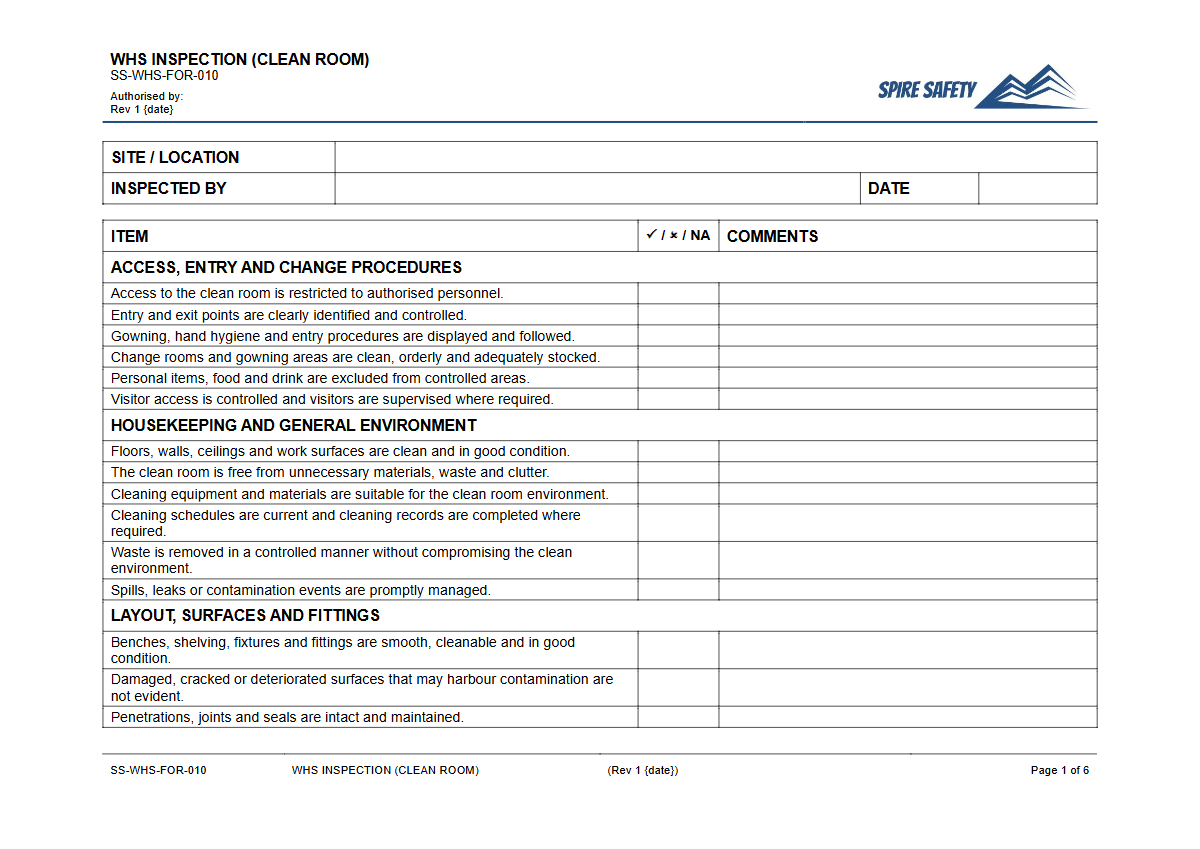
Our Free WHS Inspection (Clean Room) Template provides a structured starting point for developing a robust inspection checklist aligned with Australian WHS principles. This document helps your organisation formalise procedures for verifying that environmental controls, safety protocols, and operational standards are consistently met.
Regular, documented inspections are a fundamental part of demonstrating due diligence. This template assists in identifying potential hazards, from airborne particulates and microbial contaminants to procedural breaches and equipment malfunctions.
Using a standardised checklist ensures that inspections are thorough and repeatable, providing valuable data for trend analysis and continuous improvement. It forms a key component of effective WHS management systems by creating a clear record of proactive risk management activities.
What this Inspection Template covers
This template is designed to be a comprehensive foundation, prompting checks across several critical areas of clean room operation:
- Environmental Controls: Air pressure differentials, temperature, humidity, and HEPA/ULPA filter status.
- Contamination Control: Surface cleanliness, particle counts (if applicable), and waste disposal procedures.
- Gowning & Personnel: Correct use of personal protective equipment (PPE), adherence to gowning room protocols, and personnel behaviour.
- Equipment & Materials: Condition of equipment, proper storage of materials, and validation of cleaning supplies.
- General Safety: Trip hazards, emergency exit access, chemical storage, and electrical safety.
Video walkthrough
How to use the Free WHS Inspection (Clean Room) Template
This resource is available as a DOCX file for easy editing and a PDF for immediate use. Its primary purpose is to serve as a framework that you adapt to the unique requirements of your facility.
A generic checklist cannot account for the specific classification of your clean room (e.g., ISO 5 vs. ISO 8), the processes conducted within it, or the specific equipment you use.
Note: You must customise this template for your specific workplace, equipment, and legal requirements. We provide a structured starting point, not a complete, out-of-the-box solution.
Review the checklist against your own Safe Work Procedures (SWPs), manufacturer guidelines, and any relevant industry standards (like ISO 14644).
To implement it effectively:
- Download the DOCX version.
- Modify the checklist items to reflect your specific clean room class, equipment, and critical control points.
- Add sections for recording specific measurements like pressure readings or particle counts.
- Incorporate your company branding and document control information.
- Train authorised personnel on how to use the checklist correctly.
- Establish a clear process for documenting findings and assigning corrective actions.
Once customised and implemented, the records generated from this inspection form an essential evidence base for internal reviews and external audits. Independent WHS compliance auditing can help verify the effectiveness of your inspection program and identify any gaps in your safety processes.
When to use this Inspection Template
The frequency of clean room inspections depends on the room's classification, the sensitivity of the processes within, and your organisation's risk assessment. A common schedule might include:
- Daily Checks: Quick verification of critical parameters like air pressure differentials, temperature, and general housekeeping.
- Weekly Inspections: More detailed checks covering surface cleanliness, supply levels, and adherence to protocols.
- Monthly/Quarterly Inspections: Comprehensive reviews including equipment condition, logbook entries, and a deep dive into environmental monitoring data.
Inspections should also be conducted following any non-routine event, such as maintenance work, equipment installation, a power outage, or a suspected contamination event. This helps ensure the environment is returned to its validated state before operations resume. The principle is similar to checks in other controlled environments, such as those covered in our Free Pre-Start Checklist (Freezer) Template.
Who should use it
Clean room inspections should be carried out by personnel who are thoroughly trained in contamination control principles and the specific operational procedures of the area. This typically includes roles such as:
- Clean Room Supervisors or Team Leaders
- Quality Assurance (QA) or Quality Control (QC) Officers
- Facilities or Maintenance Technicians
- Specially trained Production Operators
The individuals performing the inspection must have the authority to halt operations if critical deviations are found. Their training is a crucial element of a compliant management system, a requirement that often aligns with broader frameworks for which organisations may seek ISO 45001 consulting to achieve certification and demonstrate best practice.
By implementing a formal inspection process using this template, you empower your team to proactively manage the integrity of your controlled environments. For more tools to support your safety programs, browse our complete free WHS resources library.
Common mistakes
Common mistakes to avoid
- Using a generic checklist that isn't customised to the clean room's specific ISO class and function.
- Inspectors lacking adequate training in contamination control principles and aseptic techniques.
- Failing to properly document corrective actions taken in response to identified issues.
- Neglecting to inspect crucial support areas like gowning rooms, pass-throughs, and airlocks.
Legal references
Legal considerations
The following legal requirements may be relevant to this type of work.
- Work Health and Safety Act (Harmonised) — Provides the primary duties for protecting workers and other people from work health and safety risks.
- Work Health and Safety Regulations (Harmonised) — Sets out requirements supporting the management of workplace hazards and risks.
The following codes may be relevant to this type of work.
- Managing WHS Risks Code of Practice — Provides practical guidance on identifying hazards, assessing risks and applying effective controls.
- Work Health and Safety Consultation, Cooperation and Coordination Code of Practice — Provides practical guidance on consulting workers and coordinating with other duty holders.
- Managing the Work Environment and Facilities Code of Practice — Provides practical guidance on safe work environments, workplace facilities and related controls.
Did you know
The Cleanest Place on Earth
Modern clean rooms were invented by American physicist Willis Whitfield in the 1960s. His design created a constant, downward flow of highly filtered air that was over 1,000 times cleaner than any previous methods, revolutionising manufacturing in electronics and pharmaceuticals.
Invisible Threats
A typical human hair is about 50-100 microns in diameter. The most stringent clean rooms, like ISO Class 1, are designed to control particles as small as 0.1 microns—500 times smaller than a human hair.
FAQ
Frequently asked questions
01What is the difference between a clean room inspection and a general workplace inspection?
02How often should clean room inspections be conducted?
03Who is qualified to conduct a clean room inspection?
04What are the key areas to check during a clean room inspection?
Share this resource
Free WHS Inspection (Clean Room) Template
Browse Categories
How To Use It
- 1Download and open in Word or PDF.
- 2Replace the placeholders with your business details.
- 3Get it reviewed by a WHS specialist before rollout.
Need it customised?
Our WHS consultants can adapt this template to your site, run a gap analysis, or audit what you already have in place.
Book a Free Consultation WHS consulting servicesor call 1300 156 382