
Free WHS Inspection (Chemical Store) Template
Regularly inspect your chemical storage areas with our structured template. This Free WHS Inspection (Chemical Store) Template helps manage risks. Download now.
Free WHS Inspection (Chemical Store) Template
DOCX • 126 KB + PDF
Updated Oct 2026
No signup required
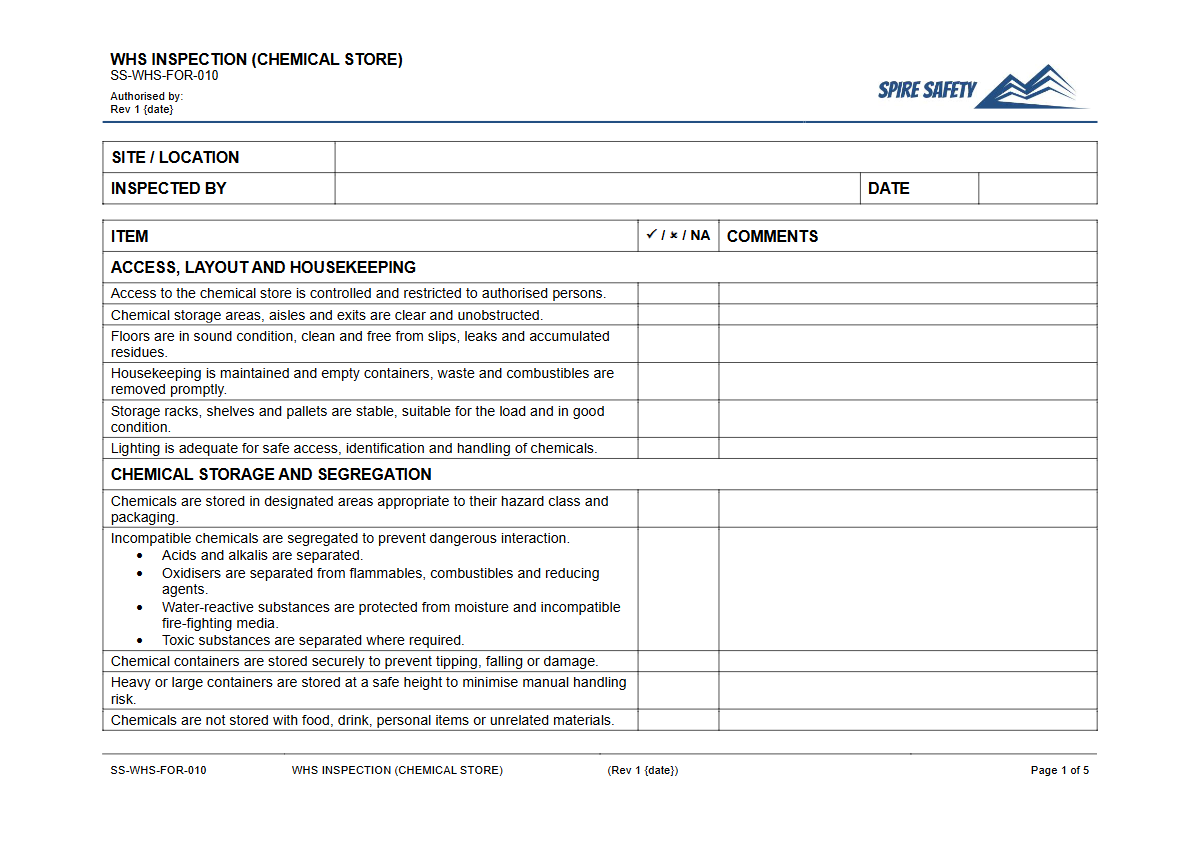
Purpose of the Free WHS Inspection (Chemical Store) Template
Managing hazardous chemicals is a critical part of workplace health and safety. A disorganised or poorly maintained chemical store can pose significant risks, including fires, explosions, chemical burns, and long-term health effects.
This Free WHS Inspection (Chemical Store) Template provides a structured starting point for organisations to formalise their inspection process. Regular inspections help systematically identify hazards, assess risks, and verify that control measures are effective and maintained.
Using this template helps a Person Conducting a Business or Undertaking (PCBU) meet their primary duty of care by proactively managing the risks associated with chemical storage. It encourages a consistent approach to safety checks, covering key areas such as segregation of incompatible substances, correct labelling, container integrity, ventilation, and emergency preparedness. Integrating this process into your overall safety framework is a key part of building robust WHS management systems.
Video walkthrough
How to use the Free WHS Inspection (Chemical Store) Template
This template is designed to be straightforward and adaptable. It guides an inspector through a series of checks and prompts them to record findings, note non-conformances, and assign corrective actions with due dates.
To begin, download the template in your preferred format (DOCX or PDF). The DOCX version is fully editable, allowing you to tailor it to your specific workplace.
Walk through the chemical storage area and assess each item on the checklist. For each point, indicate whether it is compliant, non-compliant, or not applicable.
If a hazard or deficiency is identified, provide a detailed description in the comments section and outline the necessary corrective action. Assign responsibility for the action to a specific person and set a realistic completion date.
The completed inspection record should be signed, dated, and filed for future reference and review. These records can be valuable inputs for WHS compliance auditing.
Customising the Inspection Template
It's crucial to remember that this template is a starting point. We recommend you customise it to reflect the specific chemicals, storage systems (e.g., flammable liquids cabinets, bunding, gas cylinder cages), and operational procedures unique to your workplace.
Add or remove checklist items to ensure the inspection is relevant and comprehensive for your operations.
When to use it
The frequency of chemical store inspections should be determined by a risk assessment. As a general guide, inspections should be conducted on a regular schedule, such as weekly or monthly, to ensure ongoing safety. In addition, an inspection is recommended:
- After a near miss, incident, or chemical spill.
- When new hazardous chemicals are introduced to the workplace.
- Following changes to storage layouts or procedures.
- As part of a periodic safety review process.
For specialised storage, such as refrigerated units holding temperature-sensitive chemicals, daily checks may be necessary. You can adapt other specific checklists, like our free pre-start checklist for freezers, to supplement your routine.
Who should use it
Chemical store inspections should be carried out by a person who is competent and has received adequate training on chemical hazards and storage requirements. This may include:
- WHS or Safety Officers
- Store Managers or Supervisors
- Members of the Health and Safety Committee (HSC)
- Designated workers with relevant experience
The person conducting the inspection must be familiar with the Safety Data Sheets (SDS) for the chemicals being stored and understand the principles of chemical segregation and safe handling. If your workplace uses mechanical aids like drum lifters, ensure operators are also competent and that equipment is regularly inspected using tools like a free pre-start checklist for an electric hoist. For complex sites, seeking guidance from specialist WHS consulting can help establish a robust inspection program and ensure personnel are adequately trained.
You can find more templates and checklists in our free WHS resources library to support your safety efforts.
Common mistakes
Common mistakes to avoid
- Using a generic checklist without customising it for site-specific chemicals and storage conditions.
- Neglecting to check the expiry dates of stored chemicals or the serviceability of spill kits and fire extinguishers.
- Failing to follow up and document the closure of corrective actions identified during an inspection.
- Inadequate training for personnel who conduct inspections, leading to overlooked hazards or misunderstood requirements.
Legal references
Legal considerations
The following legal requirements may be relevant to this type of work.
- Work Health and Safety Act (Harmonised) — Provides the primary duties for protecting workers and other people from work health and safety risks.
- Work Health and Safety Regulations (Harmonised) — Sets out requirements supporting the management of workplace hazards and risks.
The following codes may be relevant to this type of work.
- Managing WHS Risks Code of Practice — Provides practical guidance on identifying hazards, assessing risks and applying effective controls.
- Work Health and Safety Consultation, Cooperation and Coordination Code of Practice — Provides practical guidance on consulting workers and coordinating with other duty holders.
- Managing the Work Environment and Facilities Code of Practice — Provides practical guidance on safe work environments, workplace facilities and related controls.
Did you know
SDS Accessibility
Australian WHS Regulations require that Safety Data Sheets (SDS) for any hazardous chemical on site must be readily accessible to workers. This means not locked away in an office far from where the chemicals are handled.
Incompatible Substances
Storing incompatible chemicals together is a leading cause of workplace incidents. For example, storing oxidizing agents near flammable liquids can create a severe fire or explosion risk if one were to leak.
FAQ
Frequently asked questions
01What should be included in a chemical store inspection checklist?
02How often should a chemical store be inspected in Australia?
03Is this chemical store inspection template compliant with WHS Regulations?
04Who is responsible for conducting chemical store inspections?
Share this resource
Free WHS Inspection (Chemical Store) Template
Browse Categories
How To Use It
- 1Download and open in Word or PDF.
- 2Replace the placeholders with your business details.
- 3Get it reviewed by a WHS specialist before rollout.
Need it customised?
Our WHS consultants can adapt this template to your site, run a gap analysis, or audit what you already have in place.
Book a Free Consultation WHS consulting servicesor call 1300 156 382