
Free WHS Inspection (Fabrication Shop) Template
Identify and control hazards in your fabrication workshop with our free WHS Inspection Template. A structured DOCX and PDF to improve safety. Download now.
Free WHS Inspection (Fabrication Shop) Template
DOCX • 128 KB + PDF
Updated Oct 2026
No signup required
Purpose of the Free WHS Inspection (Fabrication Shop) Template
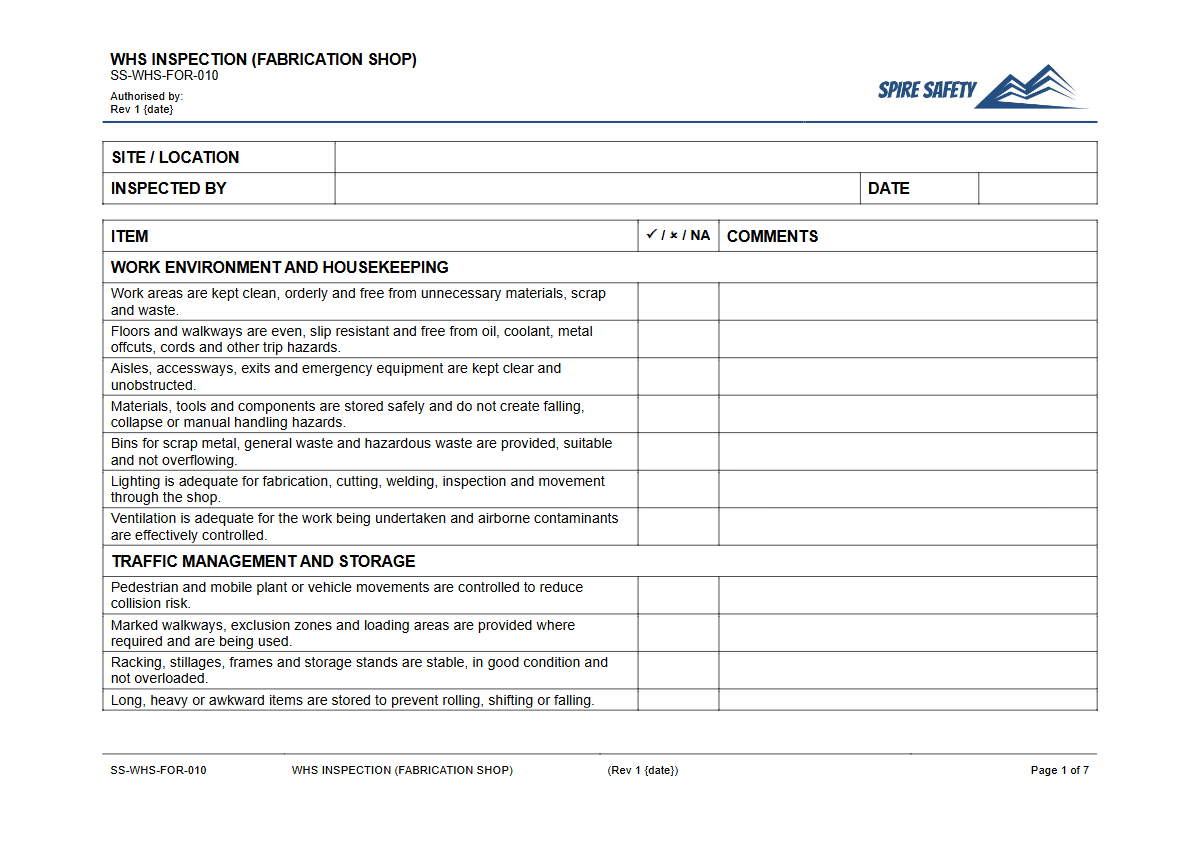
Conducting regular safety inspections is a cornerstone of effective risk management in any high-risk environment like a metal fabrication workshop. This Free WHS Inspection (Fabrication Shop) Template provides a structured starting point for systematically identifying hazards and assessing controls.
It helps formalise the process of checking for common risks such as inadequate machine guarding, poor welding fume extraction, electrical faults, trip hazards, and incorrect storage of hazardous chemicals.
Using a standardised checklist ensures key safety elements are not overlooked, creating a consistent record of your safety diligence. Integrating these regular checks into broader WHS management systems helps build a proactive safety culture, moving beyond simple compliance to active risk reduction.
This document serves as a practical tool for supervisors and managers to document findings, assign corrective actions, and track their resolution.
Video walkthrough
How to use the Free WHS Inspection (Fabrication Shop) Template
This template is designed for ease of use and customisation. After downloading the DOCX or PDF file, you should adapt it to the unique conditions of your facility.
A generic checklist cannot cover every specific piece of plant, layout configuration, or work process your organisation utilises. Effective use involves a clear, documented procedure for its implementation.
A typical workflow includes:
- Customise: Add, remove, or modify checklist items to match the specific equipment (e.g., presses, guillotines, welders, grinders) and hazards present in your workshop.
- Consult: Involve your workers and Health and Safety Representatives (HSRs) in the customisation process to ensure it is practical and comprehensive.
- Schedule: Determine an appropriate frequency for inspections (e.g., weekly, monthly) and assign responsibility to a competent person.
- Conduct & Document: Walk through the workshop, systematically completing the checklist. Take photos of any non-conformances and document required corrective actions, assigning a person responsible and a due date.
- Review & Improve: Regularly review completed inspection reports to identify recurring issues or trends that may indicate a deeper systemic problem.
Important: It is essential that you customise this template to reflect the specific machinery, processes, and layout of your workplace. We have provided a comprehensive starting point, but your fabrication shop is unique.
Your customisation should involve consulting with workers and safety representatives to ensure all relevant risks are covered.
What This Inspection Covers
Our template provides a robust framework aligned with Australian WHS principles, covering critical areas of a fabrication environment. While it requires customisation, the baseline document prompts a review of key safety categories to ensure a thorough assessment.
A comprehensive inspection should examine all aspects of the work environment, from fixed plant to worker behaviours.
Key areas prompted in the template include:
- General Work Environment: Housekeeping, lighting, ventilation, and clear access and egress routes.
- Plant & Equipment Safety: Machine guarding, operational controls, and emergency stops.
- Electrical Safety: Condition of leads and equipment, and currency of testing and tagging.
- Hazardous Substances: Correct labelling, storage, and availability of Safety Data Sheets (SDS).
- Hot Work & Welding: Use of screens, fume extraction, and fire prevention measures.
- Ergonomics & Manual Tasks: Assessment of lifting, postures, and repetitive movements.
- Personal Protective Equipment (PPE): Availability, suitability, and correct use.
The template includes checks for general plant, but for specific high-risk items like lifting equipment, you should use a dedicated checklist, such as our free Pre-Start Checklist for Electric Hoists.
When to use it
Regular, scheduled inspections are fundamental to proactive safety management. The ideal frequency depends on the scale and risk profile of your operations.
A busy, multi-shift fabrication shop may require weekly walkthroughs of high-traffic areas, supplemented by a comprehensive monthly inspection covering the entire facility. These routine checks are different from, but provide valuable input for, formal WHS compliance auditing, which is a more in-depth assessment that typically occurs on an annual or biennial basis.
In addition to scheduled inspections, this template should be used in response to specific trigger events, such as after a workplace incident or near miss, when new machinery is commissioned, or when a work process is significantly altered. Using the checklist at these times helps ensure that risk controls remain effective as the work environment changes.
Who should use it
This inspection should be carried out by a person with the knowledge and competence to identify fabrication-specific hazards. This is typically a workshop supervisor, manager, or an internal WHS advisor.
Health and Safety Representatives (HSRs) also have the right to conduct inspections and can use this template to guide their assessments after receiving appropriate training.
Crucially, the inspection process should not be conducted in isolation. Involving workers who operate the machinery and perform the tasks provides invaluable insight into the day-to-day realities and risks of the job.
Their feedback can highlight hazards that may not be obvious during a scheduled walkthrough. If you need expert assistance in tailoring safety documentation or training personnel, our WHS consulting services can provide practical guidance.
This template is just one part of a comprehensive safety toolkit. Explore our complete free WHS resources library for more checklists, forms, and guides to support your safety management efforts.
Common mistakes
Common mistakes to avoid
- Failing to customise the template for your specific machinery and workshop layout.
- Not assigning clear responsibility and deadlines for corrective actions found during the inspection.
- 'Pencil-whipping' the form without physically verifying the safety controls and conditions.
- Neglecting to involve workers who operate the equipment in the inspection process.
Legal references
Legal considerations
The following legal requirements may be relevant to this type of work.
- Work Health and Safety Act (Harmonised) — Provides the primary duties for protecting workers and other people from work health and safety risks.
- Work Health and Safety Regulations (Harmonised) — Sets out requirements supporting the management of workplace hazards and risks.
The following codes may be relevant to this type of work.
- Managing WHS Risks Code of Practice — Provides practical guidance on identifying hazards, assessing risks and applying effective controls.
- Work Health and Safety Consultation, Cooperation and Coordination Code of Practice — Provides practical guidance on consulting workers and coordinating with other duty holders.
- Managing the Work Environment and Facilities Code of Practice — Provides practical guidance on safe work environments, workplace facilities and related controls.
Did you know
Fabrication Hazards
According to Safe Work Australia, the manufacturing industry, which includes fabrication, has one of the highest rates of serious workplace injury claims. Common causes include body stressing, falls, and being hit by moving objects.
Hierarchy of Control
When you find a hazard during an inspection, you must apply the Hierarchy of Control. The most effective controls are eliminating the hazard or substituting it, while the least effective is relying solely on Personal Protective Equipment (PPE).
FAQ
Frequently asked questions
01What is the difference between an inspection and an audit in a fabrication shop?
02How often should I conduct a WHS inspection in my fabrication workshop?
03Who is responsible for fixing hazards found during an inspection?
04Can I use this fabrication shop inspection template on a tablet or phone?
Share this resource
Free WHS Inspection (Fabrication Shop) Template
Browse Categories
How To Use It
- 1Download and open in Word or PDF.
- 2Replace the placeholders with your business details.
- 3Get it reviewed by a WHS specialist before rollout.
Need it customised?
Our WHS consultants can adapt this template to your site, run a gap analysis, or audit what you already have in place.
Book a Free Consultation WHS consulting servicesor call 1300 156 382