
Free WHS Inspection (Feedlot) Template
Download our Free WHS Inspection (Feedlot) Template to formalise your safety processes.
Free WHS Inspection (Feedlot) Template
DOCX • 128 KB + PDF
Updated Oct 2026
No signup required
Purpose of the Free WHS Inspection (Feedlot) Template
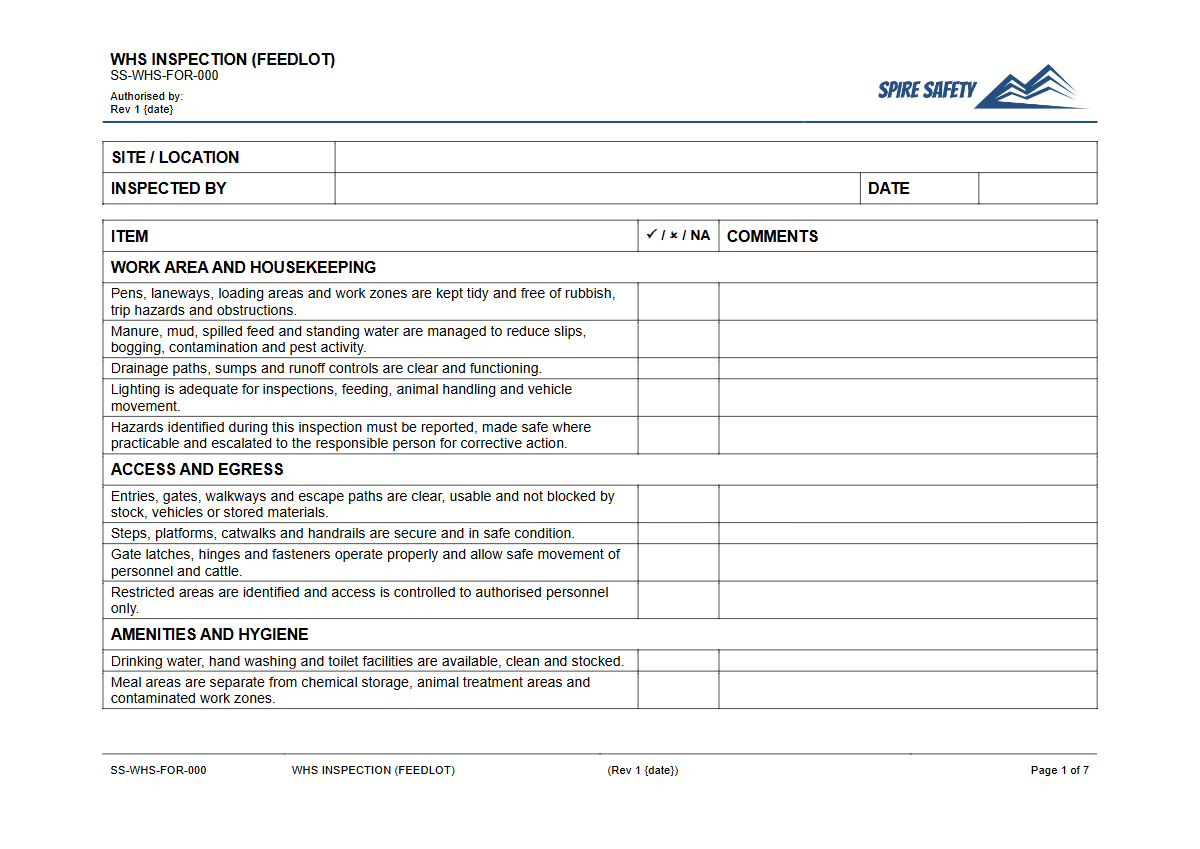
Regular safety inspections are fundamental to managing work health and safety in a high-risk agricultural setting. Our Free WHS Inspection (Feedlot) Template provides a structured starting point for your business to systematically identify hazards, assess risks, and implement control measures.
This document helps you move beyond ad-hoc checks, creating a formal record of your safety diligence and supporting a proactive safety culture within your organisation. Using a standardised checklist ensures key areas like animal handling, vehicle movement, chemical storage, and machinery safety are consistently reviewed.
This inspection template is aligned with Australian WHS principles and encourages a systematic examination of your workplace. It prompts users to look for uncontrolled hazards across various operational areas, from stockyards and loading ramps to workshops and feed processing facilities.
Documenting these findings helps demonstrate compliance efforts and provides valuable data for your risk management processes. A regular inspection schedule is a key component of robust WHS management systems, demonstrating a commitment to continuous improvement.
Video walkthrough
How to use the Free WHS Inspection (Feedlot) Template
Begin by downloading the template in your preferred format. The DOCX version is fully editable, allowing you to tailor the checklist items to your specific site, while the PDF is ready for immediate printing and use.
Before you conduct your first inspection, walk through your feedlot's specific areas and tasks. Add, remove, or modify checklist items to cover the unique plant, equipment, and processes at your facility.
Consider hazards related to livestock interaction, confined spaces, dust, noise, and the specific machinery you operate.
Note: It is crucial to customise this template to reflect the specific hazards, equipment, and procedures unique to your workplace. We have provided a solid foundation, but you must adapt it to ensure it is effective for your operational context.
During the inspection, the designated person or team should methodically go through each item, noting any non-conformances, potential hazards, or areas for improvement. For each issue identified, document the required corrective action, assign responsibility to a specific person, and set a realistic completion date. For daily checks on specific machinery, you might also use a dedicated form like our Free Pre-Start Checklist (Feed Mixer) Template.
When to use this Inspection Template
Formal WHS inspections should be conducted at regular, planned intervals (e.g., monthly or quarterly) as part of your overall safety schedule. The frequency may depend on the level of risk associated with different areas of the feedlot. In addition to your regular schedule, it is good practice to conduct an inspection:
- After a workplace incident, accident, or near miss to identify contributing factors.
- When new plant, structures, chemicals, or work processes are introduced.
- When concerns are raised by workers or Health and Safety Representatives (HSRs).
- In response to changes in WHS legislation or industry standards.
The findings from these internal inspections can also be invaluable preparation for a formal WHS compliance audit, helping you identify and rectify issues proactively.
Who should use this Inspection Template
This inspection template is designed for use by a range of personnel within a feedlot operation. Involving people with different roles and perspectives often leads to a more thorough and effective inspection. Key users include:
- The Person Conducting a Business or Undertaking (PCBU) or their delegate.
- Farm, Site, or Feedlot Managers.
- WHS/HSE Officers and Advisors.
- Supervisors and Team Leaders.
- Health and Safety Representatives (HSRs).
- Experienced workers with in-depth knowledge of specific tasks and areas.
Effective traffic management is critical in a feedlot. Your inspection should review signage, speed limits, and the condition of roadways, including access points.
Daily checks of smaller mobile plant are also vital; our Free Pre-Start Checklist (Lawn Tractor) Template can assist with this process. For more tools to support your safety programs, you can explore our complete free WHS resources library.
Common mistakes
Common mistakes to avoid
- Using a generic checklist that misses site-specific hazards like local water sources or unique equipment.
- Failing to involve workers who perform the tasks and have first-hand knowledge of the risks.
- Not following up on corrective actions, leaving identified hazards uncontrolled.
- "Pencil-whipping" the form without physically and thoroughly checking each item.
Legal references
Legal considerations
The following legal requirements may be relevant to this type of work.
- Work Health and Safety Act (Harmonised) — Provides the primary duties for protecting workers and other people from work health and safety risks.
- Work Health and Safety Regulations (Harmonised) — Sets out requirements supporting the management of workplace hazards and risks.
The following codes may be relevant to this type of work.
- Managing WHS Risks Code of Practice — Provides practical guidance on identifying hazards, assessing risks and applying effective controls.
- Work Health and Safety Consultation, Cooperation and Coordination Code of Practice — Provides practical guidance on consulting workers and coordinating with other duty holders.
- Managing the Work Environment and Facilities Code of Practice — Provides practical guidance on safe work environments, workplace facilities and related controls.
Did you know
Vehicle Incidents
According to Safe Work Australia, vehicle incidents are a leading cause of fatalities in the agriculture industry. Nearly half of these involve tractors, highlighting the need for rigorous inspection and traffic management.
Zoonotic Diseases
Feedlots present a risk of zoonotic diseases (diseases spread between animals and people), such as Q fever and leptospirosis. Safety inspections should always include checks on hygiene facilities, PPE availability, and vaccination program awareness.
FAQ
Frequently asked questions
01What is the difference between a WHS inspection and a pre-start check?
02How often should feedlot safety inspections be conducted?
03Who is responsible for fixing the problems found in an inspection?
04Can this inspection template be used on a tablet or mobile device?
Share this resource
Free WHS Inspection (Feedlot) Template
Browse Categories
How To Use It
- 1Download and open in Word or PDF.
- 2Replace the placeholders with your business details.
- 3Get it reviewed by a WHS specialist before rollout.
Need it customised?
Our WHS consultants can adapt this template to your site, run a gap analysis, or audit what you already have in place.
Book a Free Consultation WHS consulting servicesor call 1300 156 382