
Free WHS Inspection (Food Warehouse) Template
Formalise your safety checks with our free WHS Inspection (Food Warehouse) Template.
Free WHS Inspection (Food Warehouse) Template
DOCX • 129 KB + PDF
Updated Oct 2026
No signup required
Purpose of the Free WHS Inspection (Food Warehouse) Template
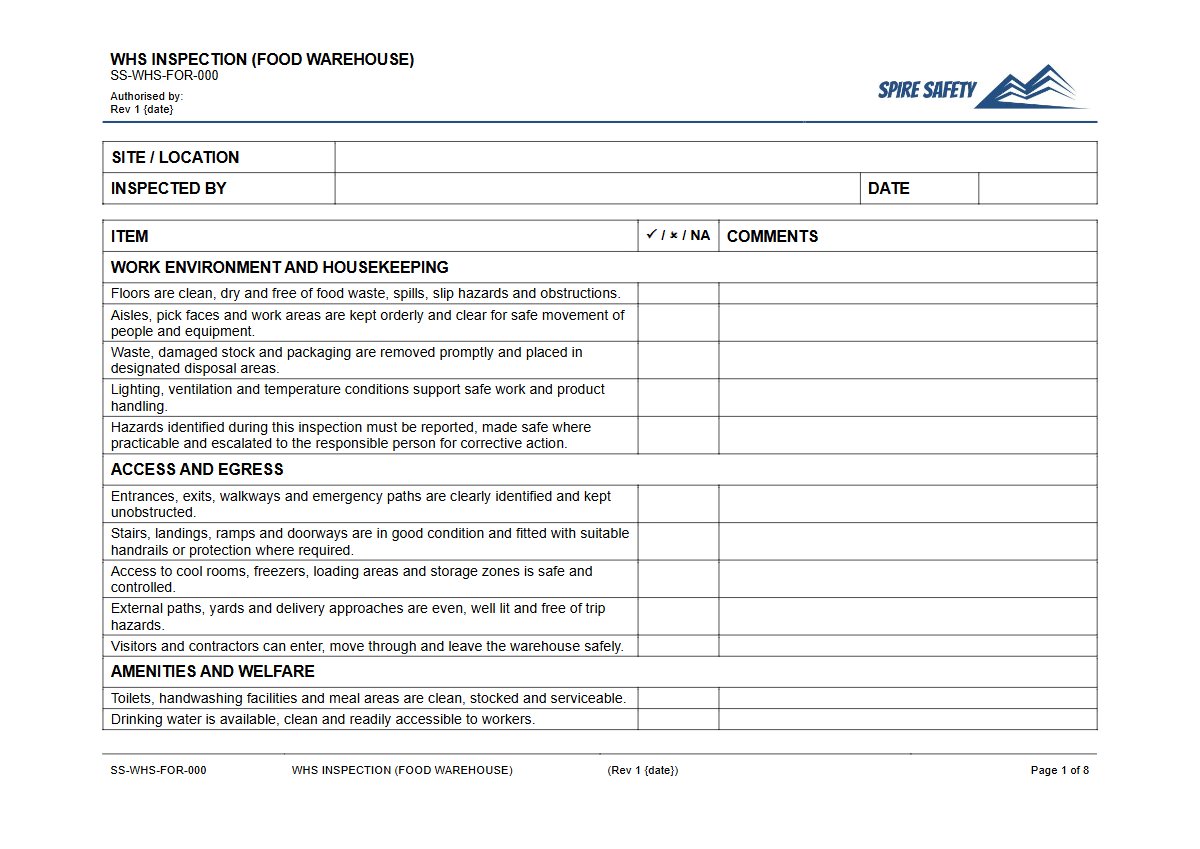
This Free WHS Inspection (Food Warehouse) Template provides a structured starting point for systematically identifying and controlling health and safety risks in your food storage and distribution facilities. Food warehouses present a unique combination of hazards, from temperature control and hygiene to traffic management and manual tasks.
Regular, documented inspections are a cornerstone of a proactive safety management system, helping your organisation meet its duty of care.
Using this template helps standardise your inspection process, ensuring that key areas are not overlooked. It provides a documented record of findings and corrective actions, which is essential for demonstrating due diligence.
This resource is aligned with Australian WHS principles and is designed to be adapted to the specific risks present in your workplace, such as those related to cool rooms or freezers. For more specific equipment checks within these environments, you can also use our Free Pre-Start Checklist (Freezer) Template.
Video walkthrough
How to use the Free WHS Inspection (Food Warehouse) Template
To get started, simply download the template in your preferred format, DOCX for easy editing or PDF for straightforward printing. The template is designed to be a comprehensive guide, but it is not a one-size-fits-all solution.
It is crucial to adapt the checklist to your specific operational environment, including the types of goods stored, the equipment used, and the layout of your facility.
Important: We recommend you customise this template to reflect the specific hazards, equipment, and processes of your workplace. Add your company branding, and include site-specific checkpoints for machinery, storage racking, loading docks, and staff amenities.
For example, if your warehouse uses automated systems, specific checks for those should be added. Similarly, equipment like conveyors require their own checks, and our Free Pre-Start Checklist (Food Conveyor) Template provides a good example of a machine-specific document.
When to use this Inspection Template
The frequency of inspections should be determined by a risk assessment. High-risk areas or activities, such as forklift charging bays or busy loading docks, may require daily or weekly checks.
A full warehouse inspection might be conducted monthly or quarterly. This template can be used for:
- Scheduled Inspections: Regular, planned safety walks conducted on a weekly, monthly, or quarterly basis.
- Ad-hoc Inspections: In response to a specific event, such as an incident, a near miss, or the introduction of new equipment or processes.
- Pre-audit Checks: To prepare for an external audit by identifying and rectifying potential non-conformances.
- Management Walkarounds: To facilitate visible safety leadership and engagement from managers and supervisors.
These inspections should be part of a broader approach to safety. Implementing comprehensive WHS management systems ensures that inspections are not just isolated events, but are integrated into a cycle of continuous improvement.
Who should use this Inspection Template
This template is designed for use by various personnel within a food warehousing operation who have responsibilities for health and safety. This can include:
- WHS Managers and Officers: To formalise and document the workplace inspection program.
- Warehouse Managers and Supervisors: To conduct regular checks of their areas of responsibility and manage corrective actions.
- Health and Safety Representatives (HSRs): As a tool to support their role in representing workers and monitoring safety measures.
- Trained Workers: As part of a team-based approach to safety, where workers are empowered to conduct inspections in their own work areas.
It is essential that anyone conducting an inspection is trained and competent to do so. They must understand the hazards they are looking for and the procedure for reporting and escalating issues.
Verifying that your safety processes are effective is a key part of WHS governance, and periodic WHS compliance auditing can provide independent assurance that your systems are working as intended.
Inspections must also consider specialised food processing equipment. For instance, handling machinery like an egg grader requires tailored pre-start checks, which you can formalise using our specific Free Pre-Start Checklist (Egg Grader) Template.
Ultimately, this structured approach to inspections supports the Person Conducting a Business or Undertaking (PCBU) in demonstrating proactive risk management. Our WHS consulting services can help your organisation embed these principles into your daily operations for a safer, more productive workplace. For more tools to support your safety system, browse our complete free WHS resources library.
Common mistakes
Common mistakes to avoid
- Using a generic template without customising it for the specific warehouse layout and equipment.
- Failing to adequately train inspectors on hazard identification and risk assessment.
- Neglecting to assign responsibility and deadlines for corrective actions found during the inspection.
- Treating the inspection as a 'tick and flick' exercise without genuine observation and engagement.
Legal references
Legal considerations
The following legal requirements may be relevant to this type of work.
- Work Health and Safety Act (Harmonised) — Provides the primary duties for protecting workers and other people from work health and safety risks.
- Work Health and Safety Regulations (Harmonised) — Sets out requirements supporting the management of workplace hazards and risks.
The following codes may be relevant to this type of work.
- Managing WHS Risks Code of Practice — Provides practical guidance on identifying hazards, assessing risks and applying effective controls.
- Work Health and Safety Consultation, Cooperation and Coordination Code of Practice — Provides practical guidance on consulting workers and coordinating with other duty holders.
- Managing the Work Environment and Facilities Code of Practice — Provides practical guidance on safe work environments, workplace facilities and related controls.
Did you know
Slips, Trips and Falls
Slips, trips and falls are a leading cause of serious injuries in the warehousing and logistics industry, often resulting from wet or contaminated floors, poor housekeeping, and uneven surfaces.
Manual Tasks
The transport, postal, and warehousing industry has one of the highest rates of serious claims for musculoskeletal disorders, often caused by hazardous manual tasks like lifting, carrying, and stacking goods.
FAQ
Frequently asked questions
01What is the difference between a safety inspection and an audit?
02How often should I conduct a food warehouse inspection?
03Is this food warehouse inspection template suitable for my state in Australia?
04Can I use this template for my HACCP program?
Share this resource
Free WHS Inspection (Food Warehouse) Template
Browse Categories
How To Use It
- 1Download and open in Word or PDF.
- 2Replace the placeholders with your business details.
- 3Get it reviewed by a WHS specialist before rollout.
Need it customised?
Our WHS consultants can adapt this template to your site, run a gap analysis, or audit what you already have in place.
Book a Free Consultation WHS consulting servicesor call 1300 156 382