
Free WHS Inspection (Freezer Facility) Template
Download our Free WHS Inspection (Freezer Facility) Template to formalise safety checks in your cold storage areas.
Free WHS Inspection (Freezer Facility) Template
DOCX • 128 KB + PDF
Updated Oct 2026
No signup required
Purpose of the Free WHS Inspection (Freezer Facility) Template
Operating a freezer facility presents unique WHS challenges, from managing cold stress and hypothermia risks to preventing slips on ice and ensuring structural integrity. This Free WHS Inspection (Freezer Facility) Template provides a structured starting point for systematically identifying and controlling these hazards.
Regular, documented inspections are a cornerstone of any effective safety management system, demonstrating due diligence and helping to prevent incidents before they occur. By using a formal checklist, you can ensure key safety elements are consistently reviewed, from emergency exits and alarm systems to the condition of personal protective equipment (PPE).
A proactive approach to safety involves more than just reactive measures. Formal inspections help embed safety into your operational rhythm, making it a planned and repeatable process.
This template is designed as a key component within broader WHS management systems, enabling you to gather data, track corrective actions, and continuously improve safety performance in your temperature-controlled environments.
Video walkthrough
How to use the Free WHS Inspection (Freezer Facility) Template
Download the template in your preferred format (DOCX or PDF) to get started. The DOCX version is fully editable, allowing you to tailor the checklist to your specific workplace.
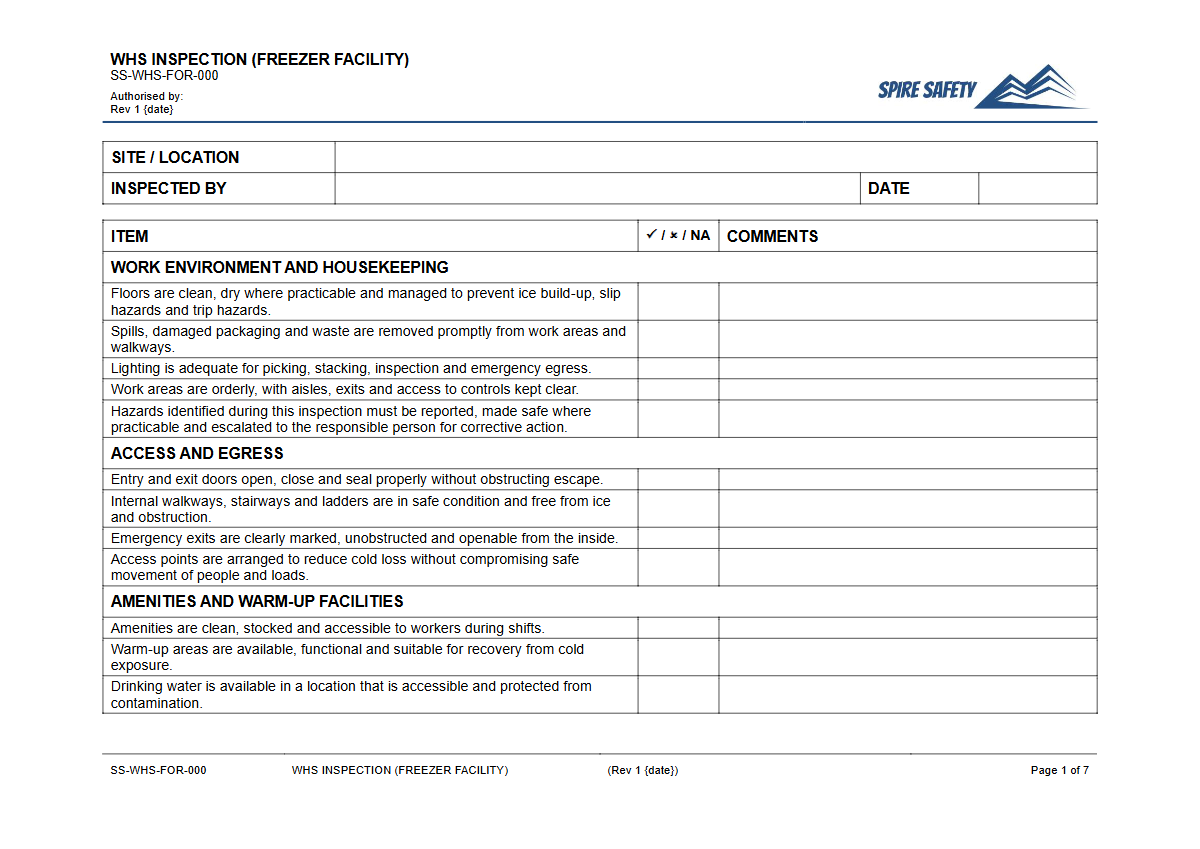
The inspection should be conducted by a competent person, such as a supervisor or WHS representative, who walks through the facility and assesses each item on the list. For each point, they should note whether it is compliant, non-compliant, or not applicable, adding detailed comments and photographic evidence where necessary, especially for non-compliant findings.
Important: This document is a template, not a finished procedure. It has been developed in alignment with Australian WHS principles but must be customised to your specific operations.
We strongly recommend you adapt the checklist to include the unique layout, equipment, and work processes of your freezer facility. If you require assistance with this customisation, consider seeking specialist WHS consulting support.
Key Inspection Areas
This template prompts a review of several critical areas in a freezer facility, including:
- Environment and Housekeeping: Checks for ice build-up on floors and racking, clear and unobstructed walkways, adequate lighting, and general tidiness.
- Structural and Plant Safety: Inspection of pallet racking for damage, condition of freezer doors and seals, and function of evaporators and condensers.
- Emergency Systems: Verification that emergency exits are clear, panic/entrapment alarms are functional, and emergency lighting is operational. For facilities with heavy stock, a separate electric hoist pre-start checklist may be necessary for the equipment used to move goods.
- Personal Protective Equipment (PPE): Ensuring appropriate thermal clothing, gloves, and footwear are available, in good condition, and stored correctly.
- Safe Work Procedures: Confirming that safety signs are visible, and procedures for working in cold environments are being followed.
When to use it
The frequency of formal inspections depends on the level of risk, the size of the facility, and your organisation's specific requirements. While daily checks are essential for high-use equipment, a full facility inspection is typically conducted on a weekly, monthly, or quarterly basis.
A great tool for those daily checks is our Free Pre-Start Checklist (Freezer) Template, which complements this more comprehensive inspection document. Full inspections should also be scheduled following any incident, after significant changes to the layout or equipment, or when new hazards are identified.
Who should use it
This template is designed for use by personnel responsible for workplace health and safety. This includes:
- WHS Managers and Safety Officers: To standardise the inspection process and ensure systematic hazard identification.
- Facility and Warehouse Managers: To maintain operational safety and compliance within their area of responsibility.
- Supervisors: To conduct routine inspections and lead their teams in safe work practices.
- Health and Safety Representatives (HSRs): To participate in workplace inspections and represent their work group on safety matters.
The completed inspection forms serve as valuable records for management review and can be a key source of evidence during formal WHS compliance auditing. Find more helpful templates like this one in our comprehensive free WHS resources library.
Common mistakes
Common mistakes to avoid
- Failing to customise the template to the specific layout and equipment of the facility.
- Treating the inspection as a 'tick-and-flick' exercise without genuine observation.
- Neglecting to assign and follow up on corrective actions for identified hazards.
- Using untrained personnel to conduct the inspection, leading to missed hazards.
Legal references
Legal considerations
The following legal requirements may be relevant to this type of work.
- Work Health and Safety Act (Harmonised) — Provides the primary duties for protecting workers and other people from work health and safety risks.
- Work Health and Safety Regulations (Harmonised) — Sets out requirements supporting the management of workplace hazards and risks.
The following codes may be relevant to this type of work.
- Managing WHS Risks Code of Practice — Provides practical guidance on identifying hazards, assessing risks and applying effective controls.
- Work Health and Safety Consultation, Cooperation and Coordination Code of Practice — Provides practical guidance on consulting workers and coordinating with other duty holders.
- Managing the Work Environment and Facilities Code of Practice — Provides practical guidance on safe work environments, workplace facilities and related controls.
Did you know
Cold Stress Risk
Without proper PPE, a worker's core body temperature can drop significantly in just 20-30 minutes inside a commercial freezer operating at -18°C. This increases the risk of hypothermia and frostbite.
Entrapment Alarms
Australian Standard AS 4673 requires cold stores where workers can be locked in to have an audible and visible alarm that can be operated from inside the room, even in the event of a power failure.
FAQ
Frequently asked questions
01What is the difference between a facility inspection and a pre-start check?
02How often should I inspect my freezer facility?
03What are the main hazards in a cold storage or freezer facility?
04Can this template be used for cool rooms and chillers too?
Share this resource
Free WHS Inspection (Freezer Facility) Template
Browse Categories
How To Use It
- 1Download and open in Word or PDF.
- 2Replace the placeholders with your business details.
- 3Get it reviewed by a WHS specialist before rollout.
Need it customised?
Our WHS consultants can adapt this template to your site, run a gap analysis, or audit what you already have in place.
Book a Free Consultation WHS consulting servicesor call 1300 156 382