
Free WHS Inspection (Function Centre) Template
Download our free WHS Inspection (Function Centre) Template to formalise safety checks for your venue.
Free WHS Inspection (Function Centre) Template
DOCX • 129 KB + PDF
Updated Oct 2026
No signup required
Purpose of the Free WHS Inspection (Function Centre) Template
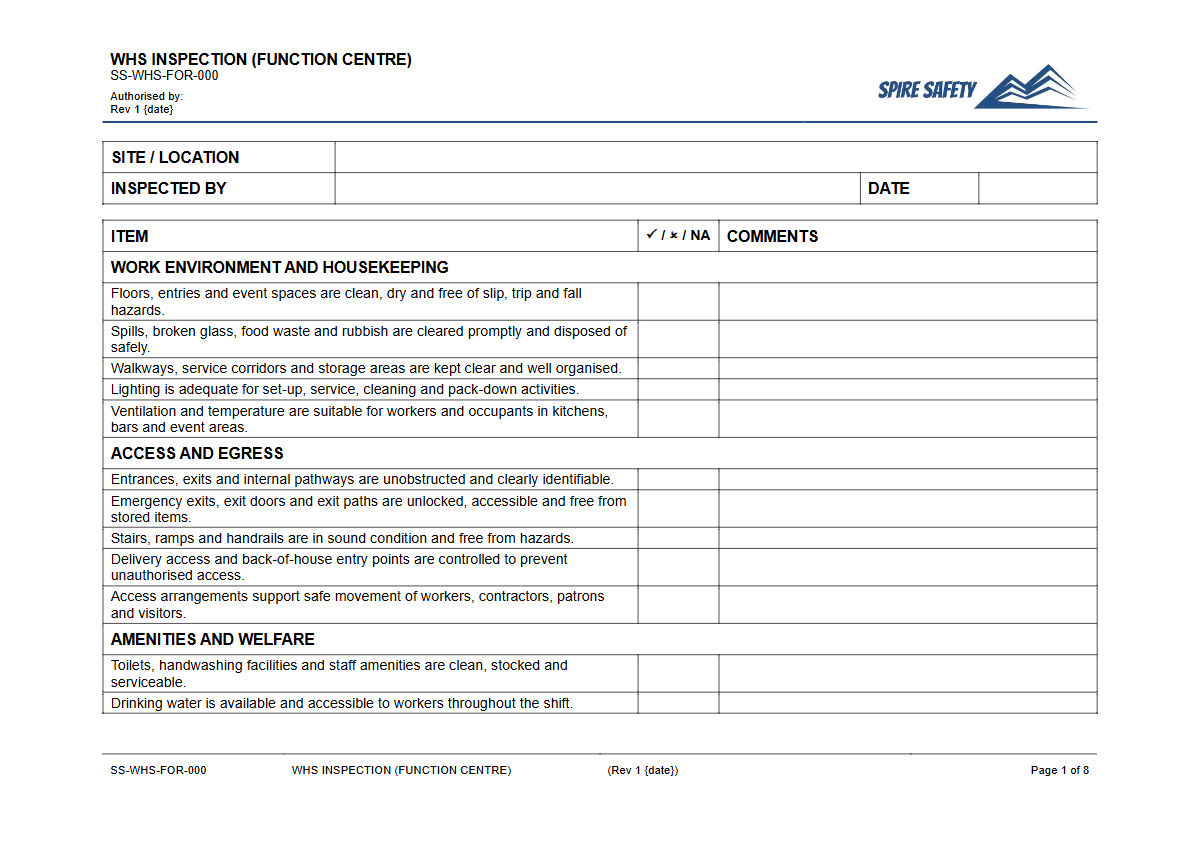
Function centres are dynamic environments with a unique combination of hazards, from commercial kitchens and public assembly areas to storage and loading docks. This Free WHS Inspection (Function Centre) Template provides a structured starting point for systematically identifying and controlling these risks.
Conducting regular, documented inspections helps your organisation demonstrate due diligence, prevent incidents, and foster a proactive safety culture. It formalises the process of checking for hazards like slip and trip risks, electrical faults, poor housekeeping, and fire safety deficiencies.
A thorough inspection covers all areas, from the front-of-house to back-of-house operations. For instance, specific checks are needed for kitchen equipment, just as they are for other machinery.
While this template provides a broad overview, you may need specific checklists for certain items, such as the detailed checks found in our Free Pre-Start Checklist (Blender) Template. By regularly using an inspection template, you create a documented history of your safety management efforts, which is invaluable for continuous improvement and compliance verification.
Video walkthrough
How to use the Free WHS Inspection (Function Centre) Template
Using this template effectively involves a few key steps. First, download the document in your preferred format (DOCX for easy customisation or PDF for immediate printing).
The next and most critical step is to adapt the template to the specific layout, equipment, and activities of your venue. Walk through your function centre and add or remove checklist items to ensure it accurately reflects your operational environment.
Important: This document is a template and must be customised to your specific workplace. We cannot guarantee it will cover all hazards unique to your site.
You must consult with your team and conduct a risk assessment to ensure all relevant areas and tasks are included. Involve your workers in this process; their direct experience is vital for identifying practical hazards and effective controls.
Once customised, integrate the inspection into your safety procedures. This could form a key part of your overall WHS management systems, providing crucial data for safety meetings and risk reviews.
Train relevant personnel on how to use the checklist correctly, ensuring they understand what each item means and how to report findings. Finally, establish a clear process for documenting corrective actions and verifying their completion.
When to Conduct an Inspection
The frequency of inspections should be determined by a risk assessment. A comprehensive venue-wide inspection is typically recommended on a regular schedule, such as monthly or quarterly.
However, more frequent checks may be necessary for high-risk areas like kitchens, stages with temporary rigging, or cool rooms. It is also good practice to conduct an inspection before and after major events, when significant changes are made to the layout or equipment, or following an incident or near miss.
Regular inspections provide the data needed to track safety performance over time. This information is essential for management reviews and can be a key input for a formal WHS compliance audit, helping to verify that your safety systems are functioning as intended.
Consistent scheduling ensures that hazard identification is an ongoing, proactive activity rather than a reactive one.
Who Should Conduct an Inspection
Venue managers, supervisors, and dedicated WHS officers are typically responsible for carrying out formal workplace inspections. It is beneficial to have a team approach, involving different people over time to bring a fresh perspective.
Most importantly, consult your workers. The people performing the day-to-day tasks are often the first to notice emerging hazards or issues with existing controls.
Their involvement is a requirement under WHS legislation and leads to better safety outcomes.
For complex issues or to get an independent assessment of your safety practices, engaging external experts can be highly valuable. Specialised WHS consulting can help you develop robust inspection programs, conduct comprehensive risk assessments, and ensure your approach is aligned with industry best practice.
Whether conducted internally or with external support, the goal is to ensure the person performing the inspection is competent to identify the hazards relevant to a function centre environment.
This document is one of many tools designed to support your safety efforts. For more templates, checklists, and guides, explore our complete free WHS resources library to find documents relevant to your operations.
Common mistakes
Common mistakes to avoid
- Using a generic checklist without customising it for the specific venue layout and equipment.
- Failing to document corrective actions taken to fix identified hazards.
- Neglecting to inspect 'back-of-house' areas like storage rooms, loading docks, and staff amenities.
- Not involving workers, who have first-hand knowledge of daily operational hazards.
Legal references
Legal considerations
The following legal requirements may be relevant to this type of work.
- Work Health and Safety Act (Harmonised) — Provides the primary duties for protecting workers and other people from work health and safety risks.
- Work Health and Safety Regulations (Harmonised) — Sets out requirements supporting the management of workplace hazards and risks.
The following codes may be relevant to this type of work.
- Managing WHS Risks Code of Practice — Provides practical guidance on identifying hazards, assessing risks and applying effective controls.
- Work Health and Safety Consultation, Cooperation and Coordination Code of Practice — Provides practical guidance on consulting workers and coordinating with other duty holders.
- Managing the Work Environment and Facilities Code of Practice — Provides practical guidance on safe work environments, workplace facilities and related controls.
Did you know
Slips, Trips, and Falls
In the hospitality industry, slips, trips, and falls are a leading cause of serious injury, often resulting from wet or greasy floors, cluttered walkways, and inadequate lighting.
Manual Handling Risks
Setting up and packing down events often involves significant manual handling. Tasks like moving tables, chairs, and audio-visual equipment are a major source of musculoskeletal injuries if not managed properly.
FAQ
Frequently asked questions
01What is the difference between a pre-start check and a full venue inspection?
02How often should a function centre be formally inspected for WHS?
03What are some common WHS hazards in a function centre?
04Who is legally responsible for WHS in a function centre?
Share this resource
Free WHS Inspection (Function Centre) Template
Browse Categories
How To Use It
- 1Download and open in Word or PDF.
- 2Replace the placeholders with your business details.
- 3Get it reviewed by a WHS specialist before rollout.
Need it customised?
Our WHS consultants can adapt this template to your site, run a gap analysis, or audit what you already have in place.
Book a Free Consultation WHS consulting servicesor call 1300 156 382