
Free WHS Inspection (Garden Centre) Template
Manage safety in your nursery with our free WHS Inspection (Garden Centre) Template. This structured document helps identify common garden centre hazards.
Free WHS Inspection (Garden Centre) Template
DOCX • 129 KB + PDF
Updated Oct 2026
No signup required
Purpose of the Free WHS Inspection (Garden Centre) Template
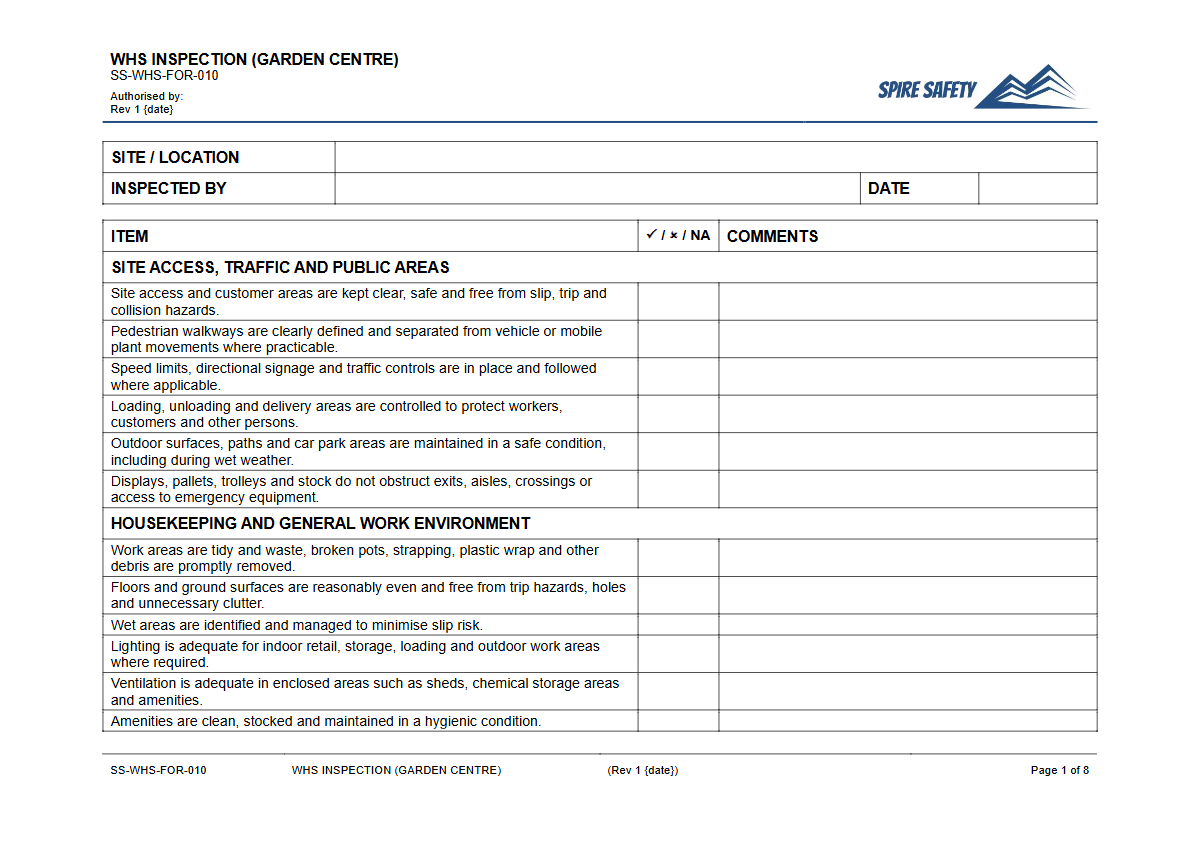
Garden centres present a unique mix of hazards, combining retail, warehousing, and outdoor agricultural work. Our Free WHS Inspection (Garden Centre) Template provides a structured starting point for identifying and controlling these risks.
Regular, documented inspections are a cornerstone of proactive safety management, helping your business meet its duty of care to both workers and the public. This template is designed to guide you through a thorough walkthrough of your site, prompting checks on key areas from customer walkways to chemical storage and staff facilities.
The checklist covers common garden centre hazards such as manual handling of heavy items like potting mix and large pots, slip and trip risks from watering and loose debris, exposure to hazardous chemicals, and the safe operation of equipment. For specific machinery, you may also need a dedicated lawn tractor pre-start checklist to complement this general site inspection.
What's included in this Inspection?
This template is provided as a customisable DOCX file, with a PDF version for easy printing. The sections are logically structured to cover typical garden centre operations, including:
- Public & Retail Areas: Walkways, entrances, exits, displays, trolley condition, and point of sale areas.
- Outdoor Plant & Goods Areas: Surface conditions, plant racking stability, irrigation systems, and public access safety.
- Storage & Warehousing: Pallet racking, forklift/vehicle interaction, and general housekeeping.
- Hazardous Substances & Dangerous Goods: Chemical storage, labelling, Safety Data Sheets (SDS) availability, and spill kits.
- Amenities & Staff Areas: First aid facilities, meal rooms, and emergency procedures.
- Plant & Equipment: General condition of tools and equipment used on site.
Video walkthrough
How to use the Free WHS Inspection (Garden Centre) Template
Using this template effectively involves more than just ticking boxes. Start by downloading the DOCX file and adapting it to your specific site.
Walk through your garden centre and add or remove checklist items to reflect the unique layout, equipment, and processes you have. A thorough inspection regime is a key part of any effective WHS management systems, providing valuable data for risk assessments and safety improvements.
Conduct the inspection with a critical eye, involving workers who use the areas and equipment daily. For each item, assess the condition and note any non-conformances or potential hazards.
Assign a corrective action, a person responsible for completing it, and a due date for every issue identified. The goal is to systematically resolve hazards, not just find them.
Once actions are completed, sign off on the inspection record and file it for future reference.
Important Note on Customisation
Please note: This document is a template designed as a starting point. It is essential that you customise this Inspection to the specific layout, equipment, tasks, and risks of your own workplace.
We are not liable for any incidents that may occur. Your safety obligations are your own, and this tool should be adapted to help you meet them.
When to use it
The frequency of your inspections will depend on the level of risk and the nature of your operations. A good practice is to schedule comprehensive site inspections on a monthly or quarterly basis. However, additional inspections should be conducted:
- Following an incident, accident, or near miss.
- When there are significant changes to the workplace layout, equipment, or work processes.
- Before and during peak seasons (e.g., spring) when stock levels and customer traffic are high.
- After periods of extreme weather that may have affected outdoor structures or surfaces.
Remember, this general site inspection doesn't replace the need for daily checks on specific equipment. High-use machinery, for example, may require a specific aerator pre-start checklist to ensure it is safe before each use.
Who should use it
While the overall responsibility for safety lies with the Person Conducting a Business or Undertaking (PCBU), conducting the inspection should be a collaborative effort. This template is ideal for:
- Business Owners and Managers
- Work Health and Safety (WHS) Officers
- Health and Safety Representatives (HSRs)
- Supervisors and Team Leaders
Involving a team in the inspection process, including workers who directly interact with the hazards, often leads to more practical and effective solutions. For businesses seeking a higher level of assurance, engaging an external party for periodic WHS compliance auditing can validate your internal processes and identify opportunities for improvement. To find more useful documents, you can browse our complete free WHS resources library.
Common mistakes
Common mistakes to avoid
- Only inspecting 'back of house' areas and ignoring public retail spaces where customer safety is also a concern.
- Failing to check the storage and labelling of hazardous chemicals, including fertilisers and pesticides.
- Not involving workers who perform the tasks in the inspection process, missing out on valuable firsthand insights.
- Completing the checklist but failing to assign and follow up on corrective actions to fix the identified issues.
Legal references
Legal considerations
The following legal requirements may be relevant to this type of work.
- Work Health and Safety Act (Harmonised) — Provides the primary duties for protecting workers and other people from work health and safety risks.
- Work Health and Safety Regulations (Harmonised) — Sets out requirements supporting the management of workplace hazards and risks.
The following codes may be relevant to this type of work.
- Managing WHS Risks Code of Practice — Provides practical guidance on identifying hazards, assessing risks and applying effective controls.
- Work Health and Safety Consultation, Cooperation and Coordination Code of Practice — Provides practical guidance on consulting workers and coordinating with other duty holders.
- Managing the Work Environment and Facilities Code of Practice — Provides practical guidance on safe work environments, workplace facilities and related controls.
Did you know
Manual Handling Risk
Manual handling injuries, particularly from lifting awkward and heavy items like bags of soil and large pots, are one of the leading causes of claims for workers' compensation in the nursery and garden industry.
Slips, Trips & Falls
According to Safe Work Australia, slips, trips and falls are a major cause of injury in retail environments. In garden centres, frequent watering, soil spills, and outdoor surfaces make this an especially high-risk area.
FAQ
Frequently asked questions
01What are the most common hazards in a garden centre?
02How often should I conduct a WHS inspection in a garden centre?
03Is this template suitable for a small nursery as well as a large garden centre?
04What is the difference between a workplace inspection and an audit?
Share this resource
Free WHS Inspection (Garden Centre) Template
Browse Categories
How To Use It
- 1Download and open in Word or PDF.
- 2Replace the placeholders with your business details.
- 3Get it reviewed by a WHS specialist before rollout.
Need it customised?
Our WHS consultants can adapt this template to your site, run a gap analysis, or audit what you already have in place.
Book a Free Consultation WHS consulting servicesor call 1300 156 382