
Free WHS Inspection (Gas Facility) Template
Streamline safety at your gas facility with our free WHS Inspection Template. A structured starting point to identify and control risks. Download now.
Free WHS Inspection (Gas Facility) Template
DOCX • 128 KB + PDF
Updated Oct 2026
No signup required
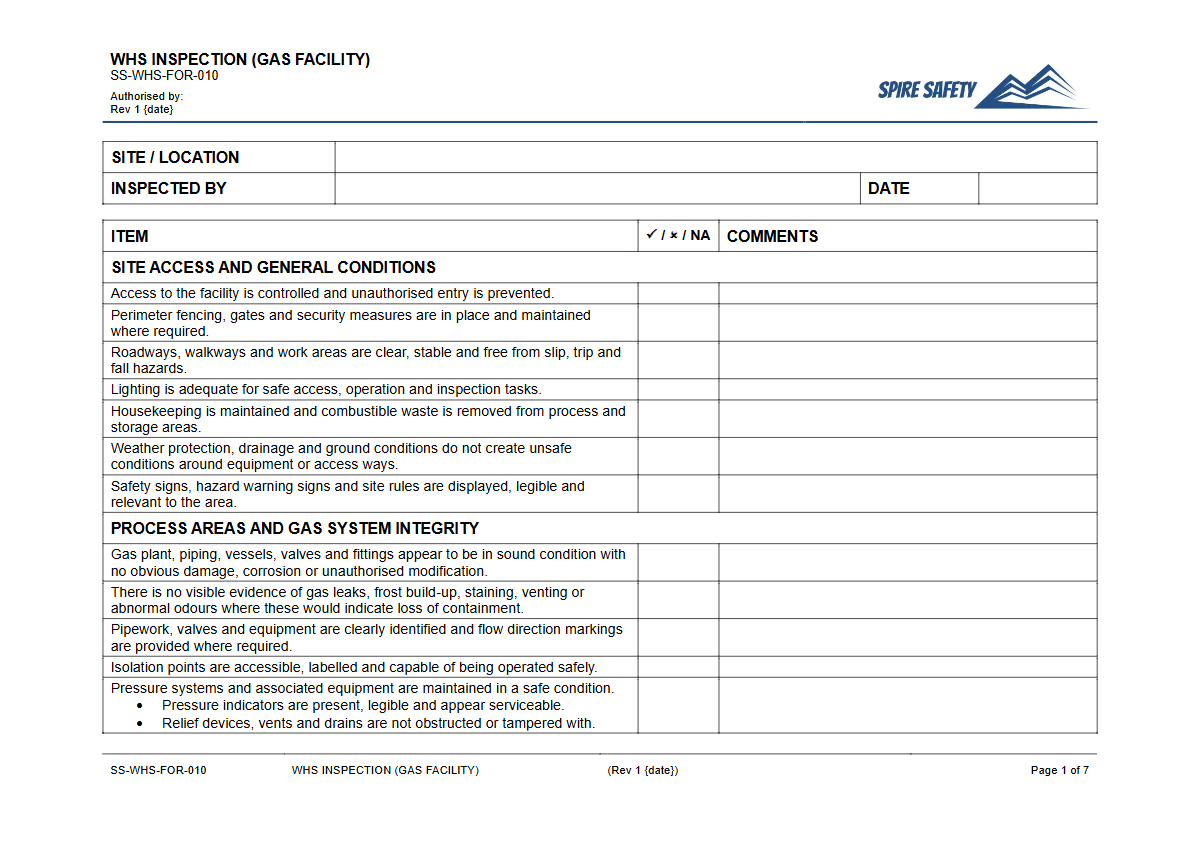
Purpose of the Free WHS Inspection (Gas Facility) Template
Gas facilities present significant risks including fire, explosion, and exposure to toxic or asphyxiant gases. A systematic inspection process is fundamental to managing these risks.
This free WHS Inspection (Gas Facility) template provides a structured starting point for organisations to develop and implement their own site-specific checklists to help meet their safety obligations.
The primary goal is to proactively identify hazards such as leaks, corrosion, equipment malfunction, inadequate ventilation, and non-compliant installations before they lead to an incident. Regular, documented inspections help a Person Conducting a Business or Undertaking (PCBU) meet their primary duty of care under WHS legislation.
It's a critical component of demonstrating due diligence, and for comprehensive verification of your safety processes, engaging in professional WHS compliance auditing can provide external assurance.
Using a standardised template ensures consistency across inspections, regardless of who performs them. It guides the inspector through a logical sequence, covering critical components from storage vessels and pipework to safety systems like emergency shutdowns and gas detectors.
This methodical approach helps prevent oversight and creates a reliable audit trail for safety records.
Video walkthrough
How to use the Free WHS Inspection (Gas Facility) Template
This resource is provided in both DOCX and PDF formats for your convenience. The DOCX version is fully editable, allowing you to tailor it to the specific equipment, processes, and regulatory requirements of your gas facility.
A key part of managing plant safety is ensuring all equipment is covered by appropriate checks.
IMPORTANT: This document is a template only. You must customise it to reflect the specific hazards, plant, and operational procedures of your workplace.
We are not responsible for any incidents that may occur from the use of this template.
After downloading, open the DOCX file and review each section. Add, remove, or modify checklist items to align with your facility's layout, types of gas (e.g., LPG, natural gas, industrial gases), and the specific plant and equipment in use.
For example, your site might use specific machinery for maintenance not listed in this template, such as an electric hoist for maintenance tasks, which would require its own inspection criteria.
Once customised, integrate the inspection form into your safety procedures. Ensure all personnel who will conduct inspections are trained on the new form and understand the criteria for each checkpoint.
Completed forms should be stored securely as part of your WHS records. You can browse our wider free WHS resources library for other useful documents.
When to use this Inspection Template
The frequency of inspections should be determined by a risk assessment. However, this template is designed for several key scenarios common in industrial environments.
It is ideal for routine, scheduled inspections (e.g., weekly or monthly) to monitor the ongoing condition of the facility. It can also be adapted for use before commissioning new equipment, after significant maintenance or repair work, and following any incident or near miss to verify the integrity of the system.
The findings from these inspections are a vital input for your overall WHS management systems. They provide data for risk assessments, maintenance planning, and management reviews, helping to drive continuous improvement in safety performance. Consistent use demonstrates a proactive approach to safety management.
Who should use this Inspection Template
This template should be used by competent and authorised personnel. The level of knowledge required depends on the complexity of the facility and the scope of the inspection.
Typically, this includes facility managers, WHS advisors, maintenance supervisors, and experienced operators who have received specific training on the hazards of the gas facility and the inspection process itself. For certain technical checks, a qualified gasfitter or engineer may be required.
A comprehensive safety approach involves documenting checks for all site equipment. For instance, a large site may need to manage vehicle access through secured areas, requiring separate checks like those in a pre-start checklist for a boom gate to ensure it functions correctly.
Similarly, if your facility integrates other processes, such as manufacturing or packaging, you may need additional checklists. An example could be a pre-start checklist for a feed mixer if your operations extend into agricultural or food production support.
Common mistakes
Common mistakes to avoid
- Using a generic checklist without customising it for site-specific equipment and hazards.
- Assigning inspection duties to personnel without adequate training on gas hazards and facility systems.
- Failing to properly document and follow up on identified defects or non-conformances.
- Inadequate record-keeping, making it difficult to track trends or demonstrate due diligence.
Legal references
Legal considerations
The following legal requirements may be relevant to this type of work.
- Work Health and Safety Act (Harmonised) — Provides the primary duties for protecting workers and other people from work health and safety risks.
- Work Health and Safety Regulations (Harmonised) — Sets out requirements supporting the management of workplace hazards and risks.
The following codes may be relevant to this type of work.
- Managing WHS Risks Code of Practice — Provides practical guidance on identifying hazards, assessing risks and applying effective controls.
- Work Health and Safety Consultation, Cooperation and Coordination Code of Practice — Provides practical guidance on consulting workers and coordinating with other duty holders.
- Managing the Work Environment and Facilities Code of Practice — Provides practical guidance on safe work environments, workplace facilities and related controls.
Did you know
Gas Leaks
Even small, seemingly insignificant gas leaks can accumulate in enclosed or low-lying areas, creating a significant explosion or asphyxiation hazard far from the original source.
Australian Standards
The Australian Standard AS/NZS 5601 series provides key technical guidance for the design, installation, and commissioning of gas installations, forming an important reference for compliance.
FAQ
Frequently asked questions
01What are the key hazards associated with a gas facility?
02How often should gas facility inspections be conducted?
03Can this template guarantee our WHS compliance?
04Who is considered 'competent' to perform a gas facility inspection?
Share this resource
Free WHS Inspection (Gas Facility) Template
Browse Categories
How To Use It
- 1Download and open in Word or PDF.
- 2Replace the placeholders with your business details.
- 3Get it reviewed by a WHS specialist before rollout.
Need it customised?
Our WHS consultants can adapt this template to your site, run a gap analysis, or audit what you already have in place.
Book a Free Consultation WHS consulting servicesor call 1300 156 382